Turkey buying British fighter jets
By Matthew Parish, Associate Editor
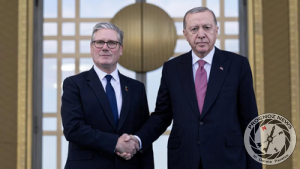
Turkey’s decision to buy 20 Eurofighter Typhoons from the United Kingdom in late 2025 anchors a wider re-ordering of defence, diplomacy and industry around Ankara’s peculiar position: a NATO power with divergent regional interests, a sanctions-hardened appetite for autonomy, and a domestic fighter programme that still needs time. The deal, signed in Ankara during Keir Starmer’s visit in late October and billed in London as the largest British fighter export in a generation, is priced at roughly £8 billion with first deliveries expected in 2030. It supplements Ankara’s plan to source lightly-used Typhoons from Gulf partners and sits alongside separate efforts to modernise Turkish F-16s while the indigenous KAAN fighter matures later in the decade.
For Ankara, the Eurofighter is a bridge across three gaps. The first is operational: Turkey needs a capable multi-role platform now to hedge against uncertainty on her borders and to sustain high-tempo air policing and strike tasks from the Black Sea to the Levant. The Typhoon, procured in a mixed package of new builds and prospective second-hand airframes from Oman and Qatar, provides that near-term lift while KAAN proceeds from prototype to squadron service. Reuters reports the Gulf tranche under discussion and confirms 2030 as the start of UK deliveries; together these elements reduce risk that a slippage in KAAN would open a deterrence hole.
The second gap is political. Since Ankara’s ejection from the F-35 programme over its purchase of Russian S-400s, Turkey has sought to diversify her fast-jet options without abandoning NATO interoperability. The choice of Eurofighter rather than, say, a large Rafale or Su-35 purchase signals that Ankara still prizes alliance-standard datalinks, munitions and common training, even as she asserts latitude in foreign policy from the Caucasus to Libya. London’s framing—that the sale strengthens NATO’s eastern flank and deepens UK-Turkey defence ties—underscores a calculation in European capitals: however fractious Ankara may be, she is essential in any post-war stabilisation architecture for the Black Sea and for managing spillovers from Syria and the eastern Mediterranean.
The third gap is industrial. Eurofighter is a four-nation project; export licences typically require consensus among the UK, Germany, Italy and Spain. Berlin’s objections earlier this year—linked by German media and industry watchers to human-rights concerns and Turkish domestic politics—illustrated how intra-European politics can derail consortium exports. In mid-October, however, reporting indicated that Germany had at least opened the door to negotiations, and today’s Ankara signing suggests that the political path has been cleared for an initial British-led tranche. Even if the UK can structure a package heavy in British workshare, German approvals matter for sensors, software baselines and supply-chain content. Ankara will regard the signing as proof that London can shepherd sensitive sales through Europe’s thicket of caveats, a useful precedent for follow-on kits, weapons and upgrades.
From London’s perspective, the sale serves three strategic ends. It sustains the BAE-centred industrial base at Warton and Samlesbury with new Typhoon work for the first time since 2017, preserving skills needed for the UK-Japan-Italy Global Combat Air Programme in the 2030s. It tightens defence-industrial links with a pivotal NATO ally at “the other end of Europe”, making practical sense of the Government’s stated tilt to Euro-Atlantic security after a period of strategic drift. And it positions the UK as Ankara’s reliable interlocutor inside the Alliance—useful leverage should Turkey act as broker on Black Sea navigation, energy corridors or future ceasefire mechanics in Ukraine.
The transaction is not without cost. Ankara’s rights record—and, this month, the highly contentious treatment of opposition figures—has already prompted criticism that Britain is trading values for contracts. Those critiques are not politically negligible in Westminster or Berlin, where export controls are more tightly fused to human-rights conditionality. Yet defence trade is rarely a morality play. The question is whether the sale makes Europe safer. On balance, a better-equipped Turkish Air Force that stays wired into NATO standards, exercises and logistics chains is preferable to one buying capabilities outside the Western defence system. And for the EU’s south-east, airpower parity reduces the temptation for brinkmanship: Athens has moved on Rafales and F-16V upgrades; Ankara’s Typhoons help stabilise deterrence while maritime boundary disputes simmer.
Regionally, the optics will be read in Tehran, Moscow and Jerusalem. Israel’s long-range air campaigns and the wider shadow war across Syria and the Levant have shaped Turkish threat perceptions; adding Typhoons improves Turkey’s air-to-air and swing-role credibility, complicating any adversary’s calculus about punitive strikes or deniable incursions near Turkish airspace. For Moscow, the lesson is more prosaic: despite S-400s and episodic alignment, Ankara is locking critical parts of her force structure to Western sustainment pipelines well into the 2030s. That narrows Russia’s influence on Turkish air readiness, even as energy and grain diplomacy continue.
Finally, this is a signal about timelines. Eurofighter deliveries from 2030 and potential Gulf transfers sooner create a staggered ramp that buys KAAN six to eight years of political breathing space. If the domestic programme meets its milestones, Turkey can by the early-to-mid-2030s field a tiered fleet: KAAN for high-end missions; Typhoon for swing-role air defence and interdiction; upgraded F-16s as reliable workhorses. If KAAN slips, Typhoon gives Ankara leverage—both operationally and in negotiations with Washington over any future re-entry to the F-35 network or deeper access to advanced munitions. In either case, London has positioned itself as Turkey’s primary partner in the interim, with industrial and diplomatic dividends to match.
The Eurofighter purchase is less a single bet than a hedging strategy: Turkey binds herself closer to NATO-standard airpower while keeping her sovereign options alive; Britain shores up a key ally and her own fighter-industrial base; and Europe discovers, once again, that collective security in the Black Sea and eastern Mediterranean still runs through Ankara.
381 Views



Most Readings

Russia’s Southern Anchor: The Geopolitics of Moscow’s Military Build-Up in Libya
93 Views