Sudan’s War: How a Revolution Unravelled into a Catastrophe
By Matthew Parish, Associate Editor
Monday 9 February 2026
Sudan’s present war is often described as a sudden feud between two generals. That is true in the narrow sense, but misleading in the wider one. Sudan did not fall into conflict because a single negotiation failed in April 2023. She fell because an unfinished revolution tried to turn an authoritarian security state into a civilian republic, while leaving intact the armed organisations that had long profited from violence, patronage and impunity. When the political settlement broke, the weapons were already loaded.
The conflict that began on 15 April 2023 is, in formal terms, a power struggle between the Sudanese Armed Forces and the Rapid Support Forces, a paramilitary organisation that grew out of the notorious Janjaweed militias of the Darfur wars. Yet the war’s geography, its financing and its brutality cannot be understood without remembering that Sudan is not merely Khartoum. She is Darfur, Kordofan, the East, the Nile Valley and the borderlands that connect her to Egypt, Chad, Libya, South Sudan, Ethiopia and the Red Sea.
What follows is an account of origins, parties, external backers, military development and humanitarian consequences, with particular attention to allegations of war crimes and the international community’s halting efforts to respond.
The origins — from Bashir’s security state to a failed transition
For three decades, Omar al-Bashir governed Sudan through a system that fused formal state institutions with parallel security and militia networks. The purpose was not only to fight insurgencies, but to manage politics — and, crucially, to ensure that no single armed institution could become strong enough to depose the regime without paying a price. That method of rule produced a familiar pattern: armed groups were created, sponsored, then partially integrated, while maintaining their own chains of command and revenue streams.
The RSF was a product of that logic. It was built from militia forces deployed in Darfur, later formalised and empowered as an instrument of counter-insurgency and regime security. By the time Bashir fell, the RSF had become not merely a battlefield tool but a political actor with its own leadership, patronage networks and economic interests.
The 2019 uprising that removed Bashir created a transitional arrangement intended to lead towards civilian rule. In practice it left the state’s coercive power concentrated in the hands of armed leaders who had collaborated to remove him. General Abdel Fattah al-Burhan led the Sudanese Armed Forces (SAF). Mohamed Hamdan Dagalo — known as Hemedti — led the RSF. The uneasy partnership between them was not a marriage of principle but a pact of convenience, formed in a moment when both feared the street, and both wished to shape what would come next.
The transition faltered under the weight of economic crisis, competing visions of reform and, above all, the unresolved question of who would control armed force in a future Sudan. In October 2021, the military seized full power, further weakening civilian politics and international confidence. That coup did not end the problem — it postponed it, while raising the stakes. The core dispute returned in a sharper form: whether and how the RSF would be integrated into a single national army, who would command that unified force and what accountability would follow for past abuses. Many transitions fail on constitutional language. Sudan’s failed on command structures.
By early 2023, tensions over security sector reform had become existential. When the confrontation erupted it did so in the capital, where each side believed speed would decide legitimacy.
Darfur, the Janjaweed and the making of the RSF — why the past returned armed
To understand the character of the present war, one must pause in Darfur in the early 2000s. The conflict there was not merely a local rebellion; it was the moment when Sudan’s centre outsourced violence on an industrial scale.
When insurgencies emerged in Darfur, the Bashir regime responded not only with regular forces but by mobilising Arab militias drawn from marginalised pastoralist communities. These militias, later known collectively as the Janjaweed, were encouraged, armed and protected by the state. Their operational logic was simple and devastating: destroy the civilian base of rebellion through village burnings, mass killings, sexual violence and forced displacement. The aim was not just military victory but demographic transformation.
International outrage followed, including findings that crimes amounting to genocide had been committed. Yet inside Sudan’s security architecture, a different lesson was drawn. Militias, if properly managed, were effective, deniable and loyal — so long as they were paid, armed and given impunity.
Over time these forces were not dismantled. They were rebranded. In 2013 the RSF was formally created, absorbing many Janjaweed fighters into a national paramilitary structure. This did not civilise them; it legalised them. Their command was centralised under Hemedti, their budget regularised and their role expanded beyond Darfur to border control, counter-insurgency and regime protection.
This history matters because the RSF did not enter the 2023 war as a neutral security service that happened to disagree with the army. It entered as an organisation shaped by militia warfare, accustomed to operating amongst civilians through coercion, reward and terror, and largely untouched by accountability. When the war spread back into Darfur, it did not create new patterns of violence. It revived old ones, now reinforced by years of institutional power and wealth.
The parties — what SAF and RSF are, and what they want
The SAF are the state’s conventional military institution. They possess aircraft, heavy weapons, established bases and the formal claim to sovereign authority. Since the outbreak of war, the internationally recognised governmental presence has largely relocated to Port Sudan on the Red Sea — a detail that speaks volumes about how thoroughly Khartoum was shattered in the early phases.
The RSF are a paramilitary organisation with roots in militia warfare. In the first weeks of fighting, they demonstrated strengths typical of such forces: rapid movement, decentralised coercion, exploitation of urban terrain and the ability to live off looting. Their weaknesses have also been typical: difficulty holding territory against sustained air power, limited capacity for conventional logistics and a reliance on local alliances that can fray when incentives shift.
Both forces claim to fight for the state. Both have behaved as if the state is spoil. The war has therefore been marked by a grim symmetry — not in capability, but in willingness to treat civilians as leverage.
Alongside the principal belligerents sit a constellation of armed actors: local militias, tribal defence forces, remnants of former rebel movements and groups pursuing their own agendas in Darfur and Kordofan. In practice Sudan’s war has been both a national contest for the centre and a set of regional wars conducted under its cover.
External backers — money, weapons, diplomacy and denial
Sudan’s neighbours and regional powers have not watched passively. They have acted according to interest, fear and opportunity. A useful way to understand this is not to search for a single puppet-master, but to trace incentives.
Egypt has long prioritised a stable military partner in Khartoum, partly because of Nile water politics, border security and a preference for state-to-state relations over revolutionary uncertainty. Many analyses therefore describe Cairo as leaning towards the SAF, even if the exact degree of military support is contested in public.
The United Arab Emirates has repeatedly been alleged to support the RSF, including through arms flows and logistical facilitation, though she denies it. The importance of such allegations is not merely diplomatic scandal. It goes to the war’s sustainability — the RSF’s ability to replenish matériel matters to whether it can continue a nationwide campaign rather than fragment into local fiefdoms.
Saudi Arabia has positioned herself primarily as a diplomatic convenor, notably through talks hosted in Jeddah. These initiatives have achieved intermittent commitments, but have not produced enforcement mechanisms capable of protecting civilians on the ground.
Russia’s role has been discussed for years in the context of security contracts, resource interests and the activities of Russian-linked networks in the region. Some reporting has described links between Wagner-associated actors and Sudanese conflict dynamics, though the shape of those connections has shifted as Russia’s own internal and external circumstances changed.
The broader point is stark. Sudan’s war is not self-contained. She is a conflict economy connected to regional trade routes, gold revenues, border smuggling and political rivalries. External involvement need not be decisive to be destructive — it is enough that it keeps both sides believing they can win.
How the war developed — from a battle for Khartoum to a war on the periphery
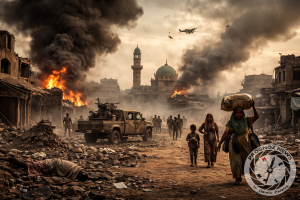
The first phase of the conflict centred on Khartoum and the adjacent cities of Omdurman and Bahri. Urban warfare in a capital is not merely a military event — it is a social collapse. Hospitals are overwhelmed or occupied. Water and electricity become weapons. Neighbourhood committees turn into emergency governments. Those with means flee first, then those without follow, until the city becomes a ruin inhabited by the trapped and the armed.
As the struggle for the centre continued, the war expanded in ways that echoed Sudan’s earlier conflicts. Darfur, in particular, became a site of severe violence. Reports from humanitarian organisations and human rights bodies have described mass killings, forced displacement and attacks that appear directed at particular communities. The echoes of the early 2000s are not incidental. They are evidence that Sudan’s unresolved past returned, armed, into the present.
Meanwhile the conflict deepened in Kordofan and other regions where sieges, disrupted markets and blocked aid turned hunger into a strategic instrument. The breaking and re-imposition of sieges has underscored how starvation and isolation have become central features of the war’s conduct.
The war has also evolved technologically. Drones, once associated mainly with conflicts in Europe and the Middle East, have become part of Sudan’s battlefield — not as a symbol of modernity, but as a cheap method of striking civilians, vehicles and aid. The effect is not only casualties but terror: the sense that even flight is unsafe.
Humanitarian consequences — displacement, famine and the collapse of public life
Sudan is now described by multiple international bodies as one of the world’s worst humanitarian crises. The figures are not abstractions. They describe a society unstitched.
Displacement has reached extraordinary levels, with millions uprooted inside Sudan and across borders. Refugees have fled into Chad, South Sudan and further afield, while internal displacement has reshaped entire provinces.
Food insecurity has escalated into famine conditions in parts of the country, driven by the collapse of agriculture, market disruption, looting, sieges and the danger of travel. Hunger is not simply a by-product of war here — it is a mechanism that war produces reliably when a state’s economic arteries are cut.
Healthcare has been devastated. When fighting enters cities and armed actors treat hospitals as assets, the result is a predictable arithmetic: preventable disease rises, childbirth becomes lethal, chronic illness becomes a death sentence and trauma injuries multiply.
For the informed reader, the most important point may be this: Sudan’s suffering is not only the suffering of victims of violence. It is the suffering of people whose entire administrative world has dissolved. Schools close. Salaries stop. Documentation is lost. Property claims become impossible. Even if the guns fell silent tomorrow, the reconstruction of civic life would be a generational task.
Allegations of war crimes — what is being said, by whom, and why it matters
Allegations of war crimes in Sudan are extensive and, in many cases, supported by reporting from international human rights bodies.
The UN’s Office of the High Commissioner for Human Rights has warned repeatedly about attacks on civilians and patterns of abuse. An Independent International Fact-Finding Mission has described a war of atrocities, reporting that civilians have been deliberately targeted and that there are large-scale violations that may constitute war crimes, with some acts possibly amounting to crimes against humanity.
Human rights organisations have documented serious abuses, including patterns attributed particularly to the RSF, though violations are not the monopoly of one side.
The International Criminal Court remains relevant because of its long-standing Darfur mandate. Recent reports to the UN Security Council have underscored that accountability processes — however slow, politically constrained and imperfect — have not disappeared.
Why does this matter when enforcement is weak? Because war crimes allegations shape three things that will define Sudan’s future.
First, they shape fear. Communities that believe extermination is possible will fight on, even when compromise might otherwise be attractive. Secondly, they shape diplomacy. External actors may prefer to back a side that seems less internationally radioactive. Thirdly, they shape the prospects for a post-war settlement. A peace that ignores crimes may stop fighting, but it will store violence for later, to be paid with interest.
Why peace talks keep failing — and why that does not mean diplomacy is futile
Sudan has not lacked for diplomatic attention. She has lacked for credible enforcement and for a political bargain that the armed actors truly fear to refuse.
Talks have often focused on ceasefires, humanitarian corridors and confidence-building. These are necessary, but they assume parties who want stability. Sudan’s belligerents have frequently behaved as if instability is useful — it enables looting, coercion and the creation of facts on the ground.
There is also a structural problem: the war is no longer only two men and two headquarters. It is a networked conflict involving local commanders, allied militias and regional economies. Even if the SAF and the RSF agreed on paper, it is uncertain that all their subordinate armed actors would comply without new incentives or coercion.
Yet diplomacy remains essential. Not because it is noble, but because the alternatives are worse: permanent fragmentation, cycles of revenge, the further militarisation of borders and the export of violence into the Sahel and the Red Sea corridor.
What the informed reader should watch next
Three dynamics will shape Sudan’s near future.
One is territorial consolidation. If either side achieves durable control over major economic corridors or administrative centres, the war may shift from fluid combat to entrenched partition.
The second is the weaponisation of hunger. If sieges and market strangulation continue, famine will not merely accompany the war — it will become its central battlefield.
The third is accountability pressure. International investigations, documentation efforts and developments linked to international justice will not end the war quickly, but they may constrain certain behaviours, influence external support and shape any eventual transition.
Sudan’s tragedy is not that she has no path out. It is that every path out demands that armed men surrender what they have taken, and that foreign partners accept that stability cannot be purchased with denials. In the meantime, Sudan’s civilians live amongst ruins, improvising survival where a state once pretended to exist.
5 Views



Most Readings