Russia tightens the screws against Telegram
By Matthew Parish, Associate Editor
Thursday 12 February 2026
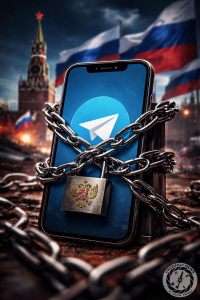
The Russian state’s latest move against Telegram is best understood not as a single switch being flipped, but as the Kremlin’s preferred method of digital coercion: a tightening spiral of technical disruption, legal pressure and narrative framing, designed to make an indispensable platform feel unreliable until its users drift, resentfully, into something the state can monitor more comprehensively.
In early February 2026, Russian users began reporting serious disruptions to Telegram, with Roskomnadzor and the Kremlin presenting the restrictions as the consequence of Telegram’s alleged non-compliance with Russian law and the platform’s purported failure to curb criminal, terrorist, or ‘extremist’ content. Russia has spoken in the language of procedure and public safety, but procedure is rarely the whole story in a system where the law is a tool of governance, not its restraint.
Telegram is not merely a messenger inside Russia. It is an information nervous system. Ministries use it. Governors use it. Soldiers’ families use it. Pro-war commentators use it. Opposition voices and investigative outlets use it. When such a platform is ‘restricted’, the consequence is not only inconvenience; it is a reshaping of what Russians can know, how quickly they can know it and whom they can safely trust.
The word ‘prohibition’ therefore has to be handled carefully. What is occurring in February 2026, according to reporting, is an escalation of curbs and phased restrictions, including forms of throttling and service degradation, alongside court fines and explicit threats of further measures. The effect, however, can approximate a ban in practice, particularly for users who lack the patience, technical confidence or financial means to route around state controls.
Why Russia is doing it
Russia’s rationale operates on three overlapping tracks.
First, the familiar legal-security track. The state claims Telegram is a vector for fraud, violent recruitment, sabotage and terrorism, as well as a platform that fails to remove content the authorities classify as extremist. This language is not accidental: it invites the public to accept restrictions as a form of policing, while also providing the bureaucratic pretext needed for regulator action.
Secondly, the sovereignty track. Moscow has pursued ‘digital sovereignty’ for years, and this episode fits a broader pattern of degrading or restricting major platforms rather than always banning them outright, a tactic that pressures behaviour while lowering the political cost of an explicit prohibition. Telegram is particularly galling to the Kremlin because it remains one of the few mass platforms in Russia that is not structurally integrated into the state’s information apparatus.
Thirdly, the substitution track. A restriction campaign only makes strategic sense if there is somewhere else to push people. Since mid-2025, Russian-linked reporting has described the state-backed messenger MAX as the intended ‘patriotic’ alternative, with ambitions to become a super-app. If the state can herd users from Telegram into an application developed within Russia’s corporate and legal environment, it gains leverage: over data, compliance and surveillance.
There is also a historical shadow. Russia tried to block Telegram in 2018, widely disrupting unrelated services while failing to truly suppress Telegram’s availability, and the ban was later lifted in 2020. The memory of that debacle matters: it explains why the current approach emphasises gradual degradation and targeted restriction, rather than a clumsy, absolute block.
The most important consequence of all this is that different Russian constituencies will experience the restrictions not as a single political act, but as a staggered social fracture.
The military, volunteers and pro-war information space
Telegram has become deeply embedded in Russia’s war effort, not only as a propaganda pipeline but as a practical tool for coordination, situational awareness and welfare communications between soldiers and families. It is therefore striking that criticism has surfaced from soldiers, pro-war bloggers and even officials aligned with the system, warning that disruptions can cost lives or undermine basic operational routines.
This produces an unusual tension inside a patriotic constituency. The Kremlin can dismiss liberal complaints as foreign-influenced, but it is harder to dismiss angry voices claiming, in effect, that the state is breaking its own wartime toolkit.
Regional authorities and emergency communications
Governors and municipal bodies use Telegram channels for air-raid-style alerts, security updates, public-service announcements and rapid crisis communication. Reporting has noted concern from regional officials about the impact on public safety messaging. If Telegram becomes intermittently unreliable, the state will try to reroute official communications to alternative platforms, but the transition period is precisely when trust erodes and rumours flourish.
In a country managing both wartime pressures and domestic insecurity, unreliable crisis communications can become politically explosive because they translate quickly into a sense that the state cannot perform basic administrative competence.
Independent media, opposition networks and civic life
For journalists and opposition activists, Telegram has been both publication infrastructure and distribution channel, particularly as other spaces have been narrowed by censorship and legal risk. A throttled Telegram reduces reach and increases the costs of organisation; it also heightens the danger of migration to a platform the state can more readily monitor.
This is not merely a battle over speech; it is a battle over social confidence. In authoritarian conditions, people do not only censor their words — they censor their relationships. If they believe a new ‘approved’ platform is watched, they will prune their networks accordingly.
Business, professionals and everyday social coordination
For ordinary Russians Telegram is a calendar, a workplace corridor, a marketplace and a family kitchen table all at once. When a platform of that breadth is degraded the immediate effect is banal frustration — but the second-order effect is economic friction. Small businesses that rely on Telegram channels for sales, appointment scheduling, customer support or local advertising will either lose income or incur costs migrating. Larger organisations will splinter across tools, which is inefficient and, in a sanctions-era economy, politically unwelcome.
The technologically capable and the resigned majority
One predictable response is circumvention. A portion of Russian society will use VPNs and other workarounds — something Russia has seen repeatedly when restricting platforms. But the crucial point is that circumvention is unevenly distributed. The young, urban and digitally confident will route around disruption; older users, rural users and those who simply fear ‘breaking the phone’ will not. Digital repression therefore operates as a class divider: the state does not need perfect control; it needs control over the majority.
The Kremlin itself
Finally there is the irony that the Kremlin and state agencies have used Telegram extensively. Pushing too hard risks harming their own communications and their own propaganda reach, at least in the short term. The state’s wager is that it can endure that inconvenience long enough to force a new equilibrium: Telegram weakened, MAX normalised and the remaining Telegram users pushed into a smaller, more easily stigmatised category of ‘suspicious’ citizens.
What happens next
If Russia persists, she is likely to continue with phased restrictions rather than a single dramatic ban, because gradual degradation allows the Kremlin to calibrate backlash — and, crucially, to blame Telegram for ‘non-compliance’ at every step. Yet the February 2026 episode has already exposed the central paradox of sovereign internet policy: the more a modern state tries to command digital life, the more it reveals how dependent it has become upon the very platforms it seeks to dominate.
Telegram is not only a technology problem for Russia; it is a legitimacy problem. A state that cannot tolerate an uncontrolled conversation is a state that does not trust its own people — and, in time, teaches its people not to trust it.
4 Views

Most Readings