The European Group of Five
By Matthew Parish, Associate Editor
Friday 27 February 2026
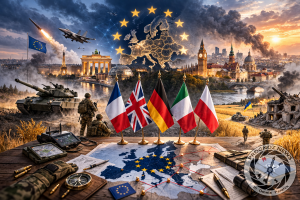
The European Group of Five — sometimes abbreviated in diplomatic shorthand to the ‘E5’ — is not a treaty organisation, nor a standing alliance in the mould of NATO. Rather it is an emerging political and military coordination forum comprising France, the United Kingdom, Germany, Italy and Poland — five of Europe’s most consequential military powers, represented respectively by Emmanuel Macron, Keir Starmer, Friedrich Merz, Giorgia Meloni and Donald Tusk.
It has arisen not from bureaucratic design but from strategic necessity.
Europe at War — and Europe Uncertain
The proximate cause of the E5’s consolidation has been Russia’s full-scale invasion of Ukraine in 2022 and the grinding, attritional war that followed. For three years Europe has confronted a paradox. On the one hand, the continent has displayed an unprecedented degree of unity in sanctions policy, arms deliveries and macro-financial assistance to Kyiv. On the other, she has been forced to confront her own military insufficiency — hollowed-out stockpiles, anaemic defence industries and decades of strategic dependency upon the United States.
The election cycles in Washington — and oscillations in American rhetoric about burden-sharing and strategic priorities — have sharpened this anxiety. European leaders increasingly speak of ‘strategic autonomy’, although the phrase is interpreted differently in Paris, Berlin, London, Rome and Warsaw. What unites them is the recognition that Europe must be able to deter, and if necessary fight, a high-intensity war on her own continent even in circumstances of partial American retrenchment.
It is in this context that the Group of Five has taken shape: an attempt to concentrate political will and military weight amongst those European states capable of acting at scale.
Why These Five?
The selection is neither accidental nor merely demographic.
France and the United Kingdom remain Europe’s only nuclear-armed powers, permanent members of the United Nations Security Council and states with expeditionary military traditions. Germany is Europe’s largest economy and, since the Zeitenwende declaration of 2022, has embarked upon a long-overdue expansion of her defence spending and procurement pipelines. Italy provides Mediterranean reach, naval capacity and a bridge to North Africa. Poland meanwhile has transformed herself into Europe’s most rapidly expanding land power, investing heavily in armoured formations, artillery and air defence.
Together these five states account for the majority of European defence expenditure outside the United States. More importantly they combine complementary capabilities — nuclear deterrence, heavy armour, long-range strike, naval projection and industrial depth.
The E5 is therefore less a political club than a concentration of usable force.
Institutional Motivation — Speed and Scale
The European Union has mechanisms for defence coordination, and NATO remains the backbone of collective defence. Yet both suffer from structural constraints.
The EU is limited by unanimity in foreign policy and by the diversity of threat perceptions across twenty-seven member states. NATO, although formidable, depends operationally and politically upon American leadership. The E5’s motivation is not to supplant either institution but to create a smaller, more agile decision-making forum capable of:
— Rapid coordination of arms deliveries to Ukraine
— Joint procurement initiatives
— Industrial synchronisation in munitions and air defence
— Planning for post-war European security guarantees
In private discussions, officials describe the format as a ‘directorate’ — an inner core able to generate momentum that can later be expanded outward to allies.
Industrial Coordination — Rearmament in Earnest
Perhaps the most tangible work undertaken by the Group of Five concerns defence industry.
Europe’s experience in Ukraine has exposed a structural weakness: her inability to produce artillery shells, precision munitions and air defence interceptors at the rate required by modern war. Stockpiles depleted in 2022 and 2023 proved difficult to replenish. Supply chains were fragmented, production lines optimised for peacetime efficiency rather than wartime surge.
The E5 has therefore sought to coordinate:
— Long-term procurement contracts to provide industry with predictable demand
— Standardisation of calibres and platforms to reduce duplication
— Joint investment in air defence systems and missile production
— Expansion of armoured vehicle output
Poland’s procurement of South Korean armour, Germany’s expansion of ammunition production, Britain’s emphasis upon long-range strike and France’s push for European missile autonomy are no longer isolated national projects; they are increasingly discussed within a common strategic frame.
Operational Planning — The Question of Ukraine
The Group’s most politically sensitive discussions concern Ukraine’s future security architecture.
Should a ceasefire emerge, who would provide enforcement? Would European troops deploy as trainers, peacekeepers or deterrent tripwires? Could a multinational European corps be assembled under E5 leadership?
While no formal decisions have been announced, exploratory staff-level conversations reportedly examine:
— Air policing missions over Western Ukraine
— Naval patrol coordination in the Black Sea
— Joint training commands
— Intelligence fusion cells
Such measures would not substitute for NATO membership, but they might provide an interim shield — particularly if American policy were to fluctuate.
Nuclear Signalling and Deterrence
An under-acknowledged dimension of the E5 is nuclear signalling.
France maintains an independent nuclear deterrent. The United Kingdom’s Trident force operates within a NATO framework but remains nationally controlled. Discussions have quietly advanced regarding how these deterrents might be politically framed as providing a European umbrella, particularly for Eastern member states that feel exposed.
Germany and Poland, while non-nuclear, have strategic stakes in the credibility of extended deterrence. The E5 forum allows these conversations to occur amongst the principal stakeholders without the diffusion inherent in larger assemblies.
Strategic Culture — Convergence and Tension
The Group is not without internal friction.
France has long championed European strategic autonomy. Poland remains deeply committed to transatlanticism. Britain, post-Brexit, balances European cooperation with a global posture. Germany’s strategic culture is still evolving under the weight of history. Italy navigates Mediterranean priorities.
Yet the war has narrowed these divergences. The scale of Russian aggression has clarified threat perceptions. What once seemed theoretical — high-intensity land warfare in Europe — is now daily reality.
The E5 reflects this convergence: not uniformity of ideology, but alignment of necessity.
A European Pillar Emerging
In practical terms the Group of Five is building what might be termed a European pillar within the Atlantic alliance — one capable of acting cohesively even if Washington’s attention drifts towards the Indo-Pacific.
This is not decoupling. It is hedging.
For Ukraine, the implications are profound. A Europe that can coordinate at scale — industrially, operationally and politically — alters the calculus of endurance. It signals to Moscow that time will not fracture Western resolve as easily as anticipated.
For Europe herself, the E5 represents a recognition long deferred: that security cannot be permanently outsourced.
Whether this grouping solidifies into a formal structure or remains an agile diplomatic forum will depend upon the trajectory of the war, American politics and Europe’s own willingness to sustain elevated defence expenditure beyond the immediacy of crisis.
But its existence already marks a psychological shift.
Europe is beginning, haltingly yet unmistakably, to think of herself not merely as a market or a regulatory superpower, but as a military actor — and to organise accordingly.
269 Views

Most Readings