Gulf states as business hubs: really?
By Matthew Parish, Associate Editor
Wednesday 4 March 2026
For two decades the Gulf States have sold the world an unusually coherent proposition—come here because the region is politically complicated, but our cities are not. Dubai, Abu Dhabi, Doha and, increasingly, Riyadh have marketed themselves as places where capital can move faster than diplomacy, where disputes can be arbitrated rather than fought, where a global workforce can live comfortably and where an airport timetable is a more reliable document than a ceasefire communiqué.
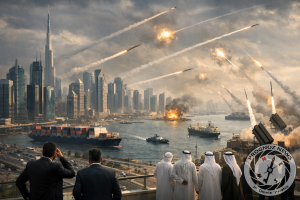
The present war with Iran attacks that proposition at its foundations—not because skyscrapers can be rebuilt, but because stability is the premium these hubs have been exporting. Once that premium is questioned, everything else in the Gulf model becomes more expensive: insurance, credit, logistics, staffing, tourism, even the willingness of boards to hold conferences in places whose names now appear on travel advisories.
The fragility of the hub model: air, sea, confidence
The most immediate damage is to the Gulf’s role as the connective tissue of globalisation—aviation. Gulf carriers and airports are not merely national champions; they are infrastructure for the world economy. When airspace is closed or intermittently disrupted the Gulf does not simply lose tourist revenue; it loses its comparative advantage as the meeting point between Europe, Asia and Africa. Reports of widespread flight suspensions and severe disruption—affecting the region’s principal carriers and hubs—show how quickly the “always-open” promise can be punctured.
Maritime trade—the second pillar—is suffering a parallel shock. London market bodies have widened “high-risk” designations across Gulf waters, and war-risk premiums have reportedly surged sharply. This matters because Jebel Ali, Fujairah, Khalifa Port, Hamad Port and their satellite free-zones are not just regional assets; they are nodes in global supply chains. If underwriters treat the Gulf as a war theatre then the Gulf’s ports become a hindrance to global trade to be avoided at all costs.
The deeper issue is confidence. Many multinationals choose the Gulf not because it is close to risk, but because it has historically managed risk—through internal security, rapid administrative decision-making, sovereign liquidity and a reputation for competence. Yet competence is not an air-defence system. When missiles and drones can interrupt normal life, even briefly, corporate risk committees start to ask whether the Gulf’s “stability premium” was always, in part, a wager on the region’s strategic luck.
Finance hubs: the stability premium becomes a risk discount
Global finance does not flee at the first sign of trouble—it reprices. The Gulf’s financial centres have been growing by offering predictable regulation, deep pools of state-backed capital and an attractive tax and visa environment. But their pitch has also been psychological: managers could live in the Gulf whilst believing they were outside the Middle East’s traditional security drama.
War forces a reassessment of that mental separation. If the Gulf becomes a theatre—rather than a sanctuary adjacent to theatres—then the region’s finance hubs face a new cost of capital. Investors begin to demand higher returns to compensate for tail-risk: sudden closures, sanctions spillover, cyber attacks, reputational entanglement with belligerents and the practical difficulty of moving staff during crises. Commentary in financial media has begun framing precisely this question—whether the region’s stability is a temporary interruption or a turning point.
This is not a theoretical point. The war is already interrupting the everyday economy that underpins hub status—firms pausing operations, staff working from home, pilots and crews refusing routes, insurers issuing cancellations. Even a temporary suspension of activity by high-profile technology deployments—such as autonomous mobility pilots—signals how quickly novelty and growth can give way to continuity planning.
The people problem: talent, families, and the return of contingency
The Gulf hubs are built as much from imported human capital as imported money. Their commercial future therefore depends upon whether expatriate professionals, and their families, continue to believe that the Gulf offers a safe and pleasant life.
War corrodes that belief in more or less subtle ways. It is not only the fear of direct attack; it is the churn of contingency—schools considering closures, travel becoming unreliable, relatives abroad urging return, employers quietly offering relocation packages “just in case”. Once a pattern of repeated disruptions is established, the region’s labour market begins to resemble a rotation rather than a settlement: shorter contracts, higher wage demands, more generous hardship benefits, faster turnover and less institutional memory.
That in turn affects the very sectors the Gulf needs for diversification—finance, professional services, research, higher education, advanced manufacturing, data centres and creative industries. Oil and gas can function under emergency conditions; knowledge economies find it harder, especially if a precedent for war is created that might always return.
The paradox of oil: richer states, poorer hubs
The Gulf’s public finances may strengthen as energy markets tighten—but a richer treasury does not automatically produce a stronger hub. Higher oil prices can fund subsidies, reconstruction, security upgrades and sovereign investment, yet they also reinforce the old narrative the Gulf is trying to outgrow: that its prosperity is inseparable from regional conflict.
Moreover shipping disruption and heightened insurance costs are inflationary forces. Even where the state can absorb costs, the private economy feels them—especially in trade, retail, construction and hospitality. If the Strait of Hormuz is effectively constrained for any sustained period, the Gulf’s logistical advantage is partially inverted: it becomes a place from which goods struggle to leave, rather than a place through which goods effortlessly pass.
Neutrality is harder to sell when missiles are flying
There is a diplomatic dimension with commercial consequences. Gulf States have been trying to play multiple roles at once—US security partners, Chinese investment destinations, Russian interlocutors, Iranian neighbours, global mediators, hosts for international arbitration and sport. War with Iran compresses those roles.
As analysts have noted, direct Iranian strikes on Gulf targets create political pressure for collective self-defence and deeper alignment with Washington—whatever the Gulf’s leadership may privately prefer. If the Gulf’s posture shifts from neutral platform to participant in the current conflict, then some capital—particularly from jurisdictions wary of secondary sanctions or geopolitical exposure—will hesitate. In a world of fragmented finance the ability to host everyone is itself a business line; war makes that line harder to maintain.
What commercial futures remain plausible?
If the war ends quickly, the Gulf may treat this as a stress-test—painful but survivable. It can point to continuity, rapid recovery and the deep pockets of her sovereign wealth funds as proof that the hub model is resilient. Some of that narrative is already visible in the way authorities and firms attempt partial resumptions and phased reopenings when conditions permit.
If however the war inculcates a longer period of regional instability, the Gulf’s strategy must evolve from “hub” to “hardened hub”—and that requires a different kind of investment.
-
Redundancy becomes as important as glamour—alternative airports, dispersed logistics, protected power and water systems, and credible civil defence planning.
-
The state may need to underwrite risk directly—through backstops for war insurance, guarantees for essential shipping, emergency liquidity for key sectors and rapid dispute resolution when contracts are disrupted.
-
Diversification must tilt towards sectors less dependent on frictionless movement—data, high-value services delivered digitally, advanced manufacturing for domestic and regional markets, and education and research that can continue during travel interruption.
-
Diplomacy becomes economic policy—because the ability to de-escalate is now part of the investment climate.
There is also a hard truth the Gulf cannot fully escape: a business hub is, by definition, a promise about the future. It says that contracts signed today will be honoured tomorrow, that flights booked next month will depart, that courts will sit, that ports will load, that bankers will show up to work. War does not merely break buildings—it breaks the credibility of that promise.
The Gulf States are not without tools. Their governments can act quickly; their sovereign investors can stabilise markets; their security services have experience in threat management; their infrastructure is, in many respects, world-class. Yet the lesson of the current conflict is that the Gulf’s commercial model has reached the point where geopolitics is no longer background noise. It is now a core variable. An aggressive and belligerent Iran is not going to go away; the problem with Iran will become worse, probably exponentially, and probably over many years, as it already becomes apparent that regime change in that jurisdiction is out of the question.
This is not a matter of whether Dubai, Abu Dhabi, Doha and Riyadh can remain important—they will. The question is what price the world will demand for doing business in a region where instability is no longer a distant memory, but a present feature—and whether the Gulf can persuade global capital that its future remains more predictable than its neighbourhood.
275 Views



Most Readings