Kharkiv’s Quiet Front: The Work of Chernova Kalyna
By Matthew Parish
Friday 27 March 2026
In the long shadow of artillery fire, where front lines bleed into civilian life and the distinction between soldier and survivor dissolves, the most consequential work is often the least visible. In Kharkiv, a city that has endured bombardment, displacement and the slow corrosion of normality, organisations such as Chernova Kalyna operate not in the theatre of politics or strategy, but in the intimate geography of human need.
Chernova Kalyna is not an abstract institution. It is a wartime improvisation — born in a basement on 24 February 2022, as Russian missiles fell and several hundred students sought shelter underground. From those first hours, necessity dictated purpose. There was no time for formal structures or mission statements; there was only the imperative to protect, to feed and to steady those who had suddenly become refugees within their own city.
That origin story matters, because it explains the character of the organisation today. Unlike many formal humanitarian bodies, Chernova Kalyna is rooted in lived experience of siege conditions. It emerged from a dormitory, guided by educators and administrators who were compelled to become logisticians, counsellors and community leaders in a matter of days.
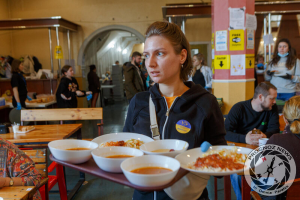
The first task was food. In wartime Kharkiv, supply chains fractured almost overnight. Electricity faltered, transport links broke down, and ordinary commerce ceased to function. Against this backdrop the foundation’s kitchen became both a lifeline and a symbol — producing hot meals not only for students, but for volunteers, territorial defence units and medical facilities. Over time this activity evolved into a systematic provision of humanitarian assistance, including food parcels, clothing and essential supplies for internally displaced persons and the urban poor.
Yet food, however vital, is only the beginning. The war in Ukraine has generated not merely material deprivation, but psychological fragmentation — a slow unravelling of the social fabric. Chernova Kalyna’s response to this reality is notable for its breadth. It provides psychological support to children and adults alike, recognising that trauma is not an incidental by-product of war but one of its central weapons.
For children the foundation organises structured activities — games, educational programmes and communal events designed to recreate fragments of normal life. These are not trivial interventions. In a city where schooling has been repeatedly disrupted and air raid sirens punctuate daily existence, such initiatives form a fragile bridge between war and the possibility of a future. They are, in effect, a form of social reconstruction conducted in real time.
The organisation’s engagement with internally displaced persons reveals the scale of the challenge. Thousands have passed through her orbit — individuals who have lost homes, employment and often family members. Chernova Kalyna does not merely distribute aid; it attempts to catalogue need, to understand the particular circumstances of each household, and to deliver targeted assistance. This administrative function — mundane on its face — is in fact critical in a context where state systems are overwhelmed or disrupted.
There is also a notable reciprocity in her model. Displaced persons are not treated solely as beneficiaries, but frequently become volunteers themselves — weaving camouflage nets, assisting in kitchens, or participating in community programmes. In this way, the organisation mitigates one of the most corrosive effects of displacement: the loss of agency. To contribute, even in small ways, is to reclaim a measure of dignity.
Chernova Kalyna’s work extends beyond immediate relief into longer-term recovery. Its broader mission encompasses rehabilitation, education and even cooperation with European institutions to facilitate access to training and healthcare systems abroad. This reflects a recognition that war is not a discrete event but a prolonged condition, requiring sustained interventions that bridge emergency response and societal rebuilding.
An unusual but revealing aspect of its work is the inclusion of animals within its humanitarian framework. Projects aimed at caring for abandoned pets and strays acknowledge a truth often overlooked in conflict analysis — that the destruction of war extends to all forms of life, and that compassion, to be coherent, must be comprehensive.
To understand Chernova Kalyna fully, one must also consider the symbolism of her name. “Chervona Kalyna” — the red viburnum — is deeply embedded in Ukrainian cultural consciousness, associated with resilience, sacrifice and national identity. The choice is not incidental. It situates the organisation within a broader historical narrative of endurance, linking contemporary humanitarian work to centuries of cultural memory.
What emerges, then, is not simply a charitable foundation but a microcosm of Ukrainian civil society under conditions of total war. It operates where the state cannot always reach, adapts faster than formal institutions, and embodies a form of civic patriotism that is neither ideological nor performative but practical and immediate.
There is a tendency, in discussions of the war in Ukraine, to focus upon military developments — the movement of brigades, the supply of weapons, the shifting geometry of the front. These are of course essential. But they are only one dimension of the conflict. Beneath them lies another struggle: the effort to sustain life, community and meaning in the midst of destruction.
In that quieter struggle, organisations like Chernova Kalyna are indispensable. They do not win battles in the conventional sense. Yet without them, the society for which those battles are fought would gradually erode.
Kharkiv, battered but unbroken, is sustained not only by its defenders at the front, but by its citizens behind it — cooking, organising, comforting, rebuilding. In the basement where Chernova Kalyna began, one finds a simple truth about this war: survival is not an abstraction. It is a daily act, repeated thousands of times, by people who refuse to allow their country to collapse into despair.
205 Views



Most Readings