Controversy: the state visit of King Charles III to the United States
By Matthew Parish, Associate Editor
Wednesday 1 April 2026
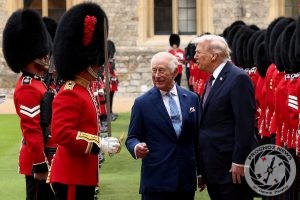
The question of whether the state visit of King Charles III to the United States ought to be cancelled or delayed cannot be answered merely as a matter of etiquette. It sits instead at the intersection of constitutional propriety, wartime diplomacy, and the evolving fragility of what has long been styled the “special relationship” between Britain and America. The present crisis — the United States’ war against Iran and her sharp public criticism of Britain’s reluctance to participate — renders the visit not simply ceremonial, but politically charged to an unusual and uncomfortable degree.
A state visit by a British monarch is never a personal undertaking. It is conducted on the advice of the elected government and serves as an instrument of statecraft rather than personal diplomacy. That principle is of constitutional importance. The monarch does not choose her destinations; he is sent. In this case Buckingham Palace has confirmed that the visit will proceed explicitly “on the advice of the UK government”. Any argument for cancellation must therefore be directed not at the Crown, but at ministers — and ultimately at the strategic judgement they are exercising.
Yet the strategic context is unusually fraught. The United States under Donald Trump is engaged in an escalating military confrontation with Iran, one that has divided Western allies and provoked widespread controversy within Britain herself. Public opinion in the United Kingdom has tilted decisively against the conflict, with majorities opposing American military action and fearing its economic consequences. The British government has sought to walk a narrow line — offering defensive cooperation whilst declining full participation in offensive operations.
It is precisely this equivocation that has provoked American ire. The President has publicly disparaged Britain’s stance, mocking her armed forces and criticising her refusal to join the war effort. Such language is not merely undiplomatic; it alters the symbolic meaning of any royal visit. A state visit is intended to signal mutual respect between sovereign equals. When one party has openly belittled the other the symbolism becomes strained — even contradictory.
Critics of the visit, including senior British politicians, have therefore argued that proceeding risks national humiliation. They contend that sending the King to Washington under such conditions appears to reward or legitimise American behaviour that has been openly dismissive of Britain’s position. In this view, postponement would serve as a calibrated diplomatic signal — not a rupture, but a reminder that respect remains a prerequisite for ceremonial affirmation.
There is historical precedent for such discomfort. State visits have often proceeded amidst controversy — from protests during Donald Trump’s earlier visit to Britain to demonstrations against other contentious leaders — yet they have rarely coincided with an active conflict in which the host nation is criticising the visiting nation’s refusal to participate. The present circumstances are therefore not routine. They represent a qualitative shift from controversy to strategic dissonance.
And yet there exists a counterargument, grounded in a colder reading of diplomatic necessity. The visit may not be a reward at all, but a tool — an attempt to stabilise a relationship under strain. Indeed, reports suggest that the British government views the monarchy’s “soft power” as a means of mollifying tensions with Washington. The King, in this interpretation, becomes a bridge precisely because formal political channels have become brittle.
To cancel or delay the visit would therefore carry risks of its own. It could be interpreted in Washington not as principled restraint, but as a diplomatic slight — particularly given the symbolic importance of the visit in marking the 250th anniversary of American independence. In an era in which the United States has shown increasing willingness to recalibrate alliances according to perceived loyalty, such a gesture might deepen rather than alleviate tensions.
There is also the constitutional dimension to consider. The British monarch, as a non-political figure, derives his value in diplomacy precisely from his detachment from partisan conflict. To cancel a visit explicitly because of disagreement with American policy would risk drawing the Crown into political controversy. That would set a precedent — subtle perhaps, but constitutionally significant — in which royal diplomacy becomes contingent upon alignment with government policy abroad.
Thus the dilemma resolves into a clash between symbolism and strategy. Cancellation would preserve dignity but risk influence; continuation preserves influence but risks the appearance of acquiescence.
In truth the most compelling argument lies not in absolute cancellation but in calibrated delay. A postponement — framed not as protest but as prudence — would allow the British government to avoid the immediate optics of endorsement whilst preserving the long-term viability of the visit. It would also align the timing of the visit with a moment of reduced tension, thereby restoring its intended symbolism of mutual respect rather than uneasy necessity.
Whether such subtlety is achievable in the present geopolitical climate is another matter. The United States administration has already signalled that it expects the visit to proceed, and may interpret any deviation as hostility. Britain for her part remains caught between her historic alliance and her contemporary reservations about American conduct.
The ultimate question is less about whether the King should travel, and more about what message Britain wishes to send — to Washington, to her own citizens, and to the wider world. A state visit is never merely a visit. In times of war it becomes a statement.
And at present, Britain must decide whether that statement is one of continuity — or of caution.
202 Views



Most Readings






Crimea Under Pressure: Ukraine’s Long Campaign Against Russia’s Southern Bastion
94 Views