The impact of artificial intelligence on geopolitics
By Matthew Parish, Associate Editor
Sunday 19 April 2026
The impact of artificial intelligence upon geopolitics is not a future question. It is a present condition. States are already reorganising their strategic assumptions around machines that learn, predict and act — often faster than the human institutions that attempt to govern them. Artificial intelligence does not merely alter the instruments of power; it reshapes the very logic by which power is understood, accumulated and exercised.
At the centre of this transformation lies a deceptively simple shift — the elevation of data from a passive resource into an active strategic asset. In earlier industrial epochs raw materials such as coal, oil and steel defined the hierarchy of nations. Today data assumes a comparable role, but with one critical distinction — it is infinitely replicable, yet unequally accessible. The states that control vast flows of behavioural, economic and military data — notably the United States and the China — find themselves endowed with a form of power that is at once diffuse and deeply entrenched. Their advantage is not merely quantitative; it is structural, rooted in the ability to train increasingly sophisticated models that in turn generate further data in a self-reinforcing cycle.
This asymmetry has begun to reorder alliances. Traditional security arrangements, such as NATO, were conceived in an era in which military hardware and territorial defence formed the backbone of deterrence. Now the integrity of digital infrastructure, the resilience of algorithmic systems and the sovereignty of data have emerged as equally vital concerns. Cyber defence is no longer an adjunct to conventional warfare — it is a silent counterpart, shaping the battlefield long before physical engagement occurs. States that lack robust digital infrastructure risk not only military inferiority but strategic irrelevance.
Artificial intelligence also disrupts the internal cohesion of states. The capacity to analyse populations at scale — through surveillance, predictive modelling and behavioural analysis — grants governments unprecedented tools of control. In the People’s Republic of China, such systems have been integrated into governance structures with remarkable thoroughness, enabling a form of algorithmic administration that blurs the boundary between state authority and technological infrastructure. Yet this same capacity exists, albeit in more fragmented form, within liberal democracies. The difference lies not in capability but in constraint — and constraint, as history repeatedly demonstrates, is subject to erosion under conditions of perceived existential threat.
For smaller or less technologically advanced nations the consequences are more ambiguous. Artificial intelligence offers the possibility of leapfrogging traditional stages of development. Ukraine — engaged in a protracted war of survival against the Russian Federation — has demonstrated how adaptive use of machine learning in drone targeting, logistics and intelligence analysis can partially offset disparities in manpower and industrial capacity. But reliance upon external platforms and foreign-developed models introduces new dependencies. Sovereignty becomes contingent not only upon territorial control but upon access to proprietary algorithms and cloud infrastructure, often owned by corporations headquartered beyond national jurisdiction.
This corporate dimension introduces a further layer of geopolitical complexity. Technology companies — particularly those based in the United States — increasingly operate as quasi-sovereign actors. Their decisions regarding data governance, model deployment and platform access can have consequences comparable to those of state policy. When a firm such as OpenAI or Google restricts or enables certain capabilities it effectively shapes the distribution of power across borders. The traditional Westphalian model of state sovereignty struggles to accommodate entities whose influence transcends territorial boundaries yet remains anchored in specific legal regimes.
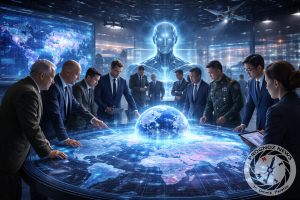
The militarisation of artificial intelligence is perhaps the most immediate and unsettling development. Autonomous systems — whether aerial drones, naval platforms or cyber tools — introduce the possibility of decision-making at machine speed. The risk is not merely that wars become more efficient; it is that they become less controllable. Escalation, once mediated by human deliberation, may occur within milliseconds, triggered by algorithmic misinterpretation or adversarial manipulation. The logic of deterrence, which in the nuclear age relied upon rational calculation, is ill-suited to systems whose internal processes are often opaque even to their creators.
Artificial intelligence also alters the informational environment in which geopolitics unfolds. The proliferation of synthetic media — text, images and video generated by machines — complicates the distinction between truth and fabrication. Influence operations, once labour-intensive, can now be conducted at scale and with remarkable sophistication. The capacity to shape narratives, to erode trust and to fragment public discourse becomes a strategic asset in its own right. Elections, referenda and public debates are increasingly contested not only in physical space but within algorithmically curated realities.
Yet it would be a mistake to interpret these developments solely in terms of competition and conflict. Artificial intelligence also creates incentives for cooperation. The risks associated with uncontrolled escalation, systemic cyber vulnerabilities and the erosion of shared epistemic foundations are not confined to any single state. They are collective in nature. Efforts to establish norms — whether through bilateral agreements, multilateral forums or informal understandings — reflect an emerging recognition that unrestrained competition in this domain may prove mutually destructive. The challenge lies in reconciling this recognition with the persistent logic of strategic rivalry.
The geopolitical impact of artificial intelligence is characterised by a paradox. It amplifies existing power structures while simultaneously destabilising them. It offers tools of unprecedented precision yet introduces uncertainties that defy traditional forms of control. States, institutions and societies find themselves navigating a landscape in which the boundaries between human intention and machine action are increasingly blurred.
Artificial intelligence does not simply enter the geopolitical arena — it transforms it. The question is no longer how states will use artificial intelligence, but how artificial intelligence will redefine what it means to be a state.
215 Views



Most Readings