The influence of the Golden Horde Empire on contemporary Slavic politics
By Matthew Parish, Associate Editor
Monday 20 April 2026
The empire known to history as the Golden Horde was neither merely a destructive force nor a transient dominion of conquest. It was rather a complex political organism whose legacy continues to echo through the institutions, strategic instincts and political cultures of the Slavic lands of Eastern Europe. To understand its influence is not simply to recount the Mongol invasions of the thirteenth century, but to examine how systems of governance, tribute, diplomacy and coercion became embedded in the evolving identities of states such as successors to the Kievan Rus’, particularly Russia, Ukraine and Belarus.
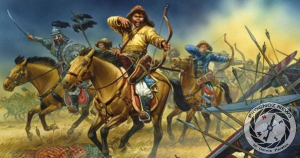
The Golden Horde emerged from the fragmentation of the vast empire forged by Genghis Khan. Following the death of his son Jochi, Jochi’s descendants established dominion over the westernmost territories of the Mongol world. Under rulers such as Batu Khan it extended it authority across the Eurasian steppe, subjugating the fragmented principalities of the former Kievan Rus’. The sack of Kyiv in 1240 marked not merely a military catastrophe, but the symbolic end of an era in which the Slavic lands had possessed a relatively decentralised yet culturally unified political structure.
The political order imposed by the Golden Horde was distinctive. It did not seek to replace local rulers wholesale, nor to impose a uniform administrative system in the manner of later empires. Instead it established a regime of indirect control based upon tribute and recognition of sovereignty. Princes were required to travel to the Horde’s capital at Sarai to receive a patent of authority, known as a yarlyk, legitimising their rule. In return they were expected to collect taxes on behalf of the khan and to suppress dissent within their own territories. This system created a class of intermediaries whose political survival depended upon loyalty to the Horde.
It is within this arrangement that one finds the roots of later Muscovite autocracy. The principality of Moscow rose not through open rebellion, but through collaboration and administrative efficiency. By acting as the Horde’s principal tax collector, the princes of Moscow accumulated both wealth and political leverage. Over time they internalised the mechanisms of centralised control, surveillance and coercion that had characterised Mongol rule. When the power of the Golden Horde began to fragment in the fifteenth century, Moscow was uniquely positioned to inherit its administrative logic while casting off her political subordination.
The contrast with other Slavic regions is instructive. In the territories that would become modern Ukraine and Belarus, Mongol influence was mediated through competing powers, notably the Grand Duchy of Lithuania and later the Polish–Lithuanian Commonwealth. These states absorbed many of the administrative practices of the Rus’ lands without the same degree of direct subordination to the Horde. As a consequence their political cultures developed along more pluralistic and aristocratic lines, characterised by negotiated authority amongst elites rather than the vertical integration of power seen in Moscow.
Yet the influence of the Golden Horde was not limited to administrative structures. She reshaped the geopolitical imagination of Eastern Europe. The experience of subjugation by a mobile, militarised power from the steppe instilled a persistent sense of vulnerability to incursions from the east. At the same time it fostered an appreciation for the strategic depth offered by vast territories and buffer zones. These instincts would later inform the expansionist policies of Muscovy and, eventually, the Russian Empire.
Diplomacy under the Golden Horde also left a durable imprint. The necessity of negotiating with a distant and often unpredictable overlord encouraged a political culture in which flexibility, ambiguity and personal relationships played a central role. Formal institutions were less significant than the ability of individual rulers to secure favour at the khan’s court. This emphasis upon personalised power and informal networks would recur in various forms throughout the political history of the region.
Religious policy offers another dimension of continuity. The Golden Horde, particularly after its conversion to Islam in the fourteenth century, generally permitted the Orthodox Church to operate with relative autonomy. Indeed ecclesiastical authorities were often exempted from taxation. This arrangement strengthened the institutional position of the Church within the Rus’ lands, allowing her to act as a repository of cultural continuity during a period of political fragmentation. In Moscow the alliance between princely and ecclesiastical authority became a cornerstone of state formation, contributing to the later ideology of the “Third Rome”.
The decline of the Golden Horde was gradual and uneven. Internal divisions, economic challenges and the rise of competing powers such as the Ottoman Empire eroded its cohesion. By the late fifteenth century, successor khanates such as Kazan, Astrakhan and Crimea operated with increasing autonomy. The symbolic end of Mongol dominance is often associated with the “Great Stand on the Ugra River” in 1480, when Muscovy refused further tribute. Yet even as political control dissipated, the institutional and cultural legacies of the Horde endured.
In contemporary Eastern Europe, the echoes of this history remain discernible. The centralised state tradition of Russia, with its emphasis upon vertical authority and security-oriented governance, can be traced in part to the administrative practices of the Golden Horde. Conversely the more decentralised and contested political landscapes of Ukraine and Belarus reflect their more complex historical trajectories, in which Mongol influence was filtered through additional layers of European political development.
To attribute these differences solely to the Golden Horde would be reductive. Geography, religion, external alliances and later historical experiences have all played decisive roles. Nevertheless the Horde’s impact constitutes a foundational layer upon which subsequent political forms were constructed. It was not merely an external conqueror, but an architect of systems that outlived is own existence.
In examining the Golden Horde’s influence, one is reminded that empires rarely vanish without residue. Their institutions, habits of governance and modes of thought persist, often in subtle and unacknowledged ways. In Eastern Europe the legacy of the Golden Horde continues to shape the region’s political realities, offering both a historical explanation for present divergences and a cautionary reminder of the enduring power of imperial inheritance.
213 Views



Most Readings