The Smolensk Air Disaster
By Matthew Parish, Associate Editor
Monday 20 April 2026
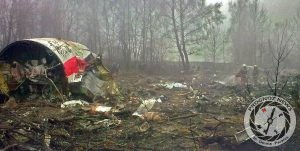
On the morning of 10 April 2010, a Polish Air Force Tupolev Tu-154M descended through dense fog towards the military airfield at Smolensk Severny, carrying the political and military elite of the Polish state. Amongst the ninety-six dead were President Lech Kaczyński, his wife, the chiefs of all branches of the armed forces, the governor of the National Bank, and numerous parliamentarians. The delegation had been travelling to commemorate the Katyn massacre, itself a symbol of Soviet atrocity and historical deception. The resulting disaster — the Smolensk air disaster — was therefore not merely an aviation accident. It became and remains a focal point of geopolitical suspicion, historical grievance, and unresolved questions about Russia’s conduct.
The orthodox account, as presented in the immediate aftermath, is prosaic and tragically familiar. According to the Russian Interstate Aviation Committee, the aircraft descended below minimum altitude in thick fog, ignoring repeated warnings from onboard systems and air traffic control, and struck trees before crashing short of the runway. The investigation found no technical fault with the aircraft and emphasised human error, including the decision to attempt a landing despite unsafe conditions.
Yet even within this official narrative, ambiguities proliferate. Polish investigators accepted that pilot error and poor weather played decisive roles, but they also identified failures on the Russian side: misleading altitude and positioning information from air traffic controllers, inadequate ground infrastructure, and systemic deficiencies at the Smolensk airfield. Thus from the outset the question was not simply whether the crash was accidental, but whether responsibility was shared — and whether that shared responsibility concealed something more troubling.
It is in the interstices of these uncertainties that alternative theories have flourished. Over the years, a succession of Polish political figures and investigative bodies have suggested that the aircraft may have been destroyed in the air, possibly by internal explosions. A Polish government sub-committee in 2018 concluded that the aircraft was “destroyed in the air as a result of several explosions”, while a later report described the disaster as an “act of unlawful interference”. These claims go further still in the political realm: leading figures such as Jarosław Kaczyński have alleged that the crash constituted an assassination ordered at the highest levels of the Kremlin.
However, such assertions exist alongside a substantial body of evidence pointing in the opposite direction. Both the Russian and the initial Polish investigations in 2011 broadly concurred that the crash could be explained by a chain of human errors under conditions of poor visibility. Independent analyses have repeatedly found no conclusive physical evidence of explosives or sabotage. The persistence of conspiracy theories therefore cannot be understood solely as a response to forensic data; it must also be situated within a broader political and historical context.
That context is essential. Polish–Russian relations are marked by centuries of mistrust, partition, occupation, and repression. The Katyn massacre — the very event the delegation was travelling to commemorate — remains emblematic of Soviet duplicity, having been falsely attributed to Nazi Germany for decades before the truth emerged. Against this backdrop the refusal of the Russian Federation to return the aircraft wreckage and original flight recorders to Poland, even years after the investigation concluded, has been perceived not merely as a bureaucratic irregularity but as a continuation of a historical pattern of concealment.
More recent developments have deepened these suspicions. In 2025 Polish prosecutors charged dozens of Russian forensic experts with falsifying autopsy reports relating to the victims, alleging systematic irregularities and manipulation of evidence. Whether or not these allegations bear directly upon the cause of the crash, they reinforce a narrative in which Russian authorities are seen as unreliable custodians of truth. In such an environment, even the absence of evidence can be interpreted as evidence withheld.
The motives attributed to Russia in theories of deliberate causation are varied but broadly coherent. The Polish delegation represented a political leadership that was sceptical of Russian intentions and committed to strengthening NATO ties. The removal of such a leadership cadre, in a single catastrophic event, would have constituted a strategic shock to the Polish state. Yet this line of reasoning encounters a fundamental difficulty: the extraordinary risk such an operation would entail. The exposure of a state-sponsored assassination of a foreign head of state would have precipitated an international crisis of incalculable magnitude. For such an operation to be rational, the benefits would have to outweigh not only the moral cost but the strategic peril — a proposition that remains, at best, speculative.
One must therefore distinguish carefully between suspicion grounded in historical experience and conclusions grounded in demonstrable fact. The Smolensk disaster sits precisely at this uneasy intersection. The inconsistencies in the investigation, the retention of evidence by Russia, and subsequent allegations of misconduct all provide fertile ground for doubt. However the technical evidence available in the public domain continues to support the conclusion that the crash resulted from a convergence of human error, environmental conditions and systemic shortcomings rather than deliberate sabotage.
The enduring power of the Smolensk tragedy lies in this ambiguity. It is not merely an aviation accident, nor simply a political controversy, but a case study in how truth becomes contested when trust between states has eroded. In such circumstances, the boundary between evidence and belief becomes porous. For Poland the disaster is a national trauma intertwined with historical memory; for Russia it is an episode in which defensive opacity has proven strategically counterproductive.
Ultimately the question of Russian responsibility for the Smolensk air disaster may never be resolved to universal satisfaction. The available evidence does not conclusively substantiate the claim of deliberate causation. Yet the conduct of the Russian authorities — their control of the investigation, their reluctance to return material evidence, and the irregularities alleged in subsequent years — has ensured that suspicion endures. In the absence of transparency, doubt becomes inevitable; and in a region shaped by the legacies of empire and war, doubt is rarely a neutral condition.
258 Views



Most Readings