The European Union’s twentieth sanctions package against Russia
By Matthew Parish, Associate Editor
Thursday 23 April 2026
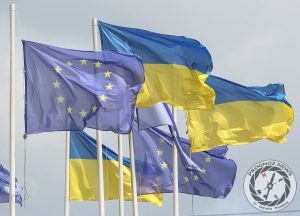
Today the European Union took a step that was at once financial, strategic and psychological. It approved a €90 billion loan facility for Ukraine for the years 2026–2027, while simultaneously adopting its twentieth package of sanctions against the Russian Federation. The coupling of these two measures is not accidental. It reflects a maturing doctrine within European policy — that support for Kyiv and coercion of Moscow must proceed in tandem, each reinforcing the credibility of the other.
The financial dimension is straightforward in its intent but profound in its implications. The €90 billion loan is designed to cover roughly two-thirds of Ukraine’s projected fiscal needs over the next two years, sustaining both the war effort and the continuity of the Ukrainian state — healthcare, education and civil administration included. In practical terms it ensures that Ukraine does not collapse behind the front line. In strategic terms it signals that time — once presumed to favour Moscow — may instead favour Kyiv, provided Western liquidity remains intact.
Yet it is the sanctions package, less visible but no less consequential, that raises the more complex question: can economic pressure meaningfully coerce the Russian Federation into desisting from her invasion?
The twentieth sanctions package is notable not for a single dramatic innovation, but for its cumulative tightening of an already dense web of restrictions. It expands the list of sanctioned entities — dozens more companies and individuals — and targets approximately forty vessels associated with Russia’s so-called “shadow fleet”, used to circumvent oil price caps. It extends financial prohibitions to additional banks and introduces measures against third-country intermediaries in places such as Kyrgyzstan, Laos and Azerbaijan — jurisdictions increasingly used to evade earlier sanctions. It also ventures into newer domains, restricting dealings with Russian crypto-asset providers and certain cybersecurity services.
This pattern — widening, deepening, and closing loopholes — reveals the central dilemma of sanctions policy. The European Union has already imposed unprecedented restrictions on Russian finance, energy exports, technology imports and elite mobility. The marginal utility of each additional package is therefore smaller than the last. Each new measure tends not to strike a fresh sector of vulnerability, but rather to reinforce existing barriers and plug evasions.
The effectiveness of such measures must therefore be assessed not in isolation, but within the broader architecture of economic warfare that has been evolving since 2022.
There is the question of energy revenues — the lifeblood of the Russian war economy. Earlier sanctions sought to cap oil prices and reduce European dependence on Russian hydrocarbons. Yet Russia adapted, redirecting exports to Asia and constructing alternative logistics chains. The targeting of the shadow fleet in this latest package is an attempt to disrupt precisely those adaptations. If enforced rigorously it may raise transport costs, increase insurance risks and reduce net revenue per barrel. However enforcement remains the perennial weakness. The maritime domain is diffuse, and compliance depends upon a mixture of Western insurance markets, flag registries and port authorities, not all of which are aligned.
Then there is the financial system. By extending sanctions to additional banks and to third-country facilitators the European Union seeks to constrict Russia’s access to global finance and complicate settlement mechanisms. Yet Russia has already undergone a partial financial decoupling from the West. She trades increasingly in non-Western currencies, relies upon state-directed capital flows and has developed domestic substitutes for some financial services. The marginal tightening of financial sanctions may therefore increase transaction costs, but it is unlikely, in isolation, to induce strategic capitulation.
There is also the technological dimension. Restrictions on high-technology imports — especially those relevant to military production — have had more tangible effects. Russian industry has been forced to rely upon parallel imports, lower-quality substitutes and reverse engineering. The inclusion of cybersecurity and digital services in the new package suggests an awareness that modern warfare depends as much upon code as upon steel. Yet here again the Russian state has demonstrated resilience, drawing upon domestic capabilities and non-Western suppliers.
One must therefore ask — what is the mechanism by which sanctions are supposed to compel behavioural change?
Economic coercion, in its classical conception, operates by imposing costs so severe that the target state recalculates its strategic objectives. It presumes a rational actor responsive to economic pain and constrained by domestic pressures. In the case of the Russian Federation, both assumptions are problematic.
The Russian political system is highly centralised and insulated from public discontent. Economic hardship, while real, does not translate easily into political constraint. Moreover the Kremlin has framed the war as existential — a narrative that reduces the salience of economic considerations relative to perceived security imperatives.
This does not mean that sanctions are ineffective. Rather their effect is indirect and cumulative. They degrade Russia’s long-term economic potential, reduce her capacity to sustain high-intensity warfare indefinitely, and constrain the quality and quantity of military production. They also impose opportunity costs — foregone growth, technological stagnation, capital flight — that will shape Russia’s post-war trajectory.
However sanctions alone are unlikely to compel an immediate cessation of hostilities. They function less as a lever of sudden coercion than as a slow constriction — a tightening vice rather than a decisive blow.
It is in this context that the €90 billion loan to Ukraine assumes its full significance. If sanctions are a long-term instrument, then Ukraine must be sustained long enough for those long-term effects to matter. The loan ensures precisely that — it buys time. It allows Ukraine to maintain resistance, to continue degrading Russian forces on the battlefield, and to await the cumulative weakening of her adversary.
The European Union’s strategy, as articulated by its leaders, rests upon these two pillars: strengthening Ukraine and increasing pressure on Russia. Neither pillar is sufficient alone. Together they form a coherent, if protracted, theory of victory.
Yet there remains a final consideration — unity. The approval of both the loan and the sanctions package required the lifting of a Hungarian veto, itself linked to disputes over energy flows through the Druzhba pipeline. This episode underscores the fragility of European consensus. Sanctions are only as strong as the political will that sustains them. Divergent national interests — particularly in energy — continue to complicate collective action.
The question is not therefore whether the latest sanctions package will by itself force the Russian Federation to desist. It will not. The more pertinent question is whether, in combination with sustained financial support for Ukraine and continued military resistance, it contributes to a strategic environment in which Russia’s objectives become unattainable or prohibitively costly.
To that question, the answer is cautiously affirmative. The European Union has not found a silver bullet. But it has refined a system of pressure — economic, financial and technological — that, over time, may yet achieve what immediate coercion cannot.
185 Views



Most Readings

Crimea Under Pressure: Ukraine’s Long Campaign Against Russia’s Southern Bastion
99 Views