Prince Harry in Ukraine
By Matthew Parish, Associate Editor
Friday 24 April 2026
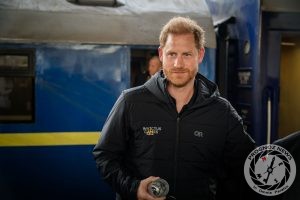
In the spring of 2026 a curious figure stepped quietly across the threshold of a country long accustomed to the noise of war. Prince Harry, once a working royal and now a peripatetic humanitarian, arrived in Ukraine not as a statesman nor as a soldier, but as something less easily defined — a symbol of continuity between the older traditions of European service and the fractured realities of modern conflict.
His visit, understated in choreography but heavy with implication, comes at a time when Ukraine’s war effort has settled into a grinding equilibrium. The front lines shift in metres rather than kilometres; the language of diplomacy is saturated with conditionalities and fatigue. Into this landscape arrives a man whose public life has been defined by departure — from monarchy, from expectation, from the rigid scaffolding of British constitutional ritual — and yet who remains tethered to the idea of duty in ways that are recognisably old-fashioned.
Prince Harry’s connection to the military is neither ornamental nor abstract. His service in Afghanistan, flying Apache helicopters under conditions of genuine risk, established a credibility that distinguishes him from the majority of Western public figures who speak about war only in policy terms. In Ukraine this distinction matters. She is a country that has come to distrust rhetoric divorced from sacrifice — a place where uniforms are not symbolic attire but daily necessities.
There is therefore a certain symmetry in his presence. Ukraine has spent the past decade reconstituting herself as a martial society, albeit one embedded within democratic aspiration. The prince for his part has spent his adult life navigating the tension between inherited identity and chosen purpose. When he meets Ukrainian veterans, as he did during this visit, the conversation is not merely diplomatic theatre. It is rather a dialogue between individuals who understand — albeit in vastly different contexts — the psychological residues of war: dislocation, endurance, and the search for meaning after violence.
Reports suggest that his itinerary included rehabilitation centres for wounded soldiers, as well as discussions with Ukrainian officials about veteran support systems. These are not trivial engagements. Ukraine faces a looming crisis not only of manpower but of memory — how to reintegrate hundreds of thousands of veterans into civilian life without losing the cohesion that wartime has imposed upon her society. Prince Harry’s involvement with initiatives such as the Invictus Games — an international sporting event for wounded service personnel that he founded — offers a template of sorts. It is an attempt to translate military trauma into communal resilience, to render injury not as an endpoint but as a transformation.
Yet the visit is not without its ambiguities. Prince Harry is no longer an official representative of the British Crown. His presence does not carry the formal imprimatur of Buckingham Palace, nor does it signal a shift in British foreign policy. Yet in the theatre of international perception, such distinctions are easily blurred. To many Ukrainians, and indeed to observers elsewhere, the arrival of a British prince — irrespective of his constitutional status — conveys a sense of continued Western engagement at a time when political attention risks drifting.
This ambiguity may in fact be the source of his effectiveness. Freed from the strictures of official diplomacy, Prince Harry operates in a space where symbolism can be more fluid, less constrained by protocol. He can speak with a degree of candour that elected officials often cannot afford. He can embody solidarity without entangling it in the complexities of military aid packages or legislative debates. In a war increasingly defined by its bureaucratic dimensions — funding cycles, procurement delays, alliance negotiations — such human gestures retain a disproportionate emotional weight.
There is also an undercurrent of personal narrative that cannot be ignored. Prince Harry’s relationship with his own country has been marked by estrangement, public dispute, and a reconfiguration of identity. Ukraine too has experienced a profound rupture — a violent severing from the political and cultural orbit of Russia, and an ongoing effort to redefine herself within a European framework. Both stories are, in their own ways, about departure and reconstruction. It is perhaps inevitable that observers would draw parallels, even if they remain imperfect.
The reaction within Ukraine has been measured but appreciative. There is little appetite for celebrity spectacle in a country where daily life is punctuated by air raid sirens. Yet there is recognition that attention — even of a symbolic kind — is a finite resource in international affairs. Prince Harry’s visit serves as a reminder that Ukraine’s struggle has not entirely receded from the consciousness of the West, despite the competing crises that crowd the global stage.
From a geopolitical perspective the visit is unlikely to alter the trajectory of the war. It does not deliver weapons, nor does it shift the calculus of negotiations with Moscow. But to assess it solely in such terms would be to misunderstand the nature of influence in contemporary conflict. Wars are fought not only with matériel and manpower, but with narratives — with the stories that societies tell themselves about endurance, legitimacy and the possibility of eventual victory.
In this domain figures like Prince Harry occupy a peculiar but not insignificant role. They are conduits of attention, carriers of symbolic capital that can be deployed in ways both subtle and resonant. His presence in Ukraine, stripped of formal authority yet rich in associative meaning, exemplifies a broader phenomenon: the diffusion of diplomatic agency beyond the traditional structures of statehood.
Whether this phenomenon is sustainable is another question. Symbolism, like morale, has diminishing returns if not reinforced by tangible outcomes. Ukraine’s needs remain overwhelmingly material — weapons, financing, political guarantees. No number of high-profile visits can substitute for these essentials. But in a war that has stretched the endurance of all involved, even small gestures acquire a cumulative significance.
As Prince Harry departs Ukraine, leaving behind the quiet echoes of his engagements, the war continues much as before. Artillery fires along the eastern front; diplomats exchange carefully calibrated statements; civilians navigate the precarious rhythms of life under threat. Nothing, and everything, had changed. For in the midst of a conflict defined by its brutality, the simple act of showing up — of bearing witness — retains a power that is at once intangible and deeply real.
Harry’s visit may be understood not as an intervention, but as an affirmation. Ukraine remains seen. She remains part of a wider moral landscape in which her struggle is recognised, if not always adequately supported. And in the austere arithmetic of war such affirmations, although insufficient, are rarely meaningless.
197 Views


Most Readings