Private Equity and Post-War Ukraine: Opportunity Amidst Ruin
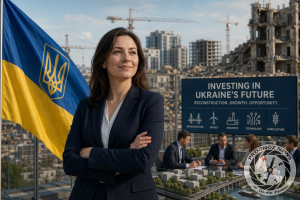
By Matthew Parish, Associate Editor
Friday 24 April 2026
There is a temptation, when contemplating Ukraine’s future, to divide time into two cleanly separated epochs: before the war, and after it. Such a distinction is comforting in its simplicity but it is also misleading. Ukraine’s war, begun in earnest with Russia’s full-scale invasion in 2022 following the earlier rupture of 2014, is not merely an interruption of economic life. It is a crucible in which a new political economy is being forged — one that private equity will inevitably seek to shape, and from which it will seek to profit.
To speak of private equity in the context of a country still at war may appear premature, even distasteful. Yet capital is rarely sentimental. It anticipates. It positions itself early, often quietly, sometimes controversially. In Ukraine’s case the outlines of post-war reconstruction are already sufficiently visible to attract the attention of global funds, sovereign investors and specialist frontier-market financiers. The question is not whether private equity will come. It is what form it will take — and what kind of country it will help build.
Ukraine’s appeal is paradoxically rooted in the scale of her destruction. The physical damage inflicted by Russian aggression — to housing, infrastructure, energy systems and industrial capacity — runs into the hundreds of billions of dollars. Entire cities have been shattered; logistics networks have been severed; power generation has been systematically targeted. Yet from the perspective of capital, such devastation translates into an equally vast reconstruction opportunity. Roads must be rebuilt, grids modernised, housing reconstructed and industry retooled. These are precisely the kinds of large-scale, capital-intensive projects that private equity funds, particularly those specialising in infrastructure and distressed assets, are designed to finance.
But Ukraine offers more than rubble to rebuild. She offers transformation. The war has accelerated structural changes that might otherwise have taken decades. The Ukrainian state has digitised at remarkable speed; corruption, whilst far from eliminated, has been subjected to unprecedented scrutiny; and the country’s geopolitical orientation has decisively shifted westwards. Integration with the European Union is no longer a distant aspiration but an organising principle of policy. Regulatory convergence, judicial reform and the adoption of European standards are not merely political commitments but preconditions for reconstruction financing.
For private equity this matters profoundly. Investors do not simply seek high returns; they seek predictable environments in which those returns can be realised. Ukraine’s pre-war reputation — one of opaque courts, political interference and oligarchic dominance — was a deterrent to all but the most adventurous capital. Post-war Ukraine by contrast is likely to be subject to intense international oversight. Reconstruction funds from the European Union, the United States and international financial institutions will come with conditions — on transparency, procurement and governance. Private equity will follow where these standards are credibly enforced.
And yet the risks remain formidable. Security is the most obvious. A frozen conflict is not peace; it is merely uncertainty institutionalised. Investors must consider not only the possibility of renewed hostilities but also the persistent threat of missile strikes, cyber attacks and sabotage. Insurance markets will struggle to price such risks, and without adequate risk mitigation mechanisms — whether through multilateral guarantees or state-backed insurance schemes — private capital will hesitate.
There is also the question of legal continuity. War disrupts ownership. Assets are destroyed, expropriated or rendered unusable. Title records may be incomplete or contested. Courts, even if reformed, will face an avalanche of disputes. For private equity funds accustomed to rigorous due diligence, Ukraine presents a landscape in which the very foundations of property rights may be uncertain. Innovative legal structures — escrow arrangements, political risk insurance, arbitration frameworks anchored in foreign jurisdictions — will be required to bridge this gap.
Moreover the social dimension cannot be ignored. Private equity is often criticised, sometimes fairly, for prioritising returns over social outcomes. In a post-war context this tension becomes acute. Reconstruction is not merely an economic process; it is a national project imbued with questions of justice, equity and identity. Who benefits from reconstruction contracts? Which regions are prioritised? How are displaced populations reintegrated? If private equity is perceived as extracting value without contributing to social recovery, political backlash will be swift and severe.
This raises the prospect of hybrid models of investment — structures in which private capital is blended with public funds and development finance. Such arrangements, already familiar in emerging markets, allow risks to be shared and returns to be moderated in exchange for broader developmental impact. In Ukraine they may become the dominant paradigm. Funds backed by institutions such as the European Bank for Reconstruction and Development or the International Finance Corporation could play a catalytic role, crowding in private investors by providing first-loss capital or political risk guarantees.
Sectorally, certain areas stand out as particularly attractive. Energy is paramount. Ukraine’s pre-war energy system, heavily reliant on large, centralised generation, has proven vulnerable to attack. Reconstruction offers an opportunity to pivot towards decentralised, renewable energy sources — solar, wind and small-scale generation — combined with modernised grids and storage solutions. Private equity funds with expertise in energy transition will find fertile ground here, particularly if supported by European green financing initiatives.
Agriculture, long the backbone of Ukraine’s economy, also presents opportunities. Despite the war Ukraine remains one of the world’s leading grain exporters. Post-war investment in logistics, storage and processing could significantly enhance value chains, moving the country beyond raw commodity exports towards higher-margin products. Land reform, a politically sensitive issue, will be central to this process — and will determine the extent to which foreign capital can participate.
Technology is another frontier. The war has catalysed a vibrant ecosystem of defence-related innovation, particularly in drones and electronic warfare. Companies such as Ukrspecsystems exemplify a broader trend: the emergence of agile, engineering-driven firms capable of rapid innovation under extreme conditions. Private equity, traditionally less comfortable with early-stage technology than venture capital, may nonetheless find opportunities in scaling such companies for export markets — particularly as demand for defence technology rises across Europe.
Infrastructure, inevitably, will absorb the largest volumes of capital. Transport corridors linking Ukraine to the European Union — rail, road and port facilities — are critical not only for economic recovery but also for geopolitical integration. Investments here are likely to be structured as public-private partnerships, with long-term concessions offering stable, if moderate, returns.
Yet one must be cautious not to romanticise the role of private equity. Capital is not a substitute for state capacity. Ukraine’s success will depend ultimately on the strength of her institutions — her courts, her regulators, her civil service. Private equity can finance reconstruction, but it cannot, by itself, create the rule of law. Indeed without strong institutions, private capital may exacerbate inequalities, entrench monopolies or enable new forms of corruption.
There is therefore a delicate balance to be struck. Ukraine must attract private capital — she cannot rebuild without it. But she must also discipline it, ensuring that investment aligns with national priorities and social needs. This will require a regulatory framework that is both robust and flexible, capable of accommodating complex financial structures while safeguarding the public interest.
Ukraine’s reconstruction may become a laboratory for a new model of post-conflict development — one in which private equity plays a central role, but within a framework shaped by democratic accountability and international partnership. If successful it could offer a template for other countries emerging from conflict. If it fails, it risks becoming another cautionary tale of capital exploiting crisis.
Opportunity amidst ruin is not a slogan; it is a reality. For private equity Ukraine represents one of the most significant investment frontiers of the twenty-first century. For Ukraine private equity represents both a necessity and a risk. The interplay between these two forces will help determine not only the country’s economic future but the character of her peace.
162 Views



Most Readings


Crimea Under Pressure: Ukraine’s Long Campaign Against Russia’s Southern Bastion
98 Views