Artists Under Fire: Creativity as Resistance in Wartime Lviv
By Matthew Parish, Associate Editor
Saturday 25 April 2026
There are cities that endure war as a matter of geography — and there are cities that transform it into a matter of identity. Lviv, long celebrated as a cultural capital of Ukraine, has in the years since the full-scale invasion of Russia in February 2022 become something more intricate and more defiant: a place where art is not merely preserved under duress, but weaponised in the service of national survival.
The phrase ‘artists under fire’ is not metaphorical here. Air raid sirens punctuate rehearsals; galleries operate beneath the shadow of missile strikes; electricity interruptions impose abrupt endings upon performances. Yet in this environment creativity has not withered. Rather it has hardened — acquiring a tensile strength, a clarity of purpose and a moral urgency that peacetime culture rarely demands.
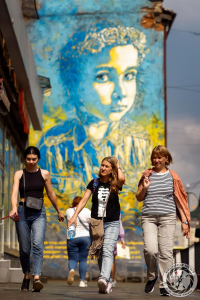
In wartime Lviv, art migrates from the gallery wall into the street — from curated exhibition into immediate declaration. Murals bloom across concrete facades, often painted overnight, their imagery stark and unmistakable: angels in camouflage, mothers holding children beneath the arc of missiles, stylised tridents piercing imperial eagles. These works do not aspire to subtlety; they are designed for legibility in a moment of existential crisis.
This visual language constitutes a form of civic speech. Where formal political discourse may be constrained by diplomacy or fatigue, street art speaks directly and without mediation. It binds the civilian population into a shared narrative of resistance, while simultaneously addressing the foreign observer — the journalist, the volunteer, the diplomat — who passes through Lviv and carries these images outward into the world.
Art becomes both internal glue and external signal. It affirms who the Ukrainians believe themselves to be, and declares who they refuse to become.
Music as Mobilisation
Music in wartime Lviv is rarely detached from purpose. Concerts double as fundraisers; performances are interspersed with appeals for drones, medical supplies, or winter clothing for soldiers at the front. The boundary between artist and activist dissolves.
Institutions such as the Lviv National Opera have continued to function, albeit under altered conditions. Repertoires have shifted subtly but decisively — emphasising Ukrainian composers, reviving works suppressed during the Soviet period, and incorporating contemporary compositions that respond directly to the war. Silence too has become part of the programme: moments of remembrance for the fallen, observed by audiences who understand that the distance between stage and battlefield is measured not in kilometres but in personal connections.
Meanwhile smaller venues and informal spaces proliferate. Cafés host acoustic sets; basements become impromptu concert halls during air raids. Music adapts — stripped down, mobile, resilient. It travels lightly, carrying with it the emotional architecture of a society under strain.
Theatre and the Rehearsal of Trauma
The theatre of wartime Lviv occupies a peculiar space between representation and reality. Plays staged today often draw directly from lived experience — displacement, loss, the fragmentation of families across borders and front lines. Actors perform roles that mirror their own biographies with uncomfortable precision.
This proximity generates a kind of artistic intensity that resists conventional critique. One does not ask whether a performance is ‘convincing’ when the material itself is drawn from ongoing catastrophe. Instead theatre becomes a form of collective processing — a rehearsal not merely of lines but of trauma.
Directors experiment with form. Traditional narratives give way to fragmented structures; documentary theatre incorporates testimony from soldiers, refugees, and volunteers. The stage becomes an archive in motion, preserving voices that might otherwise be lost amid the statistical abstractions of war reporting.
Literature and the War of Memory
If visual art and music operate in the immediacy of the present, literature in Lviv engages in a longer struggle — the contest over memory. Writers document not only events but meanings: what this war signifies for Ukrainian identity, for European security, for the moral imagination of the twenty-first century.
Public readings have acquired an almost liturgical character. Audiences gather to hear poetry and prose that attempt to articulate experiences for which ordinary language proves insufficient. There is a palpable awareness that these texts may outlast the war itself — that they will shape how future generations understand what has occurred.
The written word thus becomes a defensive structure against erasure. Where the aggressor seeks to rewrite history — to deny Ukrainian statehood, culture, or distinctiveness — literature insists upon specificity, upon voice, upon the irreducible complexity of lived experience.
The Economics of Survival
Behind this flourishing of creativity lies a more precarious reality. Artists must eat, pay rent, support families — often while contributing directly to the war effort. The traditional economic infrastructure of culture has been disrupted: tourism has declined; international exhibitions are more difficult to organise; domestic audiences face financial constraints.
Yet new mechanisms have emerged. Crowdfunding platforms, international residencies, and partnerships with foreign cultural institutions provide lifelines. The diaspora plays a critical role, amplifying Ukrainian artists abroad and facilitating access to resources.
Here one observes a subtle but significant transformation. Art is no longer insulated from economic and political realities; she is entangled within them. Financial support for artists becomes in effect a contribution to national resilience.
Creativity as Strategic Communication
To view artistic activity in Lviv purely through a cultural lens would be to miss its strategic dimension. Art functions as a form of communication — not merely expressive but persuasive. It shapes international perceptions of Ukraine, countering narratives propagated by Russia and her allies.
Images of vibrant cultural life in wartime challenge the portrayal of Ukraine as a passive victim. They present her instead as an active, creative, and enduring society — one worth supporting, one capable of renewal. In diplomatic terms this constitutes soft power; in human terms it is an assertion of dignity.
The relationship between art and war is therefore reciprocal. Conflict imposes constraints upon creativity, but also supplies it with urgency and meaning. In Lviv this relationship has reached an acute intensity — producing a cultural landscape that is at once fragile and formidable.
The Unquiet Future
Lviv’s artists do not imagine that their work can end the war. They are not naïve in this regard. Yet they understand that the outcome of conflict is determined not only by military capacity but by the endurance of identity — by the capacity of a people to continue believing in themselves under conditions designed to extinguish that belief.
Creativity becomes a form of resistance no less vital than armed defence. It sustains morale, preserves memory, and communicates purpose. It ensures that even under fire, the city does not merely survive — it speaks.
And in speaking, Lviv refuses silence.
177 Views



Most Readings