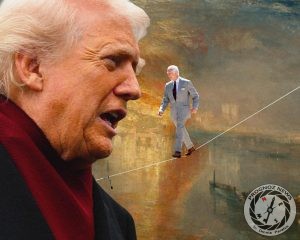
King Charles III’s high wire diplomacy in the United States
By Matthew Parish, Associate Editor
Saturday 25 April 2026
The forthcoming visit of King Charles III to the United States arrives at a moment of subtle but unmistakable strain within Anglo-American diplomacy. Such visits, once ritualised affirmations of a “special relationship”, now unfold against a shifting geopolitical landscape in which sentiment, history and strategic necessity do not always move in harmonious alignment. The pageantry will be immaculate; the underlying questions less so.
At its core Anglo-American diplomacy has always been an exercise in reconciling asymmetry. Since the mid twentieth century, the United Kingdom has been the junior partner to the United States, yet one endowed with disproportionate cultural influence, diplomatic reach and historical legitimacy. The Crown, embodied in the person of King Charles III, plays a peculiar but important role in sustaining this equilibrium. He is not a political actor, yet he symbolises continuity, stability and a certain civilisational narrative that Washington still finds useful, even if it no longer fully comprehends it.
The first challenge facing this visit lies in the transformation of American politics itself. The United States of the 2020s, under the influence of populist currents and increasingly polarised domestic discourse, no longer regards alliances with the same reflexive certainty. The presidency of Donald Trump, whether one views it as an aberration or a harbinger, revealed a willingness to instrumentalise alliances for immediate advantage. Trade disputes, rhetorical dismissals of multilateralism and an overt scepticism towards European security commitments have all left their residue. Even where administrations change the underlying electorate remains divided, and British diplomacy must now navigate not one America but several competing visions of it.
This fragmentation complicates the role of royal diplomacy. A state visit by a British monarch is intended to transcend partisan lines, appealing instead to shared heritage and mutual respect. Yet in an era in which even historical narratives are contested, such symbolism risks being interpreted through ideological lenses. To some Americans the monarchy represents tradition and continuity; to others it is an anachronism or worse, a reminder of colonial subjugation. The Crown must therefore perform a delicate balancing act: projecting relevance without presumption, dignity without distance.
A second challenge lies in the evolution of the strategic environment, particularly in relation to the war in Ukraine. The United Kingdom has positioned herself as one of Kyiv’s most steadfast allies, often adopting a more forward-leaning posture than her European counterparts. The United States remains indispensable in terms of military and financial support, yet her internal debates over the scale and duration of that support have introduced uncertainty. Anglo-American alignment on Ukraine is strong in principle, but increasingly contingent in practice.
In this context, the visit of King Charles III cannot be divorced from broader questions of Western cohesion. The monarch’s public statements are carefully calibrated, yet his long-standing interest in environmental issues, interfaith dialogue and sustainable development subtly expands the scope of diplomatic engagement beyond traditional security concerns. This breadth is both an asset and a complication. It allows Britain to project soft power across multiple domains, but it also risks diluting focus at a time when hard security questions dominate the agenda.
Economic relations present a third axis of difficulty. Despite periodic discussions, a comprehensive bilateral trade agreement between the United Kingdom and the United States remains elusive. Regulatory divergence, domestic political constraints and differing priorities have all contributed to this impasse. The symbolism of a royal visit cannot obscure the reality that economic diplomacy requires sustained negotiation, compromise and political capital. In an American context increasingly wary of globalisation, British appeals to shared economic interests must be framed with particular care.
There is also the question of global perception. Anglo-American diplomacy does not operate in a vacuum; it is observed, interpreted and sometimes contested by other powers. China in particular watches such displays of unity with scepticism, perceiving them as remnants of a Western-centric order that she seeks to reshape. Meanwhile countries in the Global South may view the spectacle with ambivalence, recognising its historical significance while questioning its contemporary relevance. The challenge for Britain is to ensure that her relationship with the United States is not seen as exclusionary or nostalgic, but as part of a broader commitment to a rules-based international system.
Underlying all these considerations is a deeper, almost philosophical tension. The “special relationship” has always been sustained as much by myth as by material interest. It rests upon shared language, legal traditions and cultural affinities that are real but not immutable. As both societies evolve, these commonalities must be actively maintained rather than passively assumed. The visit of King Charles III is therefore not merely ceremonial; it is an attempt to reaffirm a narrative that requires constant renewal.
Yet renewal is not guaranteed. The United Kingdom herself faces questions about her global role in the aftermath of Brexit, while the United States grapples with her own identity as a superpower in a multipolar world. In such circumstances diplomacy must become more adaptive, more nuanced and more attentive to domestic as well as international audiences.
The imminent visit will no doubt succeed in its immediate objectives. Speeches will be delivered, banquets held and photographs taken. But the true measure of its success will lie in whether it can subtly recalibrate Anglo-American diplomacy for an era in which neither sentiment nor strategy alone is sufficient. It is in this quiet recalibration, rather than in the visible ceremony, that the future of the relationship will be decided.
177 Views



Most Readings