Change and continuity in Transnistria
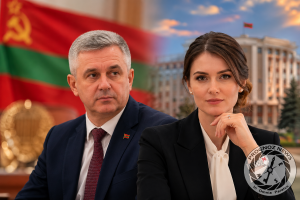
By Matthew Parish, Associate Editor
Wednesday 29 April 2026
The approaching constitutional term limit of the Transnistrian presidency—set at two consecutive five-year mandates—has once again exposed the peculiar mechanisms by which continuity of governance is maintained in one of Europe’s most durable “frozen conflicts”. Transnistria, a narrow strip of land along the eastern bank of the Dniester, has long combined the outward forms of a sovereign polity with the inward logic of a controlled corporate system. Its institutions—presidency, parliament, judiciary—exist, yet they function within a political economy profoundly shaped by a single commercial conglomerate: Sheriff.
In such a system, continuity is not merely a constitutional question; it is an economic and managerial imperative.
Constitutional form and informal succession
Formally the Transnistrian state resembles a semi-presidential republic. The presidency is directly elected and limited to two consecutive terms, while the unicameral Supreme Council provides legislative oversight. Yet formalism alone does not explain how stability is preserved. The abolition of the vice-presidential office in 2011 removed a conventional line of succession, leaving the premiership and parliamentary leadership as the principal institutional reservoirs of continuity.
Over time a pattern has emerged that is neither codified nor accidental. Both Yevgeny Shevchuk and Vadim Krasnoselskyascended to the presidency after serving as speakers of the Supreme Council. This informal pathway has become in effect a mechanism of elite consensus: leadership is rehearsed within the legislature before being transferred to the executive.
It is in this context that the swift rise of Tatyana Zalevskaya must be understood. Elected in 2025 as chair of the Supreme Council at the age of thirty-two, she occupies precisely the institutional position from which previous presidents have emerged. Her emphasis on “united teamwork” between legislature and executive is not rhetorical flourish but a signal of systemic alignment, suggesting that continuity will be orchestrated through coordination rather than contestation.
The corporate state as guarantor of stability
To speak of Transnistrian governance without reference to Sheriff is to omit the central pillar of the system. Founded in the early 1990s, the conglomerate has expanded to dominate nearly every profitable sector of the territory’s economy—from retail and telecommunications to media and energy. Its influence extends into politics through its close association with the Renewal party, which has repeatedly secured parliamentary majorities.
This fusion of economic and political authority produces what might be termed a corporate state. Decision-making is not dispersed among competing interest groups but concentrated within a network of business and political elites whose incentives are aligned. Continuity of government therefore is less about electoral legitimacy than about maintaining the operational stability of this network.
Recent parliamentary elections reinforce this interpretation. All seats in the Supreme Council were secured by Renewal, the party aligned with Sheriff interests, consolidating legislative unanimity. In such an environment leadership transitions can be managed internally, reducing the risk of fragmentation at moments of constitutional change.
Economic crisis and the necessity of managed succession
If the political system is tightly controlled, the economic environment is anything but stable. Transnistria’s longstanding dependence on subsidised Russian gas has become a structural vulnerability. The disruption of gas supplies in 2025 triggered industrial shutdowns, energy shortages, and a broader contraction in economic activity. The region’s industrial base, heavily reliant on cheap energy, proved incapable of sustaining itself under market conditions.
This crisis is not merely cyclical but existential. Up to 60 percent of economic activity is tied to energy inputs whose supply is increasingly uncertain. Trade patterns have shifted away from Russia towards the European Union and Moldova, altering the external dependencies that once underpinned the system. Meanwhile demographic decline and the prospect of economic implosion threaten to erode the social foundations of the polity.
In such circumstances continuity of government becomes inseparable from continuity of economic management. The ruling elite must ensure that leadership transitions do not disrupt the delicate balance between internal control and external dependency. The rise of a younger figure such as Zalevskaya may reflect an attempt to adapt—to present a technocratic, managerial face capable of navigating new economic realities while preserving the underlying structure of power.
Political transformation without pluralism
The emergence of Zalevskaya also signals a generational shift. Unlike her predecessors, who were shaped by the Soviet collapse and the conflicts of the 1990s, she represents a cohort educated in administrative and managerial disciplines. Her academic background in public administration and sociology of management suggests a technocratic orientation aligned with the needs of a corporate state.
Yet this transformation should not be mistaken for liberalisation. Electoral participation has declined, and the political system remains tightly controlled, with outcomes that are not recognised internationally. The appearance of renewal masks a deeper continuity: the consolidation of power within a narrow elite.
In this sense, Transnistria exemplifies a broader phenomenon in post-Soviet politics—what might be termed adaptive authoritarianism. Institutions evolve, personnel changes and rhetoric modernises, yet the fundamental distribution of power remains unchanged. Continuity is achieved not by resisting change, but by absorbing it.
Continuity as a system, not a moment
The forthcoming presidential transition, necessitated by term limits, will therefore be less a rupture than a recalibration. The mechanisms ensuring continuity are already in place: a dominant corporate actor, a unified legislature, an established informal pathway to the presidency, and a political culture that prioritises stability over competition.
What is uncertain is whether these mechanisms can withstand the pressures now bearing down upon the region. Economic crisis, shifting geopolitical alignments and the gradual erosion of Russian support are testing the resilience of the Transnistrian model. The corporate state may manage succession, but it cannot indefinitely insulate itself from structural change.
The rise of Zalevskaya then is emblematic. It represents both continuity and adaptation—a new face within an old system, tasked with preserving a political order whose foundations are increasingly fragile. In Transnistria governance persists not because it is uncontested, but because it is carefully managed. Whether such management can endure in the face of mounting economic and geopolitical strain remains the central question for the years ahead.
178 Views



Most Readings