NAFO labelled a hacker organisation by the Russian Federation
By Matthew Parish, Associate Editor
Wednesday 29 April 2026
The decision by the Russian authorities to designate the North Atlantic Fella Organisation, or NAFO, as a “hacker group” is less an exercise in technical classification than an act of political rhetoric. It illustrates with unusual clarity how modern war is fought not only with artillery and drones but with labels, narratives and the manipulation of categories themselves. The story of NAFO is not merely about internet culture; it is about the evolution of power in an age where humour, decentralisation and digital participation have become instruments of strategic consequence.
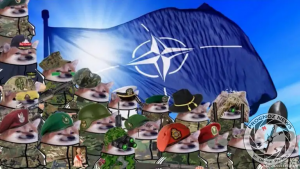
To understand the controversy, one must first appreciate what NAFO actually is. Emerging in 2022 amid the full-scale Russian invasion of Ukraine, NAFO is best described as a decentralised online movement that uses memes, satire and collective participation to counter Russian propaganda. North Atlantic Fella Organisation participants typically adopt avatars based on the Shiba Inu “doge” meme and engage in what might loosely be called digital ridicule—responding to pro-Kremlin narratives with mockery, fact-checking and coordinated social amplification.
At first glance this appears trivial, even absurd. Cartoon dogs replying to diplomats would seem an unlikely force in geopolitics. Yet this superficial frivolity conceals a deeper strategic logic. Analysts have noted that NAFO functions as a form of information warfare, a “civil society response” to state-sponsored disinformation campaigns. Its members raise funds for Ukrainian units, disrupt online propaganda networks and, perhaps most importantly, erode the aura of authority upon which authoritarian messaging depends. The movement’s success lies not in secrecy or technical sophistication but in visibility and participation. It invites anyone with an internet connection to become, however modestly, a participant in the war effort.
Herein lies the reason for Moscow’s discomfort. Traditional cyber warfare—conducted by groups such as Fancy Bear or Sandworm—is hierarchical, deniable and rooted in technical expertise. These organisations employ malware, phishing and network intrusion to achieve strategic effects. By contrast, NAFO operates without central command, without classified tools and without formal membership. It is not a “group” in the conventional sense at all, but a swarm—fluid, adaptive and resistant to control.
The designation of NAFO as a “hacker group” therefore represents a deliberate category error. It conflates two entirely different modes of digital conflict: cyber operations, which involve penetrating systems, and information operations, which involve shaping perception. This conflation is politically useful. By labelling NAFO as a hacking entity, Russian authorities can reframe a grassroots, largely humorous movement as a hostile, quasi-military threat. In doing so, they justify censorship, criminalisation and diplomatic protest under the language of cybersecurity rather than that of public discourse.
This tactic has precedent. Authoritarian regimes have long sought to redefine dissent as subversion, protest as extremism and satire as sabotage. What is novel in the NAFO case is the scale and speed at which such redefinitions must now operate. The digital environment collapses the distance between citizen and combatant. When thousands of individuals can collectively undermine a state narrative in real time, the boundary between civilian expression and strategic action becomes blurred.
NAFO’s effectiveness rests on several interlocking features, each of which challenges traditional assumptions about power. First there is humour. Authoritarian systems depend upon seriousness—upon the projection of inevitability and control. Humour punctures this façade. By reducing official statements to objects of ridicule, NAFO participants strip them of their psychological authority. The Russian state, like many before it, finds mockery more difficult to counter than criticism. One can refute an argument; it is far harder to rebut a joke.
Then there is decentralisation. NAFO has no headquarters to raid, no leader to arrest, no infrastructure to dismantle. It resembles in this respect earlier phenomena of digital mobilisation, yet with a distinctive wartime focus. Its participants are dispersed across jurisdictions, languages and legal systems. Attempts to suppress it risk amplifying it, as each act of censorship becomes itself a subject of ridicule and mobilisation.
There is also the fusion of information and material support. NAFO is not merely a discursive phenomenon; it has raised significant funds for Ukrainian units and associated causes. This linkage between online participation and tangible assistance blurs the line between symbolic and material contribution. It transforms what might otherwise be dismissed as mere “posting” into a form of civic engagement with measurable outcomes.
From the perspective of the Russian state these characteristics are destabilising. They represent a form of participation that cannot be easily controlled, predicted or countered through conventional means. The instinctive response is therefore to assimilate NAFO into familiar categories—hacker group, extremist organisation, foreign agent—through which the machinery of state power can be mobilised.
Yet this response may be strategically misguided. By elevating NAFO to the status of a formal adversary the Russian authorities risk conferring upon it a legitimacy and coherence that it does not inherently possess. The strength of NAFO lies precisely in its informality. It is a culture rather than an institution, a practice rather than a programme. To treat it as a structured enemy is to misunderstand its nature.
More broadly the episode reveals a transformation in the conduct of war. The conflict in Ukraine has demonstrated that information space is not merely an adjunct to the battlefield but a domain of contestation in its own right. Truth, falsehood, humour and narrative circulate with a speed and reach that rival physical manoeuvre. As one analyst has observed, the war has enabled ordinary individuals to “become a warrior… to fight against evil” through the repetition and amplification of truthful information.
In this environment the distinction between professional and amateur, soldier and civilian, becomes increasingly porous. NAFO exemplifies this shift. It is neither an army nor a mere audience; it occupies an intermediate space that traditional categories struggle to describe. Its designation as a “hacker group” is therefore less an accurate description than a symptom of conceptual strain.
For Ukraine and her supporters NAFO represents an opportunity. It demonstrates that democratic societies possess a latent capacity for mobilisation that extends beyond formal institutions. It suggests that the defence of truth need not be confined to governments or media organisations, but can be undertaken by networks of individuals acting in concert.
For Russia however NAFO poses a dilemma. To ignore it is to allow it to operate unchecked; to confront it is to risk legitimising and amplifying it. The attempt to resolve this dilemma through misclassification—by calling it something it is not—may offer short-term rhetorical advantage, but it does little to address the underlying challenge.
The significance of NAFO lies not in the cartoons it produces but in the questions it raises. What constitutes participation in war? Where does propaganda end and civic engagement begin? And how should states respond when the instruments of influence are no longer monopolised by governments but distributed across global networks of individuals?
These are questions for which there are no settled answers. Yet the Russian designation of NAFO as a hacker group suggests that, for now, states remain inclined to interpret new phenomena through the lens of old categories. The risk is that in doing so they misunderstand the nature of the conflict they are engaged in—and the sources of power that will determine its outcome.
195 Views



Most Readings