The vulnerability of Russia’s Tuapse refinery
By Matthew Parish, Associate Editor
Wednesday 29 April 2026
The Russian Black Sea port of Tuapse — a modest resort town in peacetime — has, during the war, become a focal point of a far larger economic struggle. At its centre lies the Tuapse refinery, an industrial complex whose importance to the Russian Federation far exceeds its geographical footprint. It is not merely an oil-processing installation; it is a junction point where extraction, refinement, maritime logistics and export revenues converge — and therefore a pressure point in the Russian war economy.
Repeated Ukrainian strikes upon this facility represent not isolated tactical gestures, but a sustained campaign aimed at exploiting precisely that vulnerability.
The structure of the refinery’s importance is straightforward. Operated by Rosneft and processing approximately 12 million tonnes of crude oil annually — roughly 240,000 barrels per day — the Tuapse refinery is a major export-oriented installation, producing diesel, fuel oil and other refined products for shipment abroad. Its location is decisive. Situated directly on the Black Sea, it is effectively Russia’s principal oil-processing and export hub on that coastline, integrating refining capacity with port infrastructure in a single node.
This integration is both its strength and its weakness.
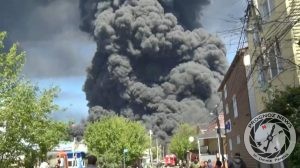
When Ukrainian unmanned aerial systems strike Tuapse, they do not merely damage storage tanks or pipelines; they interrupt an entire chain of economic activity. Fires in April 2026 forced the refinery to halt operations, not simply because refining capacity was impaired, but because port facilities — the essential means of export — were rendered unusable. In effect the refinery becomes economically inert even if portions of its industrial plant remain technically intact.
This is the essence of strategic interdiction: disabling a system by targeting its narrowest bottleneck.
The repeated nature of the strikes magnifies the effect. A single attack might be absorbed — repaired, rerouted, compensated for by other facilities. But three strikes in less than two weeks, as reported in April 2026, create a different phenomenon altogether — not destruction but paralysis. Fires reignite before previous damage is repaired; storage capacity becomes unusable; insurers withdraw or increase premiums; logistical planning becomes uncertain. The refinery ceases to be a predictable contributor to state revenue and becomes instead a recurring liability.
From an economic perspective, the consequences extend well beyond Tuapse itself.
Russia’s federal budget is structurally dependent upon hydrocarbon revenues. Oil and refined products generate foreign exchange earnings that sustain the rouble, finance imports and underpin military expenditure. Disruptions at export-oriented refineries therefore translate directly into fiscal pressure. Ukrainian analysis suggests that strikes on Black Sea oil infrastructure have already contributed to a significant contraction in maritime export capacity — in some estimates approaching 40 per cent during periods of peak disruption. Even if such figures fluctuate, the underlying dynamic remains: reduced throughput at export terminals constrains revenue flows.
There is also a temporal dimension to this pressure. Oil markets are not static. Delays in shipment, even of a few days, can disrupt contractual obligations, create storage bottlenecks upstream and force producers to discount prices. Repeated uncertainty compounds these effects. Buyers may seek alternative suppliers; shipping routes may be reconfigured; and the reliability premium attached to Russian exports diminishes.
Yet the economic consequences are not purely financial. They are also psychological and administrative.
The Tuapse strikes bring the war visibly onto Russian territory, into a region associated not with front-line combat but with tourism and civilian life. Fires, evacuations and reports of toxic emissions — including benzene and so-called “black rain” — transform a distant conflict into a domestic experience. This imposes indirect costs upon the Russian state: the diversion of emergency resources, the need for internal security measures, and the management of public perception.
Moreover the repeated targeting of a single facility imposes a burden of defence. Air defence systems must be deployed and redeployed; redundancies must be constructed; protective measures must be implemented across a wide network of infrastructure. Each of these responses consumes resources that might otherwise be directed towards offensive operations or economic stabilisation.
It would however be a mistake to assume that such strikes alone are sufficient to cripple the Russian economy. Contemporary reporting indicates that while Ukrainian attacks have caused significant disruption and environmental damage, Russia’s broader oil sector has thus far demonstrated resilience, supported in part by global price dynamics and alternative export routes. The effect is therefore cumulative rather than decisive — a gradual erosion rather than a sudden collapse.
This distinction is critical. The economic strategy implicit in the targeting of Tuapse is not one of immediate destruction, but of sustained attrition. Each strike degrades infrastructure, increases costs, reduces predictability and forces compensatory expenditure. Over time these pressures accumulate — narrowing margins, complicating logistics and constraining strategic choices.
In this sense, the Tuapse refinery is emblematic of a broader transformation in modern warfare. The battlefield is no longer confined to trenches or front lines; it extends into the industrial systems that sustain a state’s capacity to fight. Oil refineries, ports and logistics hubs become targets not because they are symbolic, but because they are structural — because they sit at the intersection of economic power and military capability.
Ukraine’s repeated strikes upon Tuapse therefore reveal a clear strategic logic. By targeting a single, highly integrated node within Russia’s energy export system, she imposes disproportionate costs — economic, logistical and psychological — upon a far larger adversary.
The refinery burns — and with it, incrementally, so too does the financial architecture that sustains the war.
198 Views



Most Readings