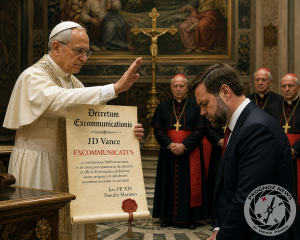
Should Pope Leo XIV excommunicate JD Vance?
By Matthew Parish, Associate Editor
Wednesday 6 May 2026
The suggestion that a Pope might excommunicate JD Vance would, at first glance, appear theatrical — a relic of medieval ecclesiastical power projected onto the theatre of contemporary American politics. Yet the idea is neither wholly fanciful nor entirely without precedent. Within the long institutional memory of the Catholic Church, excommunication has served as both a spiritual sanction and a political instrument — a means of drawing boundaries where doctrine, authority, and temporal conduct collide.
To understand whether such a step could be justified, one must begin with the theology. Excommunication is not, in its formal conception, a punishment in the secular sense — it is medicinal. The Church’s own canon law presents it as a remedy designed to bring the errant soul back into communion. The act excludes an individual from the sacraments — most notably the Eucharist — not as an expression of vengeance, but as a signal that their conduct has placed them in a state incompatible with full participation in the life of the Church.
This distinction matters — because it imposes a high threshold. A Catholic public figure is not excommunicated merely for holding controversial views, nor even for engaging in morally questionable political activity. The canonical grounds tend to be specific and grave: heresy, schism, apostasy, or certain defined acts such as procuring abortion. The question, therefore, becomes whether the public conduct or advocacy of a figure such as Vance could plausibly fall within these categories.
The difficulty is that modern political life rarely maps cleanly onto classical theological categories. Vance, a convert to Catholicism, inhabits a political tradition in the United States that often blends nationalism, populism, and a selective invocation of Christian identity. The tension emerges where such positions appear to conflict with core elements of Catholic social teaching — particularly the dignity of migrants, the universality of human rights, and the Church’s longstanding suspicion of ethnically defined political communities.
Under the current pontificate of Pope Francis, these themes were emphasised with unusual clarity. Migration, in particular, has become a defining moral axis. Pope Leo XIV has repeatedly framed the treatment of migrants not as a policy preference but as a test of Christian fidelity. In such a framework, political rhetoric or action that appears to dehumanise or exclude may be interpreted not merely as imprudent, but as morally disordered.
Yet even here, the leap to excommunication is substantial. Catholic theology has historically tolerated a wide range of prudential disagreement in politics — recognising that faithful Catholics may differ on how best to apply moral principles in complex circumstances. To excommunicate a political figure for their policy positions would risk collapsing this distinction, transforming the Church from a moral authority into a partisan actor.
History offers instructive parallels — and warnings.
In the eleventh century, Pope Gregory VII excommunicated Henry IV during the Investiture Controversy. This was not merely a theological dispute but a struggle over authority — who had the right to appoint bishops, and therefore who controlled the spiritual infrastructure of Europe. Excommunication here functioned as a weapon of institutional survival. It destabilised Henry’s rule, forcing his famous penitent journey to Canossa. The episode demonstrates the potency of excommunication when Church and state are entwined — but it also reflects a world in which such entanglement was assumed.
A later case — the condemnation of Martin Luther by Pope Leo X in 1521 — illustrates a different dimension. Luther’s excommunication followed a direct doctrinal challenge to the authority and teachings of the Church. Here the boundary was unmistakable: it was a matter of heresy. Yet the result was not reconciliation but schism — a fragmentation of Western Christianity that persists to this day. The lesson is that excommunication, while intended as corrective, can accelerate division when the underlying conflict is structural rather than personal.
More recently excommunication has been deployed with far greater restraint. The Church has generally avoided direct confrontation with modern political figures, even when their conduct appears sharply at odds with Catholic teaching. There have been exceptions — notably in Latin America, where clergy associated with authoritarian regimes or revolutionary movements have occasionally faced sanction — but these have rarely involved globally prominent lay politicians.
The modern reluctance reflects a changed context. The Church no longer commands the coercive social power it once did. Excommunication today is largely symbolic — its force depends on the individual’s own belief in the authority of the Church and their desire to remain within it. In a pluralistic society, the sanction risks irrelevance if the recipient simply disregards it — or, worse from the Church’s perspective, converts it into a badge of political authenticity.
In the case of Vance, this risk would be acute. American political culture is adept at transforming institutional censure into populist capital. An excommunication could be reframed not as a spiritual rebuke but as evidence of conflict between a “globalist” Church hierarchy and a nationalist political movement. Far from inducing repentance, it might deepen the very divisions the Church seeks to heal.
There is also the question of consistency. If the Pope were to excommunicate a figure like Vance for positions on migration or nationalism, what of other Catholic politicians whose actions diverge from Church teaching on issues such as war, economic justice or environmental stewardship? The Church’s moral doctrine is comprehensive — selective enforcement risks undermining its credibility.
And yet — the idea persists, because it speaks to a genuine tension within contemporary Catholicism. The Church claims universal moral authority — yet it operates within political systems that are increasingly polarised and ideologically rigid. When a prominent Catholic figure appears to align their public identity with positions that contradict core teachings, the question arises: where is the line?
Theologically, that line remains tied to formal rupture — heresy, schism, or explicit rejection of doctrine. Politically, however, the pressure to act symbolically is growing. The Pope is not merely a theologian — she is also a global moral voice. Silence, in certain contexts, can be interpreted as acquiescence.
Ultimately the likelihood of excommunication in such a case remains low — not because the Church lacks the authority, but because it understands the limits of its effectiveness in the modern world. The deeper challenge is not how to punish errant political figures, but how to articulate a coherent moral vision that transcends the categories of contemporary politics.
Excommunication is a blunt instrument — forged in an era when spiritual and temporal authority were inseparable. To deploy it today against a figure like JD Vance would be to revive that instrument in a world that no longer shares its assumptions. Whether such an act would restore unity or merely dramatise division is a question that history, more often than not, has answered with caution.
153 Views



Most Readings