Ukraine’s and Russia’s rival ceasefires
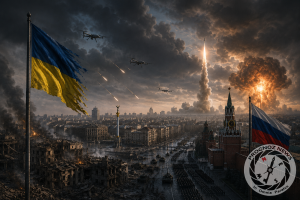
By Matthew Parish, Associate Editor
Wednesday 6 May 2026
Russia’s and Ukraine’s rival unilateral ceasefires in advance of the 9 May Victory Day commemorations reveal less about any serious appetite for peace than about the political and military anxieties of both sides as the war enters yet another dangerous phase. What has emerged over the first week of May 2026 is a peculiar combination of symbolic diplomacy, nuclear signalling, psychological warfare and tactical military manoeuvring, all compressed into a few days surrounding one of the Kremlin’s most politically sacred holidays.
President Vladimir Putin’s declaration of a two-day ceasefire for 8–9 May was presented by Moscow as a humanitarian gesture linked to the eighty-first anniversary of the Soviet victory over Nazi Germany. Yet the accompanying threat fundamentally altered the character of the proposal. Russia’s Ministry of Defence warned that any Ukrainian attempt to disrupt the Moscow parade would provoke a “massive missile strike” against central Kyiv and even advised civilians and foreign diplomatic personnel to leave the city.
This was not the language of de-escalation. It was the language of coercive deterrence.
President Volodymyr Zelenskyy responded by announcing Ukraine’s own unilateral ceasefire beginning earlier than the Russian proposal, while simultaneously accusing Moscow of continuing missile and drone attacks despite its public rhetoric about peace. Reuters, Associated Press and multiple other outlets reported continued Russian strikes during the supposed period of reduced hostilities, with hundreds of ceasefire violations alleged by Kyiv.
The mutual accusations are almost certainly true simultaneously. Neither side trusts the other sufficiently to suspend military operations entirely, especially at a moment when symbolic vulnerability carries strategic significance.
Victory Day occupies a unique position within modern Russian political mythology. Under Putin, the annual parade on Red Square has evolved from a memorial event into a ritual affirmation of state continuity, military power and civilisational destiny. Since the full-scale invasion of Ukraine in 2022, however, the parade has acquired a more defensive and anxious quality. Reports that this year’s parade has been scaled down, with reduced heavy equipment and extraordinary security precautions, indicate that the Kremlin genuinely fears Ukrainian long-range drone or missile strikes against Moscow itself.
Ukraine therefore possesses a rare form of strategic leverage. She cannot presently conquer Russian territory in any decisive manner, but she can threaten humiliation. The possibility that drones might penetrate Moscow’s air defences during the state’s most sacred militarised ceremony would represent a profound symbolic embarrassment for the Kremlin. This explains why Russia’s warnings have become so explicit.
Yet it is precisely because the symbolism matters so much that both sides may ultimately exercise restraint.
Ukraine understands that a direct strike upon Red Square during the parade, particularly if foreign dignitaries are present, could trigger a disproportionate Russian response. Moscow has already signalled that it wishes to frame any such attack not merely as a battlefield incident but as an assault upon Russian historical identity itself. The Kremlin would likely use such an event to justify a major escalation campaign against Ukrainian urban infrastructure.
That escalation would probably not take the form of nuclear weapons use. Despite increasingly frequent Russian nuclear rhetoric throughout the war, Moscow has remained careful to preserve a distinction between demonstrative signalling and actual nuclear employment. The recent testing and public discussion of nuclear-capable ballistic missile systems therefore appears primarily designed to reinforce psychological intimidation rather than to prepare for imminent strategic nuclear exchange.
Russia’s references to intercontinental ballistic missiles are especially significant because they blur the line between conventional and nuclear signalling. Modern Russian systems such as the RS-24 Yars and RS-28 Sarmat are explicitly associated with strategic nuclear deterrence. Even if launches are technically routine tests, conducting or publicising them during a moment of heightened tension serves an unmistakable political purpose.
The Kremlin is attempting to remind both Ukraine and NATO that Russia remains a nuclear superpower regardless of her difficulties on the conventional battlefield.
Moscow has increasingly experimented with intermediate-range and quasi-strategic missile demonstrations intended to create ambiguity without crossing the nuclear threshold. The previous use of the Oreshnik system against Ukraine demonstrated precisely this logic: a missile associated with strategic delivery systems used in a non-nuclear role to generate maximum psychological effect.
One should therefore expect further demonstrative missile behaviour over the coming days — potentially including additional test launches, publicised exercises by the Strategic Rocket Forces, or conventional strikes using systems associated with Russia’s nuclear infrastructure.
The more immediate danger lies elsewhere.
The likeliest form of escalation is a substantial expansion of long-range conventional attacks by both sides. Russia has already demonstrated an increased willingness to target Ukrainian cities with mass drone and missile barrages in conjunction with political messaging. Ukraine meanwhile has steadily expanded her capacity for deep strikes against Russian oil facilities, logistics hubs, military-industrial targets and airbases far from the front line.
A probable scenario over the next several days is therefore a controlled but intense exchange of symbolic attacks calibrated to avoid triggering outright strategic panic.
Russia may launch large-scale strikes against Kyiv or other major cities if she perceives even limited Ukrainian attacks upon Moscow-linked infrastructure during the Victory Day period. Those strikes would likely combine Shahed-type drones, cruise missiles and ballistic missiles in an effort to saturate Ukrainian air defences and create dramatic televised effects. Government buildings, energy infrastructure and transportation nodes would be especially vulnerable.
Ukraine for her part is unlikely to attempt an assassination-style strike against the parade itself. The political risks are immense. However she may continue indirect pressure through drone attacks against Russian military-industrial facilities, oil depots, radar installations or airfields in the Russian interior. Such operations allow Kyiv simultaneously to demonstrate reach while maintaining plausible arguments that she is targeting legitimate military infrastructure rather than ceremonial events.
Another important variable is the role of miscalculation.
Periods of declared ceasefires in this war have repeatedly produced confusion rather than stability. Local commanders frequently continue operations either intentionally or because communications break down amidst fluid battlefield conditions. Drone warfare further complicates matters because many systems are launched hours before impact, making attribution and timing ambiguous. Both sides now possess thousands of relatively inexpensive long-range drones capable of autonomous or semi-autonomous navigation. The result is an environment in which escalation can occur almost accidentally.
The psychological dimension also matters enormously. Russian threats against central Kyiv are intended not merely to deter Ukraine but to influence foreign embassies, investors and international media. Advising diplomatic personnel to leave Kyiv temporarily creates the appearance of impending catastrophe even if Moscow has no intention of conducting an unprecedented strike. Such rhetoric forms part of Russia’s broader strategy of strategic intimidation directed at Western audiences as much as Ukrainian ones.
Nevertheless, genuine escalation risks remain elevated.
The war has entered a stage in which symbolism and military operations have become deeply intertwined. Victory Day is no longer merely a commemorative event; it has become a test of prestige for both states. Russia seeks to demonstrate that she remains secure and sovereign despite years of war. Ukraine seeks to demonstrate that Russia cannot normalise invasion behind ceremonial pageantry.
Both objectives cannot fully coexist.
Yet neither side presently appears to desire uncontrollable escalation. Russia wishes to preserve the aura of strategic dominance while avoiding direct confrontation with NATO. Ukraine wishes to maintain Western support and avoid actions that could be portrayed internationally as reckless provocation.
For this reason the coming days will probably comprise a dangerous theatre of calibrated aggression rather than immediate strategic rupture: drone strikes, missile barrages, cyber operations, air defence saturation attacks, electronic warfare interference and increasingly theatrical nuclear signalling. The risk of catastrophic escalation will arise not from deliberate decision-making alone, but from the possibility that one symbolic strike produces casualties or political humiliation beyond what either side anticipated.
171 Views



Most Readings