Why is Vienna so full of spies?
By Matthew Parish, Associate Editor
Wednesday 6 May 2026
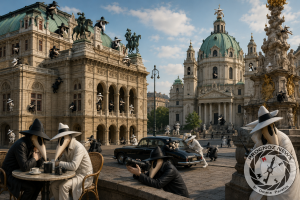
Vienna has long cultivated the image of a city of music, diplomacy and quiet civility. Its baroque façades and measured rhythms suggest a place where history is curated rather than lived. Yet beneath this cultivated calm there persists another identity — older, more ambiguous, and altogether less visible. It remains, as it was throughout the twentieth century, one of the world’s principal capitals of espionage.
To understand why, one must begin with geography and history. The city sits at the hinge between Western and Eastern Europe, a frontier that has shifted but never disappeared. During the Cold War Vienna occupied a position analogous to Berlin, although without the same physical scars. Divided into zones of occupation after 1945, it became a place where rival powers could observe one another at close quarters without direct confrontation. Even after the restoration of Austrian sovereignty in 1955, that legacy endured — and it was institutionalised in Austria’s declaration of neutrality.
Neutrality proved to be an unusually fertile soil for intelligence work. Unlike cities firmly embedded within NATO or the Warsaw Pact, Vienna offered a permissive legal and political environment. Austrian law historically criminalised espionage only when directed against Austria herself, leaving foreign intelligence services considerable room to operate so long as their activities did not directly threaten the host state. In practice this created a tacit understanding — a boundary not to be crossed, but within it a wide field of manoeuvre.
The presence of international organisations deepened this dynamic. Vienna is home to major institutions such as the United Nations Office at Vienna, the International Atomic Energy Agency and the Organization for Security and Co-operation in Europe. These bodies attract diplomats, technical experts and political representatives from across the globe. Where diplomacy gathers, intelligence follows — not merely to monitor adversaries, but to understand allies, competitors and the shifting alignments of international policy. Every conference, every negotiation, every informal reception presents an opportunity for observation or recruitment.
The culture of the city has also played its part. Vienna’s social life — discreet, polite, and structured around long-standing institutions — lends itself to quiet encounters. Conversations unfold in cafés rather than corridors; relationships are cultivated over months rather than minutes. This tempo suits intelligence work of a traditional kind — the slow accumulation of trust, the careful exchange of information, the cultivation of sources who may never fully recognise the roles they play. It is espionage as a social art, rather than a cinematic spectacle.
During the latter decades of the twentieth century, Vienna became particularly associated with Soviet and Eastern Bloc intelligence. Officers operating under diplomatic cover could move with relative ease, observing Western counterparts and engaging in the complex dance of counterintelligence. After the collapse of the Soviet Union, many assumed that this world would recede. In reality, it adapted. Russian intelligence retained a substantial presence, while new actors entered the field — from emerging powers to smaller states seeking influence disproportionate to their size.
Today the city hosts an unusually dense concentration of intelligence personnel relative to its population. Estimates are necessarily imprecise — the essence of espionage is concealment — but it is widely believed that several thousand individuals in Vienna operate in some capacity related to intelligence, whether formally accredited or not. Embassies serve as hubs, but so too do international organisations, commercial enterprises and cultural institutions. The boundaries between official diplomacy, economic engagement and intelligence gathering have become increasingly porous.
Modern espionage in Vienna is not confined to the classical model of spies exchanging documents in shadowed parks. It encompasses cyber operations, financial intelligence and influence campaigns. The city’s role as a financial centre — modest compared to London or Frankfurt, but significant in Central and Eastern Europe — renders it attractive for monitoring capital flows and, at times, for obscuring them. Information is gathered not only through human sources but through data — corporate records, communications metadata, and the digital traces left by globalised commerce.
Austria’s response has been cautious and, at times, criticised as complacent. Her commitment to neutrality and openness has limited the appetite for aggressive counterintelligence measures. While there have been periodic expulsions of diplomats accused of espionage, these actions tend to be measured rather than sweeping. Critics argue that this laxity risks turning Vienna into a permissive environment not only for intelligence gathering but for malign activities that extend beyond it. Defenders counter that the city’s role as a meeting ground depends precisely upon this openness — that to restrict it too sharply would diminish Vienna’s diplomatic significance.
The war in Ukraine has sharpened these tensions. As relations between Russia and the West have deteriorated, intelligence activities across Europe have intensified. In many capitals this has resulted in mass expulsions of suspected intelligence officers operating under diplomatic cover. Vienna by contrast has seen fewer such measures, reinforcing its reputation as a residual hub for intelligence activity. In a continent increasingly divided, it once again occupies a liminal space — neither fully aligned with one camp nor detached from the struggles of both.
There is an irony in this persistence. Vienna’s public identity rests upon culture, continuity and refinement. Yet her hidden function depends upon uncertainty, ambiguity and the quiet contest of power. The same neutrality that enables the city to host negotiations also enables others to observe them. The same discretion that preserves her social fabric provides cover for those who seek to exploit it.
Vienna is less an anomaly than a mirror of international politics itself. Espionage does not occur in the margins of diplomacy; it is woven into its fabric. Where states interact, they seek not only to persuade but to understand — and, at times, to manipulate. Vienna simply renders this reality more visible, precisely because the city has chosen not to suppress it entirely.
Vienna remains, therefore, a city of dual identities. Above ground, it offers music, architecture and the rituals of civilised exchange. Beneath that surface — though often in plain sight for those who know where to look — it continues to host one of the world’s most intricate and enduring theatres of intelligence.
193 Views



Most Readings