Is the war in Ukraine heading towards an armistice in the style of Korea?
By Matthew Parish, Associate Editor
Wednesday 20 May 2026
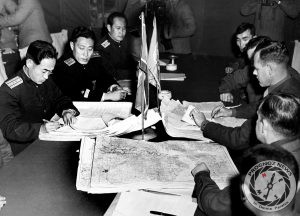
The Korean War did not end in peace. It ended in exhaustion. The guns fell largely silent not because either side achieved victory, but because the alternatives became worse than stalemate. A demilitarised zone was carved across a devastated peninsula, foreign troops remained in place for generations, and diplomacy hardened into ritualised hostility. Yet millions of people survived because the front lines froze.
If a similar armistice were eventually reached between Ukraine and Russia, the arrangement would not resemble the triumphant peace settlements imagined in European political mythology. There would be no Versailles, no Vienna Congress, and probably no definitive treaty recognising a final border. Instead there would likely emerge a heavily militarised ceasefire line stretching across hundreds of kilometres of ruined territory, monitored by foreign forces whose primary purpose would not be to create harmony but to prevent accidental escalation into continental war.
The question then becomes not whether Europe would deploy peacekeepers to Ukraine, but what kind of force Europe could realistically sustain in the face of Russian hostility, Ukrainian suspicion and American strategic ambiguity.
The first principle is that any European peacekeeping mission in Ukraine would not resemble traditional United Nations peacekeeping. There would be no lightly armed Scandinavian officers driving white Land Cruisers between villages while local militias politely observe ceasefire terms. Ukraine is too large, too heavily armed and too strategically important for that. Any peacekeeping force would instead resemble a forward military shield: a hybrid between deterrence force, tripwire formation and armistice monitoring mechanism.
The second principle is that Russia would almost certainly reject any NATO-labelled deployment directly upon the ceasefire line. Moscow has spent years describing the war as a struggle against NATO encroachment. Accepting American, British, Polish or French combat brigades positioned directly opposite Russian forces would be politically humiliating for the Kremlin. Hence a compromise arrangement would probably involve formally non-NATO European coalitions operating under alternative legal mechanisms.
One possibility would be an ad hoc European security coalition authorised by bilateral treaty with Kyiv rather than by NATO itself. Another might involve a mandate through the Organization for Security and Co-operation in Europe, although Russia’s participation in that institution makes such an arrangement diplomatically cumbersome. A European Union flag is conceivable but problematic because the EU lacks integrated military command structures for large-scale combat deployments. Most likely would be a multinational coalition built around France, the United Kingdom, Poland and Germany, operating through specially negotiated status agreements with Ukraine.
The geography of deployment would matter enormously.
The most dangerous sector would obviously be the armistice line itself. If the war froze approximately along existing front lines, then Europe would confront a demarcation zone extending from the northern reaches of Kharkiv oblast through the Donbas and southward toward the lower Dnipro River. Unlike Korea’s narrow DMZ, Ukraine’s front spans immense open terrain. Monitoring such a line would require layered deployment rather than a single trench-like barrier.
The immediate contact zone might remain exclusively Ukrainian and Russian controlled, separated by buffer sectors monitored electronically through drones, satellite surveillance, radar systems and ground sensors. European forces might not stand directly on the front itself because that would expose them constantly to artillery accidents, sabotage and provocation. Instead they could occupy secondary defensive belts some tens of kilometres behind Ukrainian positions.
This distinction matters because European governments would wish simultaneously to reassure Ukraine while avoiding circumstances in which a single Russian artillery strike could instantly kill dozens of French or German soldiers and thereby trigger demands for retaliation.
A likely deployment model would therefore involve three concentric layers.
The first layer would consist of Ukrainian forces holding the armistice line itself. Kyiv would never accept foreigners replacing Ukrainian troops in direct defence of Ukrainian territory. Politically and psychologically, such a replacement would appear to acknowledge diminished sovereignty. Ukraine’s army would remain the primary shield.
The second layer would contain European stabilisation forces stationed behind the line in major logistical hubs and strategic cities. These deployments would serve two purposes: deterring renewed Russian offensives and reassuring the Ukrainian population that Europe’s commitments are durable.
The third layer would involve air defence, logistics and intelligence infrastructure spread across western and central Ukraine, integrated with European military systems.
Where precisely might such forces be deployed?
Kyiv would almost certainly host a substantial European command presence. The capital remains Ukraine’s political heart and symbolic centre of gravity. Air defence units protecting Kyiv would become essential because any armistice would remain perpetually vulnerable to missile coercion.
Odesa would also be critical. The city is Ukraine’s principal maritime outlet and one of the most strategically important ports on the Black Sea. A European naval monitoring mission based around Odesa might emerge to supervise shipping corridors and prevent renewed Russian maritime blockades. French and British naval expertise would probably dominate such operations.
Dnipro could become another major hub because it lies near the operational centre of the country while remaining outside immediate artillery range from most conceivable armistice lines. European logistics headquarters, repair depots and reserve formations might cluster there.
Lviv would likely transform into the principal western gateway for the entire mission. Already functioning as Ukraine’s logistical bridge to Europe, the city could evolve into something resembling Cold War West Berlin in reverse: a heavily internationalised support centre filled with military advisers, intelligence personnel, diplomats, reconstruction contractors and aid organisations.
One should also expect substantial deployment in the skies rather than only upon the ground. Any serious European stabilisation effort would require integrated air defence systems stretching from Poland and Romania deep into Ukrainian territory. Patriot batteries, SAMP/T systems and layered anti-drone defences would become semi-permanent fixtures. The peacekeeping mission would therefore not merely consist of infantry patrols but of a continent-wide military architecture.
The composition of the force would reveal Europe’s internal political realities.
Poland would almost certainly insist upon a major role. Warsaw regards Ukrainian security as existential to Polish national defence. Polish forces are among Europe’s largest land armies and have undergone rapid expansion since 2022. Yet Russian objections to Polish troops near the front could be particularly fierce because of the deep historical antagonism between Moscow and Warsaw.
France would probably seek leadership status because Paris increasingly views European strategic autonomy as a defining geopolitical objective. A French-led command structure would symbolise Europe acting independently rather than merely as an American auxiliary.
Britain’s role would be paradoxical. Although outside the European Union, London remains one of Ukraine’s strongest military backers and retains significant expeditionary capability. British intelligence, training and naval components would almost certainly play major roles, even if politically London attempted to avoid direct front-line exposure.
Germany would face the greatest domestic debate. Berlin possesses enormous financial resources but retains deep public caution regarding military deployments eastward. Nevertheless any serious European mission would be impossible without German logistics, funding and industrial support.
Smaller contributors might include the Netherlands, the Nordic states, the Baltic countries, Romania and perhaps Canada. Southern European participation would probably remain more limited.
The legal structure of such a mission would be extraordinarily delicate. Would European forces possess authority to return fire? Would they intervene if Russia resumed offensive operations? Would they merely observe violations or actively prevent them? Korea again provides the precedent: armistice arrangements become stable only when violations carry credible consequences.
Hence any European deployment that lacked robust rules of engagement would risk disaster. Peacekeepers unable to defend themselves rapidly become hostages to escalation dynamics.
At the same time Europe would attempt carefully to avoid creating automatic escalation mechanisms that could drag the continent into direct war with Russia. This balancing act would define the entire mission. The force would need to be strong enough to deter, but ambiguous enough to reassure Moscow that accidental incidents need not lead immediately to strategic catastrophe.
Economically the undertaking would be immense. Sustaining perhaps 50,000 to 100,000 foreign troops, integrated air defence systems, surveillance networks and reconstruction security operations across a country the size of Ukraine would require tens of billions of euros annually. Yet Europe may conclude that such costs are cheaper than allowing recurrent wars every few years along the eastern frontier.
The Korean analogy also implies something psychologically uncomfortable for Europeans: armistices can last generations without truly resolving underlying conflicts. Korea never achieved reconciliation. She achieved managed hostility. If Ukraine entered a comparable condition, Europe might find itself maintaining military deployments in Ukraine for decades. In the Balkans, foreign troops have remained since 1995 to the present day.
An entire generation of European officers could spend careers rotating through Ukrainian assignments much as American soldiers long cycled through South Korea or West Germany during the Cold War.
For Ukraine herself such an arrangement would be emotionally ambivalent. European deployments would provide security guarantees stronger than diplomatic promises alone. However they would symbolise that the war remained unfinished. Large portions of occupied territory might remain beyond Kyiv’s control indefinitely, while the nation adapted psychologically to permanent militarisation.
Russia too would evolve under such conditions. The Kremlin would likely continue portraying the armistice as temporary, insisting upon historical claims and periodically testing Western resolve through cyberattacks, drone incursions, political warfare and disinformation campaigns. The peace would therefore remain armed peace.
The broader consequence may be that Europe itself would cease being a post-military civilisation. Since the end of the Cold War, many Europeans assumed that large-scale continental warfare had become historically obsolete. Ukraine shattered that assumption. A Korean-style armistice would institutionalise its replacement.
Europe would no longer merely assist Ukraine. It would physically embed itself into Ukraine’s defence geography. The continent’s eastern frontier would harden into a militarised civilisational boundary extending from the Arctic to the Black Sea.
And like Korea’s DMZ, the line itself might gradually become one of the strangest places on earth: heavily fortified yet eerily quiet, technologically saturated yet psychologically frozen, permanently awaiting either reconciliation or renewed catastrophe.
179 Views



Most Readings