Europe’s Long Road Eastward: Ukraine, Moldova and the Opening of the Next Chapter
By Matthew Parish, Associate Editor
Saturday 13 June 2026
On Monday, in Luxembourg, a moment of profound historical significance is expected to unfold. The European Union will formally commence the first substantive phase of accession negotiations with Ukraine and Moldova, opening what Brussels describes as the “Fundamentals” cluster of talks. Although the process of accession negotiations technically began in 2024, the opening of the first negotiating cluster marks the beginning of the detailed and arduous work required for eventual membership.
The decision is more than a bureaucratic milestone. It represents the culmination of decades of geopolitical evolution and, for Ukraine in particular, years of sacrifice measured not merely in legislative reforms but in human lives.
For Ukraine, European Union membership has become inseparable from national identity. Since the Revolution of Dignity in 2014, successive governments in Kyiv have framed integration with Europe not as a foreign policy option but as a civilisational choice. Russia’s full-scale invasion in 2022 accelerated this trajectory dramatically. What had previously been viewed in some European capitals as a distant aspiration became an urgent strategic imperative. The granting of candidate status in 2022 and the opening of accession negotiations in 2024 were extraordinary developments in themselves. Monday’s negotiations represent the next stage of turning aspiration into reality.
Moldova’s journey has been quieter but no less remarkable. Under the leadership of President Maia Sandu, Moldova has pursued a determined programme of reform while facing sustained political pressure, economic coercion and disinformation campaigns from Moscow. Like Ukraine, Moldova sees European integration not merely as an economic project but as a guarantee of democratic stability and national sovereignty.
The cluster opening on Monday focuses upon what the European Union calls “Fundamentals”. These include judicial independence, anti-corruption measures, public administration reform, financial controls, democratic institutions and the protection of fundamental rights. In many respects this is the most important cluster of all because it addresses the institutional foundations upon which every other aspect of EU membership depends.
For Ukraine, the symbolism is particularly powerful. Even while fighting Europe’s largest war since 1945, the country continues simultaneously to undertake one of the most demanding programmes of legal and administrative transformation ever attempted by a candidate state. European officials have repeatedly acknowledged the remarkable speed with which Ukrainian institutions have aligned themselves with the acquis communautaire, the enormous body of European law that prospective members must adopt. Ukraine completed the formal screening process of its legislation in 2025, a significant achievement given the circumstances under which its government operates.
Yet it would be a mistake to regard Monday’s events as a guarantee of rapid membership. The accession process remains extraordinarily demanding. Every chapter of negotiations must ultimately be completed and every member state must agree at each major stage. The European Union itself is engaged in an increasingly vigorous debate about how enlargement should proceed and what institutional safeguards may be required before admitting new members. Several major European states have recently proposed stronger mechanisms to prevent democratic backsliding among future members, reflecting lessons learned from internal disputes within the Union over the past decade.
Moreover enlargement today is no longer merely an administrative exercise. It is a geopolitical project. The European Union increasingly recognises that the question of enlargement is inseparable from questions of security. The integration of Ukraine and Moldova would extend the zone of European stability eastwards while reinforcing democratic institutions in a region long contested by competing political models.
The negotiations would not have reached this point without a significant political breakthrough in Hungary. For many months Budapest blocked progress, citing concerns regarding the rights of the Hungarian minority in Ukraine’s Transcarpathian region. Following negotiations between Kyiv and the new Hungarian government, agreement was reached on minority rights issues, removing what had become the principal obstacle to moving the process forward.
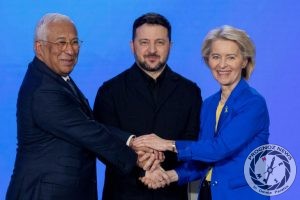
For the European Union itself Monday’s negotiations are a test of credibility. European leaders have repeatedly stated that candidate countries which undertake difficult reforms and satisfy membership criteria should be rewarded with progress towards accession. Having made those commitments, the Union must now demonstrate that it is prepared to honour them. European Council President António Costa and European Commission President Ursula von der Leyen have both characterised the opening of the first negotiating cluster as recognition of the resilience and reform efforts demonstrated by Ukraine and Moldova.
The road ahead remains long. Even the most optimistic scenarios envision years of negotiation before full membership becomes possible. Nonetheless history often advances through a series of procedural decisions that appear technical at the time but later acquire immense significance. Monday’s opening of the first accession cluster may prove to be one of those moments.
For Ukraine and Moldova the negotiations beginning this coming week are not merely discussions about regulations, procurement rules or judicial procedures. They are negotiations about where these countries belong in the political geography of Europe.
The answer increasingly appears to be that they belong within it.
109 Views



Most Readings