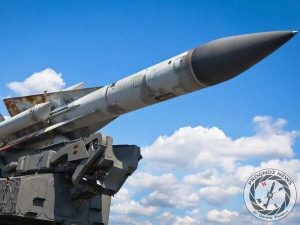
FREYA European Anti-Ballistic Missile Defence Scheme
By Matthew Parish, Associate Editor
Sunday 9 August 2026
Before the full-scale Russian invasion of Ukraine in 2022, European missile defence was often regarded as a specialised military concern rather than a central pillar of continental security. Air defence planning focused primarily upon aircraft and cruise missiles, while the interception of ballistic missiles remained heavily dependent upon American technology, most notably the Patriot system. Four years of relentless Russian missile attacks upon Ukrainian cities have fundamentally altered that perception. Europe has discovered that the ability to defeat ballistic missiles is no longer a luxury of great powers but a prerequisite for national survival.
It is from this strategic awakening that the FREYA programme has emerged.
Announced in July 2026, FREYA is not merely another weapons project. It represents an attempt to create a genuinely European anti-ballistic missile architecture that combines Ukraine’s unique wartime experience with the industrial and technological resources of some of Europe’s largest defence companies. Nine European countries joined Ukraine in launching the initiative, including the United Kingdom, France, Germany, Italy, Denmark, the Netherlands, Norway, Spain and Sweden. The coalition is explicitly intended to remain open to additional partners.
The choice of the name is fitting. In Norse mythology, Freya was the goddess associated with both beauty and war, embodying the paradox that civilisation sometimes survives only because it possesses the means to defend itself. Modern Europe faces a similar contradiction. The European Union was founded upon ideals of peace, integration and economic cooperation, yet preserving those ideals increasingly requires sophisticated military capabilities that previous generations hoped would never again be necessary.
Unlike many multinational defence programmes that begin in committee rooms, FREYA begins on the battlefield. Ukraine has accumulated more practical experience in defending against ballistic missile attack than any European state since the Second World War. Every Russian Iskander strike, every attempted interception and every operational success or failure has generated data that cannot be reproduced in peacetime testing. Ukraine has therefore become not merely a customer of missile defence technology but one of the world’s foremost authorities on its practical employment.
That practical experience explains the unusual structure of the programme. Rather than attempting to build every component within one country, FREYA has adopted an open architecture. Ukraine is expected to provide the launcher technology and the interceptor missile itself, while partner nations contribute radars, sensors, guidance systems and command-and-control technologies. Major European defence firms, including Thales, Leonardo, Saab, Kongsberg, Eurosam, Hensoldt and others, have become involved in different aspects of the project.
The philosophy underlying the project is perhaps even more significant than its engineering.
For decades Europe purchased strategic missile defence largely from the United States. Patriot batteries became the indispensable asset whenever serious ballistic missile threats emerged. They remain exceptionally capable systems, but they are expensive, difficult to manufacture in large numbers and subject to the competing priorities of American foreign policy. Recent shortages of interceptor missiles have demonstrated the limitations of relying upon a single supplier for continental defence. FREYA therefore represents an effort not simply to duplicate Patriot but to complement it with a European-produced alternative that can be manufactured more rapidly and at substantially lower cost.
Cost matters enormously.
Modern missile defence has become an economic contest almost as much as a technological one. Russia can manufacture ballistic missiles in significant quantities. If each defending interceptor costs several million euros while each attacking missile costs substantially less, the economics favour the aggressor. A successful defensive system must therefore reduce interception costs without sacrificing reliability. Developers have indicated that FREYA aims to produce interceptor missiles costing below one million euros each, an ambitious objective that, if achieved, could fundamentally alter the economics of European air defence.
Equally important is industrial sovereignty.
The war in Ukraine has exposed the vulnerabilities of global supply chains. European governments have repeatedly discovered that possessing financial resources does not necessarily guarantee rapid access to military equipment if production capacity lies elsewhere. FREYA therefore forms part of a broader movement towards European defence autonomy. It sits alongside other initiatives, including new European interceptor programmes and expanded continental missile manufacturing, reflecting a determination that Europe should possess the industrial capacity to defend itself even during periods when external assistance may be delayed or politically constrained.
Yet FREYA also illustrates a remarkable reversal of traditional assumptions about military innovation.
Historically, Western Europe exported advanced military technology while countries under attack imported it. Ukraine has inverted that relationship. Its wartime innovations in drone warfare, electronic warfare and integrated air defence are increasingly influencing NATO doctrine and European procurement decisions. In this respect FREYA is not Europe teaching Ukraine but Ukraine teaching Europe. Combat experience has become one of Ukraine’s most valuable strategic exports.
There remain formidable challenges. Ballistic missile interception is among the most technically demanding problems in military engineering. It requires precise detection within seconds of launch, accurate trajectory prediction, resilient communications, sophisticated guidance systems and interceptors capable of striking targets travelling at several kilometres per second. Every element must function flawlessly under combat conditions. Even small failures in software integration or sensor fusion can produce catastrophic consequences.
Funding also remains uncertain. While participating governments have committed themselves politically to the programme, translating declarations into sustained industrial investment requires long-term budgetary commitments extending well beyond electoral cycles. European defence procurement has often suffered from fragmentation, duplication and delays. FREYA will succeed only if participating nations maintain an unusual degree of political discipline and industrial coordination.
Nevertheless, the geopolitical implications extend far beyond missile defence itself.
If successful, FREYA would demonstrate that Europe can respond collectively to strategic threats through indigenous innovation rather than dependence upon external suppliers. It would deepen defence cooperation between Ukraine and the rest of Europe regardless of the precise institutional arrangements eventually governing Ukraine’s relationship with NATO or the European Union. It would strengthen Europe’s defence industrial base while creating common technical standards that could underpin future collaborative military projects.
Most importantly, FREYA symbolises Europe’s changing strategic psychology.
For decades the continent assumed that major interstate war belonged largely to history. Ukraine has shown otherwise. The question facing European governments is no longer whether ballistic missile defence is necessary but whether sufficient capability can be built before the next crisis arrives. FREYA represents one answer to that question: a programme born not from theoretical planning but from the harsh realities of modern warfare.
Whether it ultimately fulfils its ambitious objectives remains uncertain. The first prototype is expected around the middle of 2027, and much difficult engineering still lies ahead.
Yet even at this early stage, FREYA has already achieved something important. It has demonstrated that Europe’s response to strategic vulnerability is no longer simply to purchase security from abroad but increasingly to create it at home. That shift may ultimately prove to be the programme’s greatest achievement — not merely the development of another interceptor missile, but the emergence of a more confident and strategically self-reliant Europe.
59 Views



Most Readings





Crimea Under Pressure: Ukraine’s Long Campaign Against Russia’s Southern Bastion
93 Views