John Mearsheimer and the War America Cannot Win
By Matthew Parish
Wednesday 2 September 2026
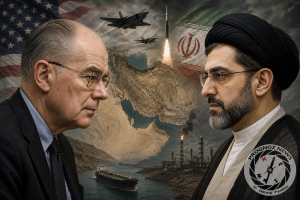
There is something almost unnerving about John Mearsheimer when events begin to vindicate him. He does not celebrate very much. He does not appear particularly surprised. He simply explains that this was approximately what one should have expected all along.
So it has been with the United States’ war with Iran.
Mearsheimer’s analysis of the conflict has become progressively more uncompromising during 2026. Before the principal American attack he argued that Washington had no compelling strategic reason to go to war. Once hostilities had begun, he argued that the United States and Israel had set themselves objectives they could not realistically achieve. By June he was describing the American position as one of defeat. By July he was arguing explicitly that the United States could not defeat Iran. Most recently, in August, his attention has shifted towards what may ultimately prove the most important battlefield of all — the American economy.
This is quintessential Mearsheimer. Strip away the moral rhetoric, forget who is good and who is wicked, disregard speeches about democracy, terrorism and civilisation, and ask the brutally simple realist question: what does each side actually need to achieve in order to win? His answer is deeply uncomfortable for Washington.
The asymmetry of victory
The central insight in Mearsheimer’s analysis is that the United States and Iran have radically different definitions of victory. For Washington and Jerusalem, victory requires something enormous. Iran must cease to be a strategically independent regional power. Its nuclear programme must be neutralised or subordinated, its missile and drone capabilities substantially destroyed, its support for armed movements across the Middle East curtailed and — in the strongest version of the war aims — its political system replaced by something much more accommodating towards the United States and Israel.
Iran’s requirements are considerably simpler. She has to survive. Mearsheimer made precisely this argument in March. Even if Iran’s infrastructure were devastated, its missile stocks depleted and its nuclear facilities badly damaged, Iran could still claim strategic victory if the state survived and remained unwilling to become an American or Israeli client. He drew the obvious historical analogy with Vietnam: the United States can dominate the tactical battlefield and nevertheless lose the political war. This asymmetry is extraordinarily important.
A great power launching a war against a smaller power often assumes that because it can destroy more things, it possesses greater political leverage. Yet destruction and victory are not synonymous. Serbia survived NATO’s 1999 bombing campaign. The Taliban survived twenty years of American military pressure. North Vietnam endured levels of aerial destruction scarcely imaginable today. Political communities can absorb remarkable punishment where they believe that the alternative is submission. Iran is a country of roughly ninety million people, occupying an enormous mountainous territory, possessing a substantial indigenous military-industrial capacity and enjoying a national history measured not in decades but millennia. It was never Iraq in 2003. This, for Mearsheimer, was the elementary strategic mistake.
Israel and the American interest
There is another dimension to Mearsheimer’s argument that inevitably attracts far greater controversy. He believes that the war was principally promoted by Israel and by pro-Israel political forces in the United States. Before the war he argued that virtually every important international actor apart from Israel favoured avoiding an American attack, including Gulf Arab states hardly renowned for affection towards Tehran. He also maintained that senior American military thinking recognised the danger of entering a prolonged conflict for which Washington possessed no satisfactory military solution.
After the war began his criticism hardened. Mearsheimer has repeatedly characterised Israel not as the indispensable American strategic asset her defenders describe, but increasingly as a strategic liability — a state whose regional objectives can pull the United States into conflicts that do not necessarily serve American interests.
This argument is inseparable from the thesis Mearsheimer developed with Stephen Walt two decades ago in The Israel Lobby and U.S. Foreign Policy. It is also the part of his contemporary commentary that requires the greatest care. There is an important distinction between arguing that Israeli governments and organised lobbying groups exercise substantial influence over American foreign policy — an entirely legitimate subject for political analysis — and imagining that American policy is simply dictated from Jerusalem. The latter would absolve American presidents, congressmen, officials, donors and voters of responsibility for decisions made by the United States herself.
Trump was not compelled by some mysterious external force to wage war. Whatever pressures existed, the American government ultimately chose its policy. Yet Mearsheimer’s broader question remains legitimate: did the United States go to war because Iran represented an intolerable threat to America, or because Iran represented an intolerable obstacle to Israeli regional predominance? Those are not necessarily the same thing.
The Strait that changed the war
Mearsheimer’s most interesting analysis, however, concerns neither ideology nor lobbying. It concerns geography. The Strait of Hormuz is one of those narrow pieces of water upon which absurdly large portions of human prosperity depend. Iran does not have to sink the United States Navy to exercise strategic leverage there. It merely has to make commercial transit sufficiently dangerous, unpredictable or expensive that energy markets react accordingly. Tankers, insurers, commodity traders and financial markets perform the remainder of the work.
This is why Mearsheimer believes the balance of coercive leverage favours Tehran. By late June he was arguing that Iran’s ability to constrain shipping through Hormuz gave her something the United States lacked: an instrument capable of imposing enormous costs not merely upon her immediate adversary but upon the international economic system. The paradox is exquisite. America possesses aircraft carriers, stealth bombers, satellites, precision-guided weapons and military expenditure approaching astronomical proportions. Iran possesses geography.
Geography is considerably cheaper. Mearsheimer therefore regards escalation as potentially strengthening Iran’s position rather than America’s. Washington can destroy Iranian installations. Iran can retaliate against American regional bases, Israeli infrastructure and — most consequentially — maritime commerce. The United States consequently faces the unpleasant problem of escalation against an opponent whose most economically destructive responses become more attractive as the conflict intensifies. In July Mearsheimer argued explicitly that Iran benefited from climbing the escalation ladder and that Washington possessed no viable military strategy capable of compelling Tehran to abandon its position over Hormuz. This is offensive realism applied to an unexpectedly asymmetric battlefield.
The arsenal problem
There is also the matter of ammunition. Modern Western warfare developed during an era in which the United States generally fought opponents unable to contest the skies seriously or exhaust American defensive inventories. Iraq, Afghanistan, Libya and Serbia could not manufacture enormous quantities of sophisticated long-range missiles and drones and launch them repeatedly against American bases and allies. Iran can.
Mearsheimer argues that this changes the arithmetic dramatically. Defensive missiles costing millions of dollars may be consumed intercepting weapons costing fractions of that amount. Stocks accumulated over years can disappear in weeks. Industrial replacement schedules cannot necessarily keep pace with wartime expenditure. He has therefore pointed to depleted American munitions inventories as one reason renewed large-scale escalation is unattractive to Washington. He simultaneously emphasises Iran’s capacity for a substantial second strike using missiles and drones against Israel, Gulf infrastructure and American installations.
This is one of the most important lessons emerging from twenty-first century warfare more generally. The decisive military resource may no longer be possession of the most sophisticated weapon. It may be the ability to manufacture enormous numbers of weapons that are merely good enough. Ukraine has already taught the world something similar about drones. Iran may be teaching it about missiles.
Economic warfare turns westwards
By August Mearsheimer’s analysis had moved towards the American domestic economy.
His argument is that Washington is now effectively wagering that economic pressure will break Iran before disruption associated with the war inflicts intolerable costs upon the United States herself. Tehran is making the opposite wager. Restrictions upon energy transit through Hormuz increase pressure on global oil and gas markets, feeding inflation and potentially contributing to higher bond yields and deteriorating American economic conditions.
This is where the Iranian conflict becomes particularly dangerous for President Trump.
Wars fought by volunteer professional militaries can remain remarkably abstract for civilian populations. A family in Ohio does not necessarily notice that a missile has struck an American installation thousands of miles away. It notices petrol prices. It notices grocery prices. It notices mortgage rates. It notices pension funds declining and government borrowing becoming more expensive.
A prolonged Iranian strategy therefore does not necessarily seek to defeat the United States Armed Forces. It seeks to transmit the costs of war into Western kitchens, petrol stations, bond markets and ballot boxes. That is an altogether more sophisticated conception of asymmetric warfare.
Where Mearsheimer may be wrong
Mearsheimer should nevertheless not be treated as an oracle. Realism’s great strength is also its recurrent weakness. By reducing international politics to interests, power and security competition it can underestimate ideology, domestic politics, institutional inertia, misperception and sheer human irrationality. States sometimes continue wars they ought rationally to terminate.
Iran may also be more internally fragile than Mearsheimer assumes. Economic strangulation can produce unpredictable political effects. Iranian elites may fracture. Military losses may alter calculations inside the regime. Conversely, American technological advantages might eventually generate military opportunities that are not presently apparent.
Nor is control of Hormuz cost-free for Iran. Iran itself depends upon commerce. China, India and other states upon whose political tolerance Tehran depends have little interest in permanent disruption of international energy markets. A strategy that creates leverage today might create diplomatic isolation tomorrow. Most importantly, declaring a victor in an unfinished confrontation is hazardous. Mearsheimer has repeatedly described Iran as having won and America as having lost. Yet history is littered with wars in which apparent winners discovered years later that their victories contained the seeds of strategic disaster.
Nevertheless, his diagnosis of the original problem is difficult to dismiss. The United States entered a confrontation without an obvious mechanism for converting overwhelming destructive capacity into an achievable political settlement. That is not strategy. It is firepower searching for a purpose.
The tragedy of great-power politics
There is a final irony. Mearsheimer is frequently portrayed as an opponent of American power. He is nothing of the sort. His intellectual project is fundamentally concerned with how powerful states preserve themselves in an anarchic international system. His objection is to squandering power.
From his perspective, America’s principal strategic competitor is China. Every missile expended in the Middle East, every additional trillion dollars of debt, every military asset tied down defending regional partners and every diplomatic relationship damaged by an unnecessary war represents resources unavailable for the central geopolitical contest of the twenty-first century.
This is why his criticism of the Iran war fits perfectly alongside his criticism of American policy towards Ukraine, even though the moral and historical circumstances of the two conflicts are profoundly different. Mearsheimer habitually asks the same question: does this policy increase or diminish America’s relative power? With Iran his answer is emphatic. It diminishes it.
There is something characteristically American about believing that every strategic problem must possess a military solution. The United States built the most powerful armed forces in human history and consequently developed a recurring temptation to regard military superiority as political omnipotence. But countries are not computer servers. They cannot simply be switched off. Iran does not need to conquer Washington. It does not need to defeat the United States Navy in some twenty-first century Battle of Jutland. It does not even need to emerge physically undamaged. It merely has to remain Iran.
If John Mearsheimer is right, that is the terrible simplicity at the heart of America’s predicament. Washington chose a war in which victory required transformation of its opponent, while its opponent chose a war in which victory required endurance. And endurance is one of the few weapons that cannot be destroyed from the air.
46 Views



Most Readings