Should Britain Elect a Large Language Model as Prime Minister?
By Matthew Parish
Wednesday 2 September 2026
There was once a time when suggesting that Britain ought to replace its Prime Minister with a computer would have been considered an amusing premise for a science-fiction comedy. After the experience of British government since 2016, the proposal requires somewhat more careful consideration. Britain has now managed seven Prime Ministers in a decade — David Cameron, Theresa May, Boris Johnson, Liz Truss, Rishi Sunak, Sir Keir Starmer and now Andy Burnham. This is an extraordinary rate of political attrition for a country whose constitutional arrangements are supposedly celebrated for their stability.
The latest incumbent has already encountered the institution that has increasingly assumed the role once occupied by the monarch, the House of Lords or perhaps the Almighty in constraining British governments: the bond market. On 2 September 2026 the yield on ten-year British government debt reached 5.268 per cent, its highest level since 2008. Thirty-year borrowing costs have recently approached 5.9 per cent, levels unseen since 1998.
It would be unfair to blame all this upon Mr Burnham. The current sell-off is international and has been aggravated by renewed conflict involving Iran, higher oil prices and fears of renewed inflation. British government debt also suffers from structural peculiarities, including its unusually large proportion of inflation-linked bonds. Nevertheless markets are plainly nervous about the new government’s spending ambitions. Mr Burnham’s arrival in Downing Street in July was itself accompanied by falling gilt prices and rising yields after remarks suggesting that he might exploit greater flexibility within the fiscal rules. Britain therefore finds herself once again contemplating that most modern of constitutional questions: will the Prime Minister frighten the people who lend the government money?
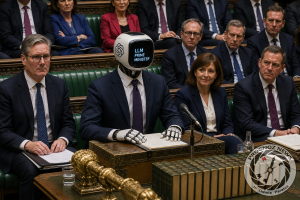
Perhaps we have been approaching the problem from the wrong direction. Perhaps the next Prime Minister should be a large language model.
The impossible office
The argument is less ridiculous than it sounds because the British premiership has become an almost impossible job. A Prime Minister is simultaneously expected to be chief executive of an enormously complicated organisation, chief diplomat, commander of the machinery of national security, economic strategist, party leader, television personality, moral exemplar, electoral magician, parliamentary performer and national psychotherapist.
The constitutional position makes matters worse. There is no comprehensive statutory definition of the Prime Minister’s functions. The office is essentially an accumulation of conventions, prerogative powers, political authority and institutional relationships. The House of Commons Library describes it as a collection of functions whose effective exercise depends heavily upon the personality, temperament and abilities of its occupant.
This might have worked tolerably well when government was smaller, information travelled more slowly and a Prime Minister could disappear to Chequers for the weekend without being expected to pronounce instantly upon every controversy occurring anywhere upon the planet.
It works less well in the information age.
A modern British Prime Minister is bombarded with Treasury projections, intelligence assessments, polling data, diplomatic cables, NHS statistics, migration figures, military briefings, departmental submissions and incessant political advice. Human beings are not particularly good at processing information on this scale. They become tired. They become frightened. They become angry. They acquire favourites. They worry about opinion polls. They read hostile newspaper columns at three o’clock in the morning. They make decisions because somebody shouted loudest in a meeting.
A sufficiently sophisticated large language model would suffer from none of these disadvantages. It would read everything.
Prime Minister GPT
Imagine the first morning. At 7.00am the artificial Prime Minister receives the overnight intelligence summaries from MI6, MI5 and GCHQ. By 7.00.04 it has read them. At 7.01 it receives the Treasury’s latest fiscal projections, Bank of England data, gilt curves, overnight Asian market movements and the Chancellor’s proposed spending measures. By 7.02 it has constructed perhaps ten thousand alternative fiscal scenarios.
At 7.03 the Department of Health sends over an eight-hundred-page NHS workforce paper. This presents no particular inconvenience. At 7.04 somebody in Downing Street asks whether Britain should nationalise Thames Water. The Prime Minister replies: “There are seventeen plausible structures. Shall I prepare the comparative table?”
Already this represents an improvement upon several recent administrations. The most attractive quality of an AI Prime Minister would not necessarily be intelligence. It would be emotional indifference. Bond markets do not particularly care whether a Prime Minister possesses charisma. They care whether the government will repay its debts without inflating them away. An artificial Prime Minister could be instructed that maintaining sovereign credibility constituted a hard constraint. Before announcing another £20 billion programme because somebody at Labour Party conference applauded enthusiastically, it could calculate the likely effects upon borrowing requirements, gilt yields, sterling, inflation and debt-service expenditure.
Liz Truss demonstrated in 2022 how rapidly markets can punish a government when they conclude that fiscal policy has become detached from economic reality. Her premiership lasted seven weeks. The lesson was brutal but useful: in a highly indebted country, political sovereignty is constrained by arithmetic. Artificial intelligence is rather good at arithmetic.
The machine has no constituency
There are other advantages. An AI Prime Minister would not have attended Eton. Nor would it have attended Winchester, Oxford, Cambridge or the annual dinner of some obscure faction of the Labour Party. It would not have a constituency association demanding a bypass. It would not have a spouse whose professional activities caused awkward newspaper stories. It would not accept free spectacles. It would not possess an ideological vendetta dating from an undergraduate argument in 1987.
It could not be seduced by a Russian oligarch, flattered by an American President or terrified by an angry newspaper proprietor. It would not reshuffle the Cabinet because one minister had been more impressive on television than another. It would not wake up one morning and decide to hold a referendum upon Britain’s membership of its principal trading bloc because several dozen troublesome backbenchers were complaining.
These are not trivial advantages. Indeed one of the striking characteristics of Britain’s political crisis since 2016 has been how frequently enormous questions of state have become entangled with tiny questions of personality. Cameron’s referendum was partly inseparable from Conservative Party management. May became imprisoned by parliamentary arithmetic. Johnson’s premiership became inseparable from Johnson. Truss turned an economic theory into a practical experiment upon sixty-seven million people. Sunak never acquired sufficient political authority to escape the wreckage. Starmer won an enormous parliamentary majority yet departed less than two years later. Britain has experienced the highest rate of prime-ministerial turnover in almost two centuries.
There is something wrong with a political system in which changing the person at the top repeatedly fails to solve the underlying problems. Perhaps the problem is the person.
But who programs the Prime Minister?
Here we encounter the objection that destroys the fantasy. Artificial intelligence does not have political values independently of the humans who create, train and instruct it. Ask an AI Prime Minister whether taxes should rise and it cannot derive the answer from mathematics alone. Taxation involves questions about distributive justice.
Ask whether immigration should fall and economics will provide only part of the answer. The remainder concerns culture, identity, humanitarian obligations and competing conceptions of nationhood. Ask whether Britain should go to war and no optimisation function can determine how many British soldiers’ lives ought to be risked to defend another country. Ask whether pensioners should receive more money than young families and eventually one reaches a moral judgment.
Politics exists precisely because reasonable people disagree about these things. The danger of an AI Prime Minister would therefore be that politics had not disappeared at all. It would merely have become invisible. Somebody would determine its objectives. Somebody would choose its training material. Somebody would determine what weight it attached to economic growth against equality, liberty against security, present consumption against future investment and British interests against international obligations. The programmer would become the sovereign. And unlike a Prime Minister, the programmer might never have to stand for election.
Democracy is inefficient for a reason
There is a deeper difficulty. Human politicians are inefficient because democracy is inefficient. Democracy requires argument, compromise, hesitation and occasionally irrationality because human beings themselves contain these qualities. Parliament is not supposed to be an optimisation engine. It is an institution through which conflicting interests negotiate their coexistence.
An artificial intelligence might calculate that closing fifty hospitals and constructing fifteen enormous regional medical centres would increase aggregate health outcomes by 4.7 per cent. The people living beside the fifty hospitals might nevertheless object. They might even be right.
Human political judgment incorporates things that are exceptionally difficult to reduce to numbers — loyalty, dignity, history, legitimacy, community and the intuitive sense that although something might be economically efficient it simply should not be done. The danger of machine government is therefore not necessarily that the machine would make mistakes. It is that the machine might be right too often in the wrong way.
The more interesting possibility
Yet there is a halfway house. Britain need not elect ChatGPT Prime Minister. It might instead recognise that modern government has become too complicated to be conducted principally through human intuition. Every Prime Minister should have an artificial counterpart. Call it the Shadow Prime Minister — not the Leader of the Opposition but a permanent artificial intelligence inside the machinery of government.
Every major policy proposal would be submitted to it. The machine would examine Treasury consequences, legal obstacles, historical precedents, international comparisons, implementation risks and contradictions with existing government policy. Before a Chancellor delivered a Budget, the machine would attempt to destroy it. Before Britain embarked upon a military operation, the machine would construct the strongest possible case against intervention. Before a Prime Minister announced an immigration target, the machine would calculate whether it was remotely achievable.
Before ministers promised that a programme would cost £5 billion, the machine would compare the estimate with every analogous British government procurement disaster of the previous fifty years and quietly ask whether £15 billion might be more realistic. Most importantly, its assessments could in appropriate cases be published. Imagine a government announcing a magnificent new £40 billion infrastructure programme while an independent state AI simultaneously published: Estimated final cost: £83–£117 billion. Probability of completion by announced date: 11 per cent.
British politics might become considerably more entertaining. It might also become considerably more honest.
The machine in Downing Street
There is an irony here. Politicians increasingly fear artificial intelligence because it threatens human employment. Yet one of the occupations most obviously susceptible to AI assistance is their own. Much of government consists of absorbing enormous quantities of information, identifying contradictions, forecasting consequences and choosing between imperfect alternatives. These are precisely the fields in which increasingly sophisticated reasoning models may become extraordinarily powerful.
The Prime Minister of the future may therefore remain human, but the nature of premiership may change profoundly. The successful Prime Minister may cease pretending to know everything. Instead he or she will preside over an architecture of machine intelligence capable of modelling the consequences of government decisions before ministers make them.
This would require safeguards of formidable seriousness. Government models would need protection against manipulation. Their assumptions would require auditing. Different models should probably compete against one another. Ministers must remain responsible for decisions. Parliament must be able to interrogate the reasoning behind machine-generated recommendations.
But these are engineering and constitutional problems. They are not arguments for ignoring the technology. Britain has spent the decade since 2016 conducting an unusually expensive experiment in the limitations of human political leadership. Seven Prime Ministers have entered Downing Street. The fundamental problems — weak productivity, high public debt, strained public services, expensive housing, political fragmentation and uncertainty about Britain’s place in the world — have stubbornly remained.
Now Mr Burnham faces the same machine into which his predecessors disappeared. The bond markets are already reminding him that optimism is not a fiscal policy. Yet it is worth remembering that today’s turmoil is not exclusively his creation: British yields are participating in a broader international sell-off driven substantially by renewed geopolitical and inflationary fears. The more revealing question will be what happens when his government begins making the difficult decisions about taxation, spending and borrowing that its promises inevitably require.
Perhaps Mr Burnham will succeed. One should hope so, because Britain badly needs somebody to succeed. But if Britain arrives at Prime Minister number eight rather sooner than expected, there may be a computer sitting somewhere in Whitehall that could reasonably be forgiven for wondering when it gets a turn. It could hardly complain that it lacked relevant experience.
28 Views


Most Readings