Drawing into Kyiv at Dawn
By Matthew Parish
Wednesday 16 September 2026
There is something peculiarly disturbing about arriving in a great city when almost nobody appears to be there. Kyiv is a city one normally associates with movement: the perpetual growl of traffic along its immense boulevards, people rushing down the escalators into the Metro, taxis manoeuvring aggressively around the railway station, soldiers carrying kit, women carrying shopping, couriers weaving between cars and the innumerable coffee shops that seem capable of opening at virtually any hour. Yet there are mornings in wartime when all this disappears. The train draws slowly into the Ukrainian capital through the mist before dawn and Kyiv appears to have been abandoned. The carriage is almost empty, the platforms are almost empty and the streets beyond them appear almost empty as well. The only sounds that seem capable of penetrating the damp grey air are the air-raid sirens and, every so often, the heavy concussion of an explosion somewhere across the city.
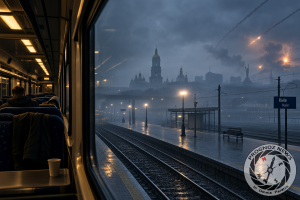
The train itself has acquired the strange melancholy of an object continuing to perform its ordinary function after the world around it has ceased to be ordinary. There are rows of vacant seats, a discarded paper cup, a coat thrown across a table and perhaps two or three passengers sleeping in positions that would be uncomfortable under any circumstances other than complete exhaustion. Nobody talks. There is no excitement about approaching Kyiv and none of the usual gathering of belongings as the suburbs begin to appear. Through the window there are railway sidings, warehouses, apartment blocks and electricity pylons emerging briefly from the mist before disappearing again. Here and there a light burns behind a window, providing the reassuring evidence that somebody is still inside, but otherwise the city appears not merely asleep but evacuated.
Then the air-raid siren begins again, rising and falling over the buildings with that horrible mechanical lament that everybody who has spent sufficient time in Ukraine has learned to recognise immediately. After years of full-scale war, Ukrainians have developed an extraordinary capacity to incorporate air-raid warnings into everyday life. People continue conversations, finish their meals, check their telephones to discover the character and direction of the incoming threat and make rapid calculations about whether it is worth going downstairs. This is one of the more perverse psychological consequences of prolonged warfare: something intended to provoke immediate terror becomes part of the administrative furniture of existence. Yet at dawn, in an apparently deserted city, the siren regains something of its original meaning because there is scarcely any other noise against which to hear it.
The sound travels across the mist and between the apartment blocks. There is almost no traffic to drown it out and few human voices to diminish its authority. It seems to belong to the city itself, as though Kyiv were an injured animal crying out into the darkness. From the railway carriage it is difficult to tell precisely where the sirens are coming from because they appear to be everywhere at once, reflected from buildings and distorted by the damp morning air. Then comes an explosion, deep enough to be felt faintly through the body of the train, and for a few seconds everybody who is awake looks towards the windows.
Nobody knows immediately what has happened. It may have been an interception by Ukrainian air defence. It may have been an incoming Russian drone or missile striking something. It may have occurred several kilometres away, because explosions travel strangely across cities in cold and misty weather. Modern warfare produces this peculiar form of sensory uncertainty in which one hears the consequences of events without being able to see their causes. There is a flash somewhere behind the buildings, perhaps another dull concussion and then silence again, except for the siren. The train nevertheless continues forward because railway timetables, like wars, have their own logic.
There is something almost absurd about the coexistence of these two systems. Somewhere far away, men have programmed coordinates into missiles and drones and launched them towards the city through which this train is travelling. Elsewhere Ukrainian soldiers are operating radar systems and air-defence batteries, trying to calculate trajectories and destroy the incoming weapons before they reach their targets. Yet inside the railway carriage somebody is brushing his teeth in the lavatory, the conductor is checking the doors and the driver is preparing to bring the train into Kyiv-Pasazhyrskyi more or less according to the timetable. A vast technological contest involving explosives, algorithms, radar, electronic warfare and human calculation is taking place in the sky while below it the railway is attempting to remain a railway.
This is perhaps one of the strangest characteristics of life in Ukraine after so many years of war. The extraordinary has ceased to displace the ordinary. Instead the two exist simultaneously. A ballistic missile alert can appear on a telephone while one is choosing breakfast. A Shahed-type drone can be passing overhead while somebody is taking a shower. An explosion can interrupt a business meeting for several seconds before everybody returns to discussing the spreadsheet. War has not replaced civilian life so much as penetrated it, occupying the spaces between its ordinary activities until danger and routine have become almost impossible to separate.
Yet there are moments when this accommodation breaks down, and arriving in Kyiv through the mist during a heavy period of Russian attacks is one of them. The city appears exhausted. Streets that ought to be beginning their morning movement are empty. Platforms designed for crowds contain only isolated figures. There are no queues of taxis and little of the impatient movement that normally characterises a capital city railway station. The Russian pummelling of Kyiv has become sufficiently persistent that on mornings such as this the population seems to have withdrawn from the visible surfaces of urban life, disappearing into apartments, shelters, Metro stations, corridors and bathrooms while waiting for the sky to become safe again.
Kyiv is not literally deserted, of course, and it is important to understand the distinction. A great many people remain here and the city continues to function. Hospitals are staffed, trains run, soldiers move around, cafés open, municipal workers report for duty and people continue the innumerable small obligations from which ordinary existence is constructed. Yet desertedness is not necessarily a demographic condition. It is also an atmosphere, and a city can contain hundreds of thousands of people while nevertheless appearing abandoned when everybody has learned that being unnecessarily visible beneath an uncertain sky is a bad idea.
The mist intensifies the sensation. Buildings lose their upper floors in it and street lamps become pale circles of light without apparent sources. Railway signals glow red and green through the damp air. The enormous city beyond the station dissolves into silhouettes: apartment towers, bridges, church domes and industrial structures whose precise identities become impossible to distinguish. Somewhere behind them there may be smoke from an impact or from an interception, but the mist absorbs that as well. Kyiv seems to have been reduced to fragments suspended in grey air while invisible machines hunt one another above it.
This is one of the psychological innovations of contemporary warfare. The battlefield is no longer necessarily somewhere else. It may be several hundred metres above one’s apartment, entirely invisible from the ground. Russian drones fly towards targets using combinations of satellite navigation, inertial guidance and programmed routes while Ukrainian interceptors, electronic warfare systems and air-defence missiles attempt to find them. Civilians beneath this technological contest may understand almost nothing of what is happening until they hear the buzzing of an engine, the crack of gunfire, the roar of an interceptor or the enormous concussion of something exploding. The sky itself has acquired hostile intentions.
Bombardment therefore achieves effects beyond whatever is physically destroyed. It attacks sleep and concentration. It fragments working days and destroys routines. It persuades people to move mattresses into corridors and teaches children which walls of an apartment are safest. It makes people hesitate before travelling across town and encourages them to keep shoes and clothing beside the bed. Most insidiously, it forces civilians to organise part of their consciousness around the decisions of distant strangers who may at that moment be selecting targets on electronic maps.
This is why the nearly empty train approaching Kyiv has significance beyond its melancholy appearance. Ukraine’s railways have become one of the great institutions of national continuity during the war. They have carried refugees away from danger, brought people back to their homes, transported soldiers and families, moved foreign dignitaries and aid workers and maintained connections across a country whose civilian airspace disappeared almost overnight in February 2022. The railway timetable is therefore more than a timetable. It represents the stubborn proposition that Ukraine remains connected and that ordinary geography continues to exist despite repeated attempts to destroy it.
The Russian missile and drone campaign and the Ukrainian railway system consequently embody two opposing conceptions of time. Bombardment seeks interruption. It seeks the cancellation of plans, the destruction of sleep and the creation of uncertainty about what will happen next. A railway timetable represents precisely the opposite idea: that at a stated hour tomorrow morning a train will leave one place and arrive at another. One system attempts to make the future unpredictable while the other insists upon predicting it down to the minute.
There is no guarantee that the railway will always win this argument. Tracks can be damaged, substations destroyed and trains delayed. People can be killed and stations can become targets. Nevertheless the continued movement of trains through wartime Ukraine has become an assertion of civilisation in its most practical sense. Civilisation is not merely art, philosophy, cathedrals and universities. It is also the collective assumption that arrangements made for tomorrow will still be honoured when tomorrow arrives.
The train begins to slow. Rails multiply outside the window and signals appear more frequently through the fog. The great railway complex of central Kyiv emerges gradually, although it too seems strangely emptied of humanity. Another explosion rolls across the city and the windows vibrate slightly. A passenger who has been asleep opens his eyes, looks briefly outside and reaches for his luggage. Nobody discusses what has happened because there is nothing useful to add. Everybody has heard explosions before.
This may be the most remarkable and perhaps the saddest form of Ukrainian resilience: not dramatic courage but habituation. War cannot be lived permanently at the emotional pitch of heroism. Nobody can experience terror every time a siren sounds for years without eventually becoming incapable of functioning. Human beings adapt because they must. They become irritated by air-raid alerts rather than terrified by them. They complain about interrupted sleep. They learn to distinguish sounds and estimate distances. They acquire opinions about different kinds of missiles in much the same way that people elsewhere acquire opinions about trains or motorcars.
There is something deeply wrong about possessing this knowledge, but it is also what permits life to continue. The conductor walks through the carriage. The driver brings the train towards the platform. Someone pulls on a coat and somebody else checks a message on a telephone. The gestures are entirely mundane, which is precisely what makes them moving. The persistence of Ukraine is constructed not only from soldiers in trenches but from millions of people repeatedly performing ordinary acts in circumstances in which ordinary life ought logically to have become impossible.
The train finally enters the station. The brakes engage with their familiar metallic complaint and the carriage shudders as it slows. Outside, the platform is wet and almost deserted, illuminated by harsh electric lights whose reflections stretch across the paving stones. The siren is still sounding somewhere beyond the station. In the distance another detonation is heard, followed by the brief and instinctive silence in which everybody waits to discover whether another will follow.
Then the doors open and the cold morning air enters the carriage. There is the smell of wet concrete, steel and the peculiar industrial dampness of railway stations before sunrise. One steps down onto the platform carrying a suitcase while Kyiv lies beyond the station concealed beneath mist and war. Somewhere people are underground. Somewhere soldiers are watching radar screens. Somewhere a family is sitting in a corridor away from its windows. Somewhere, despite everything, somebody is already making coffee and preparing to go to work.
The great city has not disappeared. It has withdrawn temporarily into itself, hiding from the machines passing through the sky and waiting for the morning to become ordinary again. That distinction matters because the purpose of sustained bombardment is not merely to break buildings. It is to persuade the inhabitants of a city that ordinary life is no longer possible there, that the future cannot be trusted and that eventually they should leave.
Yet the train has arrived. The rails still run into Kyiv. The station clock is still measuring time and people are still getting off with bags in their hands and places they intend to go. Beyond the mist the city remains battered, exhausted and frightened, but alive, and gradually the streets will begin to fill again once the alarms cease. The explosions may return tonight, and the sirens almost certainly will, but tomorrow morning another train will approach through the darkness carrying people who have decided, for whatever reason, that they are going to Kyiv.
In wartime, sometimes that is what defiance looks like. It does not shout and it does not carry a flag. It sits half-awake in an almost empty railway carriage while explosions roll across the capital, watches the grey outline of Kyiv emerge through the mist and waits patiently for the doors to open.
31 Views



Most Readings