Canada Comes to Europe
By Matthew Parish
Thursday 17 September 2026
The emerging Canada–European Union relationship may become one of the more consequential geopolitical experiments of the present decade. It is neither Canadian accession to the European Union nor merely another free-trade agreement. Instead, Ottawa and Brussels appear to be constructing something for which the European constitutional vocabulary does not yet possess a settled name: a transatlantic political, economic, technological and defence association between a North American state and Europe’s principal supranational institution.
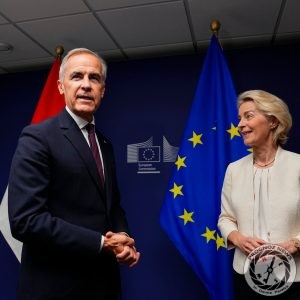
Something rather extraordinary happened in Strasbourg on 16 September 2026. During her State of the Union address, European Commission President Ursula von der Leyen, with Canadian Prime Minister Mark Carney present in the chamber, proposed opening the door for Canada to become the European Union’s first “associate member”. The expression is striking precisely because no such formal category presently exists in the EU treaties. What is being contemplated therefore remains to be negotiated, rather than being an established constitutional status into which Canada can simply enter.
Yet concentrating too closely upon the words associate member risks missing what is happening. Von der Leyen described an intended transition from the existing Comprehensive Economic and Trade Agreement, CETA, towards an “Alliance for the Future” involving a common prosperity and economic-security space, intelligent manufacturing, technology, integrated defence industries, the Arctic, energy, critical minerals, batteries, artificial intelligence, quantum computing and cyber security. The Canadian government has responded positively to the ambition of creating a substantially deeper relationship, while describing the eventual institutional form as something Canada and the EU will define together.
The importance of this proposal extends considerably beyond Canada and Europe. It represents an attempt to answer one of the defining geopolitical questions of the twenty-first century: what happens when middle and great powers that share broadly similar political and economic systems conclude that neither traditional alliances nor conventional free-trade agreements provide sufficient protection in a world of economic coercion, technological rivalry and increasingly uncertain security guarantees?
Canada’s European turn
Canada has always faced an unusual geographical problem. She is the second-largest country in the world by territory but lives beside an overwhelmingly larger economic and military power. Her prosperity has consequently been intimately connected with the United States, while her political traditions, demographic origins and diplomatic relationships have always been considerably more diverse.
For decades there was little contradiction between these facts. Canada could enjoy privileged access to the American economy, participate in NATO, retain especially close relationships with Britain and France and cultivate broader multilateral institutions without being forced to choose between them. The post-1945 transatlantic order made Canada’s geography unusually comfortable.
That assumption has become less secure. Under Prime Minister Mark Carney, the Canadian government has explicitly described its strategy as one of building greater “strategic autonomy, resilience, and sovereignty” through stronger relationships with trusted partners. The European Union has become central to that effort.
The economic foundations are already substantial. The EU was Canada’s second-largest trading partner for goods and services in 2025, with bilateral trade of approximately C$178 billion. The EU was also Canada’s second-largest source of foreign direct investment, while Canadian investment in the EU was estimated at C$315 billion.
CETA has meanwhile demonstrated how much further the relationship might travel. Von der Leyen told the European Parliament that EU-Canadian trade in goods had increased by 75 per cent in less than a decade under the agreement. The emerging project is therefore not an attempt to construct a relationship from nothing. It is an attempt to transform a successful commercial relationship into something approaching a geopolitical one.
Something more than trade
The defence dimension is particularly important. Canada and the EU signed a Security and Defence Partnership in June 2025 covering subjects ranging from military mobility and cyber threats to maritime security, emerging technologies, space security, economic security and support for Ukraine. NATO remains the cornerstone of collective defence for Canada and those EU states belonging to the Alliance, so this framework is formally complementary to NATO rather than a substitute for it.
Then came a remarkable institutional innovation. Canada became the first non-European country to obtain participation in the EU’s Security Action for Europe, or SAFE, defence instrument. SAFE provides up to €150 billion in loans supporting common defence procurement and expansion of Europe’s defence-industrial capacity. The agreement with Canada permits Canadian companies and products to participate in procurement financed through the programme.
This matters because defence industrial policy is becoming inseparable from geopolitics. A military alliance says that countries intend to defend one another. An integrated defence-industrial system goes considerably further: it means that their factories, research institutions, supply chains, technologies and procurement decisions become mutually dependent.
Canada and the EU are therefore experimenting with an arrangement in which political alignment is embodied in industrial infrastructure. Missiles, aircraft, drones, satellites, artificial intelligence, cyber systems, communications networks and ammunition production may increasingly be developed across an economic space stretching from Vancouver to Warsaw.
That would create strategic relationships considerably harder to reverse than diplomatic communiqués.
The Arctic bridge
There is also a geographical logic that is easily overlooked when looking at conventional maps of the Atlantic. Canada and Europe are not as distant as they appear. Look northwards rather than eastwards and Canada is effectively part of Europe’s strategic neighbourhood.
Von der Leyen specifically proposed making the Arctic a flagship Canada-EU project. This is potentially one of the most consequential elements of the new relationship.
Climate change is making Arctic waters progressively more accessible while Russia possesses an enormous Arctic coastline and China has sought a growing role in polar affairs. Canada, Denmark through Greenland, Finland and Sweden are NATO Arctic states, while Norway and Iceland bind the North Atlantic geography together. The strategic map of Europe therefore increasingly extends across Greenland towards the Canadian Arctic.
A Canada-EU strategic association would reinforce this northern arc. Critical infrastructure, satellites, submarine cables, early-warning systems, shipping routes, minerals and energy resources all become part of the same security environment. The Atlantic would cease to be understood principally as the ocean separating Europe from North America. In geopolitical terms it could increasingly become an internal sea connecting two parts of a wider democratic security and economic system.
The American question
It is impossible to understand the acceleration of Canada’s European policy without considering deterioration in Ottawa’s relationship with Washington. The current American administration’s tariffs and repeated rhetoric about Canada becoming the 51st state have contributed to Canadian efforts to reduce economic dependence upon the United States. Roughly 70 per cent of Canadian exports still go to the American market, which demonstrates both the depth of the existing relationship and the difficulty of rapid diversification.
President Donald Trump has already reacted critically to the proposed Canada-EU association and raised the possibility of additional tariffs depending upon how the arrangement develops. The precise consequences are uncertain because the Canadian-European arrangement itself has not yet been negotiated. There is nevertheless a deeper structural issue here. For most of the post-war period the United States encouraged European integration while simultaneously encouraging close Canadian-European relations because these arrangements strengthened an American-led Atlantic system. Canada becoming closer to Europe therefore posed no strategic dilemma.
The emerging model is subtly different. Canada and the EU are increasingly speaking the language of strategic autonomy. Their purpose is not necessarily separation from the United States, and both remain deeply connected to American markets and security structures. Nevertheless, autonomy means possessing credible alternatives when Washington’s preferences differ from theirs. That is a significant change in the architecture of the West.
A third economic space
The economic implications may eventually prove greater than the military ones. The world economy is increasingly organised around enormous regulatory and technological ecosystems. The United States has one. China has another. The European Union has developed a third through the Single Market and what is sometimes called the “Brussels effect”: the capacity of European regulations to influence global commercial standards.
Canada possesses extraordinary resources but a comparatively small domestic market. The EU possesses an enormous market but remains dependent upon imports for numerous strategically important raw materials. Their complementarities are obvious.
Canada has energy, uranium and extensive critical-mineral resources. Europe needs diversified supplies of precisely those materials as it attempts to reduce dangerous external dependencies. Both sides are now discussing closer cooperation in critical minerals, energy, artificial intelligence and computing, space, financial services, payments and digital trade.
This could eventually create something more interesting than another tariff-reduction agreement: a partially integrated transatlantic economic-security area.
Supply chains would increasingly be judged not merely according to price but according to political reliability. Canadian minerals might feed European battery factories; European industrial technology might support Canadian processing; defence companies might participate in common procurement; researchers might share technological programmes; financial and digital systems might gradually become interoperable.
Economic efficiency would remain important, but resilience would become an independent objective. That is geoeconomics replacing globalisation in its older form.
The constitutional puzzle
The greatest uncertainty concerns what “associate membership” could actually mean. Canada does not seek conventional EU membership, and geography alone makes the traditional accession model politically improbable. The EU treaties contain no existing category of associate member of the kind von der Leyen has proposed. Reuters notes that creating a treaty-based category would entail formidable legal and political complications, including agreement among the member states and domestic ratification requirements.
A more plausible development may therefore be functional rather than constitutional.
Canada could gradually acquire privileged participation in different parts of the European system without joining the Union itself: defence procurement, research programmes, digital markets, critical-mineral arrangements, industrial partnerships, mobility schemes and selected regulatory structures. Some mechanisms already exist. Canada has participated in EU Permanent Structured Cooperation projects since 2021 and has now entered SAFE.
Over time these separate arrangements could become sufficiently extensive that the political terminology catches up with institutional reality.
There is nevertheless an unavoidable question about sovereignty. Access to the European Single Market normally entails acceptance of European standards. The closer Canada moves towards regulatory integration, the more difficult it becomes to obtain the advantages of European rules without accepting constraints created in Brussels. Any eventual agreement must therefore confront the classic problem of association with the EU: how much participation can a non-member obtain without becoming a rule-taker? Canada may provide the laboratory in which a new answer is developed.
Britain should be watching
There is another intriguing implication. If the European Union can invent a sophisticated category of association for Canada, the obvious question is whether similar architecture might eventually be available to other democratic states that want deep integration without membership. Britain inevitably comes to mind. The United Kingdom’s historical circumstances are radically different because she was formerly an EU member, and any British relationship with the Union carries political complications absent from the Canadian case. Nevertheless, a successful Canadian model could demonstrate that European integration need not consist solely of the binary categories of membership and non-membership.
Japan, South Korea, Australia and other states may also watch the experiment closely. The EU already maintains Security and Defence Partnerships with several non-member countries, while SAFE establishes mechanisms through which selected partners can participate in European defence procurement.
Europe may therefore be stumbling towards something genuinely innovative: concentric circles of geopolitical integration surrounding the formal European Union. At the centre would remain the member states. Around them might develop countries deeply integrated economically, technologically or militarily without possessing the full rights and obligations of membership. Beyond those would sit conventional strategic partners. Canada could become the prototype for the middle category.
Ukraine and the new Atlantic
For Ukraine, this development deserves particular attention. Canada and the EU have explicitly reaffirmed continued support for Ukrainian sovereignty and territorial integrity and have been coordinating on defence, sanctions, economic security and assistance to Kyiv.
More importantly, an integrated Canadian-European defence industry would increase the geographical and industrial depth of the security system upon which Ukraine increasingly depends.
Ukraine herself occupies an unusual position within SAFE: together with EEA/EFTA states, she can participate with EU member states in common procurement under the instrument. Canada’s entry therefore creates the possibility of increasingly interconnected Ukrainian, Canadian and European defence production.
This is potentially more significant over the long term than individual military-aid packages. Wars of attrition are sustained by industrial ecosystems. The ability to manufacture drones, ammunition, sensors, air-defence systems and electronic-warfare equipment continuously matters as much as the transfer of existing stocks. The emerging Canada-EU architecture may therefore contribute to a defence-industrial geography in which Ukraine becomes progressively integrated with European and Canadian production networks.
A new kind of West
The forthcoming Canada-EU summit on 29–30 October 2026 will provide the next major opportunity to give substance to these ideas. Much remains undefined and it would be premature to treat von der Leyen’s proposal as an accomplished constitutional transformation. “Associate membership” is presently a political proposition, not an established legal status.
Nevertheless, the direction is unmistakable. The twentieth-century West was constructed principally around American power. Washington supplied the central military guarantee, the dollar anchored much of the financial system and American markets and technologies provided enormous economic gravitational force. Europe integrated internally beneath this strategic umbrella while Canada occupied a comfortable position beside the United States and inside the Atlantic alliance.
The twenty-first-century arrangement may become more complicated. Canada is unlikely to cease being North American. Europe is unlikely to become strategically independent of the United States in any absolute sense. NATO remains indispensable and the economic interdependence of Canada, Europe and America is too extensive to dissolve without enormous costs. Yet something important is happening beneath those continuities. Countries are constructing additional relationships because they no longer wish their security or prosperity to depend excessively upon any single external power, supply chain, technology provider or market.
Canada and the European Union are unusually well suited to attempt this experiment. Canada brings territory, natural resources, advanced industries, Arctic geography and a substantial defence relationship with the United States. Europe brings market scale, regulatory power, industrial capacity and an increasingly substantial collective defence apparatus. Both possess interests in maintaining an international environment in which medium-sized powers retain meaningful room for independent action.
Perhaps this is ultimately what associate membership will mean. It need not amount to Canada joining Europe. Instead, Canada and Europe may be trying to construct a political category appropriate to a world in which geography matters enormously but no longer dictates everything. Canada will remain across the Atlantic. But geopolitically, economically and strategically, she may be becoming considerably more European. And in an age in which the architecture of the post-war international system is being reconstructed almost everywhere at once, that may prove considerably more important than the terminology eventually chosen to describe it.
42 Views



Most Readings