Kant, Newton, and Einstein: The Continuum of Thought from Metaphysics to Relativity
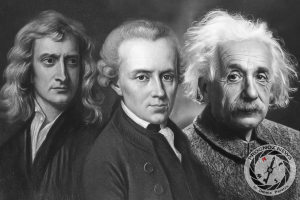
By Matthew Parish, Associate Editor
Friday 6 February 2026
The history of philosophy and physics are rarely parallel, yet at decisive junctures they intersect to redefine how humankind conceives of space, time, and causality. Few such intersections are as profound as that between Immanuel Kant’s Critique of Pure Reason (1781) and Albert Einstein’s theories of relativity (1905–1915). Although separated by more than a century, Kant’s metaphysical inquiries into the conditions of possible experience laid a conceptual groundwork that foreshadowed Einstein’s reappraisal of Isaac Newton’s classical physics. The extent of this intellectual anticipation lies not in any direct prediction of relativity but in the transformation of the very categories—space, time, and motion—that both thinkers sought to reinterpret.
Newtonian Absolutism and Kant’s Critical Response
Newton’s Principia Mathematica (1687) had enshrined an absolute conception of space and time. Space was a universal, infinite container in which all material events occurred; time flowed uniformly and independently of events, providing the unchanging background against which motion could be measured. This metaphysical realism about space and time underpinned the immense predictive success of Newtonian mechanics and endured as an article of scientific faith for two centuries.
Kant, however, living in the intellectual afterglow of Newton’s triumph, questioned the status of such absolutes. In the Critique of Pure Reason, he proposed that space and time were not properties of the external world but forms of human sensibility—a priori intuitions that structure all possible experience. For Kant, these were not empirical objects but the necessary conditions through which any experience of phenomena could occur. Hence the spatial and temporal ordering of the world was a feature of the mind’s constructive activity, not an ontological given.
By making space and time transcendental—rooted in human cognition rather than in physical reality—Kant undermined the metaphysical certainty of Newton’s absolutes. The Newtonian world was not the “thing in itself” (Ding an sich), but the phenomenal world as it appears through human perception and understanding. Kant’s revolution was thus epistemological, but it opened the conceptual possibility that space and time might be relative to the framework of perception or measurement—a possibility Einstein later translated into physical law.
From Kantian Relativism to Einsteinian Relativity
Einstein’s special and general theories of relativity did not emerge from philosophical speculation but from the empirical and mathematical anomalies of nineteenth-century physics, notably the invariance of the speed of light and the equivalence of inertial and gravitational mass. Yet when he reconceived space and time as components of a single four-dimensional continuum—spacetime—whose geometry depends on the distribution of matter and energy, he effected a transformation that bears an unmistakable Kantian resonance.
In Einstein’s universe, the measurement of time and space is not absolute but relative to the observer’s frame of reference. The simultaneity of events, the length of objects and the passage of time all depend upon the relative motion of the observer. The general theory further extended this relativity to gravitation, showing that what had been conceived as a “force” was in fact the curvature of spacetime caused by mass. In this vision, Newton’s immutable stage for physical events dissolved into a dynamic, interdependent fabric of relations—a reality that no longer mirrored Newtonian absolutes but echoed Kant’s insight that space and time are conditions of perception, not things in themselves.
However Einstein’s relativity was realist in a sense that Kant’s was not. Whereas Kant confined his transcendental forms to the structure of human cognition, Einstein attributed physical existence to the geometric structure of spacetime itself. Yet the philosophical affinity remains: both displaced space and time from the realm of fixed absolutes into that of relational dependence—upon consciousness in Kant’s case, and upon reference frames or gravitational fields in Einstein’s.
The Conceptual Bridge: The Relativity of Observation
The intellectual bridge between Kant and Einstein is the notion that the observer plays a constitutive role in the determination of phenomena. For Kant, the observer’s mind imposes order upon sensory data through categories of understanding—causality, substance, and unity among them. For Einstein, the observer’s state of motion determines the form of measurement and the relations between physical magnitudes. The transformation from epistemological to physical relativity replaces transcendental subjectivity with empirical observation, but the structural analogy persists: reality as we apprehend it is not independent of the conditions under which it is apprehended.
This shift from objectivism to relationalism—already latent in Kant’s thought—prepared the intellectual climate in which Newton’s mechanics could be re-examined. Kant did not and could not conceive of the mathematical apparatus of relativity, but his insistence that the foundations of physics rest on human modes of cognition weakened the dogma of absolute space and time, leaving open the conceptual space for Einstein’s revolution.
The Limits of the Analogy
Yet the correspondence has its limits. Kant’s “synthetic a priori” truths, such as the Euclidean nature of space, were for him immutable features of human sensibility. Einstein’s general relativity, by contrast, demonstrated that the geometry of space is non-Euclidean and dependent upon physical conditions. Thus Einstein’s discoveries can be seen as both fulfilment and refutation of Kantian philosophy: they realised the relativity Kant intuited but dissolved the synthetic a priori certainty upon which his epistemology rested. Space and time were shown not only to be relative but physically mutable—a finding that exceeded even Kant’s critical imagination.
Conclusion: Kant’s Shadow on Relativity
Einstein’s reappraisal of Newton’s cosmos was a scientific revolution, but it unfolded within an intellectual landscape first transformed by Kant. The Critique of Pure Reason redefined the relationship between observer and world, between perception and reality, and between metaphysics and science. In doing so it foreshadowed the conceptual daring of relativity—the recognition that the structure of experience (and thus of measurement) depends on the standpoint of the observer.
Kant’s transcendental idealism thus stands as a philosophical prelude to the relativistic worldview. Both thinkers dismantled the illusion of absolute reference points: Kant within the realm of knowledge, Einstein within that of physical law. Together, they mark the long arc of modern thought’s emancipation from Newtonian absolutism—a movement from certainty to relation, from the immutable to the dynamic, from the universe as a fixed stage to one perpetually conditioned by the perspectives through which it is known.
361 Views



Most Readings