Is Zaporizhzhia in danger?
By Matthew Parish, Associate Editor
Sunday 8 February 2026
Zaporizhzhia has always lived under the shadow of the southern front. What has changed in recent weeks is not the idea of danger, but its geometry. The threat is beginning to feel closer, not only because of missiles and drones, but because Russian ground pressure west of Orikhiv is steadily nibbling at the spaces that once served as Ukraine’s protective depth.
Two separate dynamics now overlap.
First, there is the slow movement of the line itself in eastern Zaporizhzhia Oblast, particularly on the Orikhiv axis. Independent open-source assessments have recorded Russian advances and infiltrations around settlements west of Orikhiv, including movement east of Shcherbaky and activity on the outskirts of Prymorske. Even where these actions do not immediately translate into dramatic territorial change, they matter because they compress Ukraine’s room for manoeuvre and push the fighting towards a set of routes and river lines that frame the approaches to the regional capital.
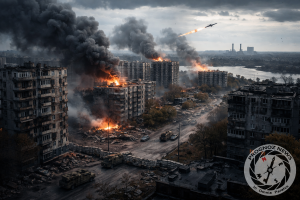
Second, there is the intensifying air threat to the city itself. Zaporizhzhia has endured repeated strikes throughout the full-scale war, but the pattern this winter has been one of persistence and scale. On 3 February 2026, a Russian drone attack struck Zaporizhzhia, damaging high-rise residential buildings and causing civilian deaths and injuries. On 6 February the Associated Press reported further damage in the region from a large wave of drones and missiles, with the regional authorities describing injuries and widespread harm to apartment blocks. These are not merely episodes of terror. They are part of a wider attempt to make urban life brittle, to strain air defence, to burden emergency services and to encourage departure.
If you overlay these two dynamics, the danger becomes clearer: Zaporizhzhia is threatened not by a single dramatic breakthrough but by a grinding convergence of proximity and attrition.
Geography explains why.
Zaporizhzhia city sits on the Dnipro, a logistical and psychological hinge between central Ukraine and the south. It is also the principal Ukrainian-held urban centre of the oblast, while much of the region to the south and east, including Enerhodar and the Zaporizhzhia Nuclear Power Plant, remains under Russian occupation. The front line west and south-west of the city is not simply a line on a map; it is a buffer that limits how close Russian tube artillery, glide bombs and short-range drones can operate against bridges, substations, depots and the ordinary infrastructure that keeps a winter city alive.
Open-source assessments in mid-January stated that Zaporizhzhia city was roughly 17 kilometres from the frontline at certain points of this sector. That figure should not be treated as a precise measurement of safety, because modern warfare erodes the old assumptions about distance. Yet it is indicative of something important: this is no longer a distant front for the regional capital. Even small Russian gains in the Orikhiv sector can translate into disproportionate effects, because they can broaden the range of weapons that are economical, frequent and hard to stop.
This is how a city becomes endangered without being besieged.
There are three ways this danger could deepen.
The first is a tightening air campaign that targets the city’s capacity to function. Winter strikes against energy and heating are not only about physical damage, but about civic exhaustion. The Associated Press has described repeated large-scale drone barrages focusing on infrastructure and causing blackouts and disruption of heating and water supplies. For a frontline-adjacent city, the consequences are magnified: repairs are harder under air alerts, spare parts are scarcer, skilled crews are overstretched and the population is already carrying the accumulated fatigue of four years of full-scale war.
The second is the extension of the “drone envelope” and the widening of the lethal zone around the city’s southern approaches. The modern battlefield is increasingly defined by reconnaissance-strike loops, in which drones find targets and other systems hit them quickly. That matters for Zaporizhzhia because the city is not only a place where people live; it is a rear area where units rest, resupply and rotate. If Russian forces can push their reconnaissance and strike capabilities deeper into the Ukrainian rear, they can disrupt the rhythms that keep the front stable even without capturing ground. Recent assessments have described Russian loitering munitions striking or attempting to strike Ukrainian air defence assets in the broader Zaporizhzhia area, a reminder that air defence itself is part of the contested battlefield.
The third is ground pressure designed to create dilemmas rather than breakthroughs. Russian advances around Stepnohirsk, Shcherbaky and Prymorske have been discussed in open-source reporting as a mixture of bypass attempts, infiltration and incremental forward movement. The logic of such operations is often to find weak seams, force Ukraine to commit reserves, and create a constant sense that the line might crack. In January Ukrainian analyst group DeepState reported Russian advances in Zaporizhzhia Oblast. Even small shifts can trigger bigger consequences: additional evacuations, more pressure on roads, and a tighter calculus for keeping civilians in towns that were already precarious.
This brings us to the human dimension, which is where the danger becomes most political.
When a city is subject to persistent air attack, and when the front line is close enough for the population to feel the war’s physical presence, the state must make hard choices about who can safely remain. On 2 January 2026 Ukraine’s authorities announced forced evacuations of children from frontline settlements in Zaporizhzhia and Dnipropetrovsk regions, citing a difficult security situation. This is not simply a humanitarian measure. It is also an admission that the war is compressing civilian space. As the buffer shrinks, schools, clinics and public services become harder to operate, and a city like Zaporizhzhia must absorb waves of displaced families from smaller communities that can no longer be defended as living places.
Zaporizhzhia therefore faces a double load: the direct burden of being targeted, and the indirect burden of serving as a refuge and administrative centre for a region under pressure.
The danger is amplified by symbolism.
Zaporizhzhia is one of the major Ukrainian industrial cities of the south-east, a visible marker of statehood on the Dnipro, and an emblem of Ukraine’s continued hold on territory that Russia claims. For Moscow, striking the city serves propaganda as well as military ends: it suggests inevitability, it attempts to demoralise, and it signals to foreign audiences that the war’s costs will continue unless Ukraine yields. For Kyi, holding Zaporizhzhia is equally symbolic, particularly while the nuclear power plant remains occupied. The city’s survival as a functioning urban centre is itself a strategic statement.
None of this means that Zaporizhzhia is on the verge of immediate capture. A rapid, sweeping assault against a prepared defensive network is difficult, especially when the defender can see, strike and erode attacking forces. Even where Russian units make local advances, they have often paid heavily for them across the theatre. The more realistic risk is that Zaporizhzhia becomes increasingly constrained, a city that remains Ukrainian but lives under a tightening regime of alerts, outages, damaged housing and periodic disruption of the transport and logistics that connect it to the rest of the country.
In practical terms, the danger to Zaporizhzhia should be understood as a spectrum:
It begins with fear and inconvenience.
It progresses to depopulation pressure, as families with children and the elderly seek safer regions.
It evolves into economic thinning, as businesses struggle with unreliable electricity, workforce flight and higher insurance and security costs.
It culminates in strategic vulnerability, if the city’s role as a logistics hub is sufficiently degraded that Ukraine must reroute supply and rotation patterns in ways that strain other sectors.
This is why the apparent “smallness” of advances west of Orikhiv matters. War is not only about flags planted in villages. It is about how close the killing systems can get to the arteries of a city, and how many times a society can be forced to repair the same kinds of damage before resilience begins to fray.
Zaporizhzhia’s danger, then, is not a headline event. It is a slow crisis with occasional sharp spikes. And it will be shaped by two contests running in parallel: the ground fight that decides distance, and the air fight that decides whether distance still protects.
228 Views



Most Readings