Are the United Kingdom and the United States becoming more corrupt?
By Matthew Parish, Associate Editor
Thursday 12 February 2026
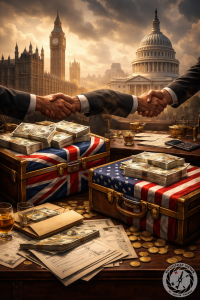
A recent study claims that the United Kingdom and the United States are becoming more corrupt. To assess this assertion the first task is to ask what, precisely, has been measured. Corruption is not a single act. It ranges from the cash-in-an-envelope bribery that many people imagine, through to the more lawful, varnished forms of influence that thrive in wealthy democracies: opaque political finance, lucrative employment after public office, procurement shaped by proximity to power, regulators captured by the industries they supervise, and a justice system bent—quietly or openly—towards the interests of those who can afford to litigate forever.
The study that has prompted much of the present discussion is Transparency International’s Corruption Perceptions Index CPI) for 2025, published on 10 February 2026. It is, by design, a measure of perceived public-sector corruption, assembled from multiple expert and business surveys rather than from a count of proven criminal cases. That distinction matters—perceptions can deteriorate because corruption has increased, because investigative journalism has improved, because scandals have become more visible, because institutions have become more polarised, or because citizens’ tolerance for conflicts of interest has fallen. Yet perceptions are not trivial. In the real world of investment decisions, diplomatic trust and the willingness of citizens to obey laws voluntarily, perception is often the mechanism by which governance either accrues legitimacy—or loses it.
Transparency International’s CPI report describes a pattern that will trouble readers who assume that “advanced democracies” naturally immunise themselves. It notes a more recent decline concentrated amongst higher-scoring countries, including the United States and the United Kingdom, and links that slippage to weakened checks and balances, gaps in anti-corruption legislation and scaled-back enforcement, alongside political polarisation and the growing influence of private money over decision-making. In the executive summary the report points to a “worrying trend” of worsening perceived corruption in democracies including the US and UK and records the two countries’ 2025 scores as 64 (US) and 70 (UK), each out of 100 (least corrupt). Contemporary reporting summarised the same findings as “new lows” for both countries within the CPI’s historical series.
So—are the UK and US really becoming more corrupt?
They may be becoming more corrupt in a particular way: not necessarily through an explosion of petty bribery, but through normalised conflicts of interest and influence that sit in the grey zone between “legal” and “proper”. In a democracy the most damaging corruption is often the kind that does not require a brown envelope. It is the kind that turns public office into a market—where access is sold as “fundraising”, where regulation becomes a revolving door, and where state contracts become a reward for proximity rather than competence.
The CPI report gives a UK example that has become emblematic: controversies surrounding pandemic procurement, particularly personal protective equipment, where those close to power were able to secure lucrative contracts. That episode matters not only because of any wrongdoing in individual contracts (some of which have been litigated and debated at length), but because it revealed a vulnerability: in a crisis, standard guardrails are relaxed, and personal networks can substitute for transparent processes. Crisis is an accelerant for corruption everywhere—Ukraine knows this better than most—because urgency is the enemy of scrutiny.
In the United States Transparency International highlights something slightly different: the weakening of anti-corruption enforcement beyond her borders. The CPI report criticises decisions that “temporarily freeze and then degrade” enforcement of the Foreign Corrupt Practices Act, a key law against corporate bribery of foreign officials, warning that such moves send a signal that bribery and related practices are tolerable. This is not merely a foreign-policy detail. It points to a deeper question: does the state still believe that rules apply to powerful actors, including corporations and political allies? When enforcement becomes sporadic, selective or politically interpreted, corruption is invited in—not only through what is done, but through what is seen to be permitted.
Both countries also share a structural temptation: large sums of private money flow towards politics, often lawfully, and the boundary between democratic participation and purchased access is not self-policing. The CPI report explicitly links rising risks to “the growing influence of private money on decision making”. News reporting on the CPI release similarly foregrounded concerns about wealthy influence and institutional erosion in both countries. The details differ—American campaign finance is a universe of its own, while British party finance and honours culture have their own particular pathologies—but the underlying danger is the same. Where access is monetised, public decision-making begins to look like a service available at different price points.
Yet it would be careless—and politically convenient—to treat the CPI as a simple thermometer reading of “how corrupt a country truly is”. The CPI measures perceptions from composite sources; it is widely used precisely because direct measurement of corruption is notoriously hard, but its authors are clear about its scope and limits. In the United Kingdom and the United States, a paradox is always present: strong media, adversarial politics and active civil society can make corruption more visible than in places where it is deeper but quieter. A country in which whistleblowers speak, journalists publish and prosecutors act may feel “more corrupt” because it is less able to hide. Conversely, a country where fear reigns may look “cleaner” on the surface because nobody dares to name the rot lest they be targeted, for example with prosecutions for criminal defamation (a technique used by some archaic European states).
Indeed the CPI report itself draws a strong connection between open civic space and better control of corruption, showing higher average CPI scores where civic freedoms are protected. That finding cuts in two directions for the UK and US. On one hand, if civic space narrows—through intimidation of journalists, politicisation of oversight, legal harassment of critics, or the erosion of norms—then corruption risks rise and perceptions worsen. On the other hand the very existence of civic contestation can make a society look noisier and “more corrupt” precisely because she is arguing about standards in public, rather than pretending that standards are naturally met.
There is also the problem of conflation. Many citizens use “corruption” as a shorthand for “a government I dislike”, or for a general sense that the social contract has frayed. Polarisation makes that worse. When half the electorate believes institutions are illegitimate, every enforcement action becomes “political” and every scandal becomes proof that the other side is uniquely rotten. This is not a defence of misconduct; it is a description of a feedback loop. Once public trust collapses, corruption becomes easier—because people stop expecting integrity, and politicians stop fearing reputational consequences.
So what can we reasonably conclude?
First, there is enough smoke in both countries to treat the CPI decline as more than mere mood. The report does not claim that London and Washington resemble Mogadishu; it claims that, relative to their own baselines, these systems have become more vulnerable to integrity failures, especially where oversight is weakened and private money bends decision-making. Those are plausible mechanisms, and they match what citizens have watched over the past decade: scandal clusters, “rules for them” allegations, and a creeping sense that consequences are unevenly distributed.
Secondly, the kind of corruption at issue is often legalistic rather than overt. In the United Kingdom arguments about lobbying, the revolving door and honours are frequently not about criminality but about propriety and accountability. Transparency International explicitly points to problems around revolving doors (for example workers moving from public sector regulators to jobs in the private sector where they are regulated, achieving regulatory concessions for their new employers); lobbying transparency; and the enforcement of anti-corruption rules. In the United States the question is not only who takes bribes, but whether enforcement and the rule of law are applied consistently—and whether political power is being used to reward friends and punish enemies. These are the forms of corruption that corrode democracy without necessarily producing a neat criminal docket.
Thirdly, perceptions matter because they shape behaviour. If businesses believe contracts depend on access, they invest in access. If citizens believe politics is a club, they withdraw, leaving politics to those who enjoy the club. If civil servants believe ministers will protect allies, they stop raising concerns. In that sense, “becoming more corrupt” can be a self-fulfilling trajectory—a slow change in incentives until the abnormal becomes routine.
Finally, this debate has a particular resonance for Ukraine. She is asked, daily, to prove that she can defeat corruption while fighting a war for survival. It is awkward, to put it mildly, when older democracies lecture Kyiv on governance while their own standards appear to be slipping. That does not absolve Ukraine of reform; it clarifies the real lesson. Anti-corruption is not a destination reached once and for all, but a continuous maintenance of institutions—courts, audit bodies, procurement systems, parliamentary scrutiny, free media—against the natural tendency of power to protect itself.
If the United Kingdom and United States wish to reverse the trend, the remedies are not mysterious, but they require political self-denial:
-
tighten rules on political finance and access, so that fundraising cannot plausibly be confused with the sale of influence
-
make lobbying transparency meaningful, with enforcement and real consequences for non-compliance
-
slow the revolving door through longer cooling-off periods and enforceable restrictions, not voluntary codes
-
harden public procurement against cronyism, especially in crises, through default transparency and retrospective audits with teeth
-
defend civic space—journalists, watchdogs, whistleblowers—because scrutiny is not a nuisance but the immune system
None of this is glamorous. It does not generate stirring speeches. It does however decide whether a democracy remains a system in which power is borrowed, temporary and accountable—or becomes a system in which power is an asset, tradable and privately protected.
On the evidence of the CPI and the broader discussion around it, the safest answer is this: both the United Kingdom and the United States are not inevitably becoming more corrupt, but it is becoming easier. And when corruption becomes easier—when rules are treated as optional, oversight as partisan, and access as a commodity—it rarely stops at the boundary of what is merely “unseemly”.
318 Views



Most Readings