The Islamic Revolutionary Guard Corps
By Matthew Parish, Associate Editor
Tuesday 17 March 2026
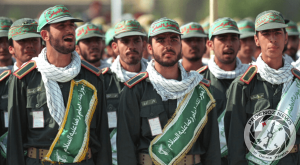
The Islamic Revolutionary Guard Corps — known in Persian as the Pasdaran — stands today as one of the most consequential, opaque and ideologically driven military institutions in the modern world. It is at once an army, a political movement, an intelligence service, a terrorist organisation and a commercial empire. To understand contemporary Iran, and much of the Middle East’s strategic turbulence, one must begin with the peculiar origins of this institution, forged in revolution and sustained through war.
Revolutionary Origins — 1979 and the Birth of a Parallel State
The Islamic Revolutionary Guard Corps was created in the immediate aftermath of the Iranian Revolution of 1979. The collapse of the monarchy of Shah Mohammad Reza Pahlavi left behind a fractured security apparatus — a conventional army distrusted by the revolutionary clerics and a patchwork of militias that had helped overthrow the ancien régime.
Ayatollah Ruhollah Khomeini, the revolution’s spiritual leader, resolved this dilemma by establishing a new force in April–May 1979. Its purpose was not merely to defend Iran as a state, but to defend the revolution as an idea.
From the outset therefore the IRGC was conceived as a counterweight to the regular armed forces — a parallel military loyal not to institutions but to ideology and to the person of the Supreme Leader.
This distinction proved decisive. Whereas the regular army, the Artesh, was charged with defending territorial integrity, the IRGC was entrusted with preserving the Islamic system itself.
In practical terms this meant enforcing revolutionary morality, suppressing dissent and ensuring that no counter-revolution — whether monarchist, liberal or leftist — could take root. It was, from the beginning, both sword and shield of the Islamic Republic.
War and Expansion — The Crucible of the Iran–Iraq Conflict
The Iran–Iraq War (1980–1988) transformed the IRGC from an improvised militia into a formidable military institution. Initially deployed to supplement the regular army, it rapidly developed its own command structures, doctrine and culture.
The war also embedded a distinctive ethos — one that fused Shi’a martyrdom traditions with modern warfare. Volunteer formations such as the Basij, often composed of young men and even boys, were mobilised in vast numbers and deployed in high-risk operations.
At sea the IRGC pioneered asymmetric tactics — including fast attack craft and naval mining — that would later define Iran’s doctrine in the Persian Gulf.
The conflict provided both legitimacy and institutional memory. The IRGC emerged not merely as a military force, but as the guardian of a narrative — the “sacred defence” — which justified its continued prominence in Iranian society.
From Military Force to Political-Economic Power
Following the war the IRGC underwent a second transformation — from battlefield force to political and economic powerhouse.
Throughout the 1990s and 2000s it expanded into construction, energy, telecommunications and finance, often benefiting from state patronage and sanctions-driven economic isolation.
Simultaneously, veterans of the IRGC entered politics in increasing numbers, occupying positions in parliament, ministries and provincial administrations.
The Corps also developed specialised branches:
-
The Quds Force, responsible for external operations and support to allied militias
-
The Basij, a mass mobilisation force used for internal security and social control
-
Missile and aerospace divisions overseeing Iran’s strategic weapons programmes
By the early twenty-first century the IRGC had become a state within a state — an institution whose influence extended across every domain of Iranian life.
Its mission likewise expanded beyond Iran’s borders. Through networks of allied groups in Lebanon, Iraq, Syria and Yemen it projected influence across the Middle East in what Iranian strategists describe as an “axis of resistance”.
Ideology and International Reach
At the heart of the IRGC lies a paradox. It is both deeply national — rooted in the defence of the Iranian state — and overtly transnational, committed to the export of revolutionary ideology.
This duality is embodied most clearly in the activities of the Quds Force, which has provided training, funding and operational support to a range of non-state actors across the region.
Critics, particularly in Western states, characterise these activities as sponsorship of militant or terrorist organisations. Supporters, within Iran and amongst her allies, frame them as legitimate resistance against foreign intervention.
This divergence in perception has led to increasing international pressure. The United States has designated the IRGC as a terrorist organisation, and the European Union has recently followed suit, citing repression and external operations.
The IRGC in Contemporary Iran — Ascendancy Amid Crisis
Recent events suggest that the IRGC has reached the zenith of her power. Amidst intensifying conflict involving Iran, Israel and the United States it has assumed an increasingly central role in both military operations and internal governance.
Intelligence assessments indicate that, despite external pressure and military strikes, the Iranian state has not fragmented. Instead, the IRGC has consolidated control, tightening internal security and maintaining strategic capabilities such as control over the Strait of Hormuz.
The death of senior leadership figures and the emergence of a new Supreme Leader with close ties to the Corps appear, if anything, to have strengthened its institutional dominance.
Operationally the IRGC remains deeply embedded in both conventional and unconventional warfare — from missile and drone strikes to the management of proxy networks.
A Revolutionary Institution Without Precedent
The Islamic Revolutionary Guard Corps is not easily comparable to Western military institutions. It is neither purely an army nor merely a political guard. Rather it is the institutional embodiment of a revolution that has refused to settle into conventional statehood.
Its origins lie in distrust — of the old army, of foreign influence, of internal dissent. Its growth was forged in war. Its present power rests upon an intricate fusion of military capability, ideological legitimacy and economic control.
In contemporary geopolitics the IRGC represents a model of statecraft in which the boundary between military and political authority is deliberately erased. As long as the Islamic Republic endures, it is difficult to imagine a scenario in which the IRGC does not remain at its core.
Indeed the history of the IRGC suggests a broader lesson — that revolutionary institutions, once established and legitimised through conflict, rarely recede. Instead they adapt, expand and, in times of crisis, assume ever greater authority.
In Iran today, that process appears not merely ongoing but complete.
218 Views


Most Readings

Crimea Under Pressure: Ukraine’s Long Campaign Against Russia’s Southern Bastion
99 Views