Too Much Capital, Too Few Convictions: Why Excess Liquidity Breeds Instability in an Age of War
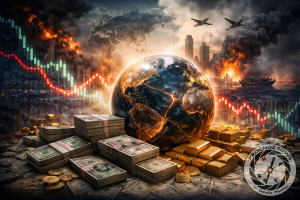
By Matthew Parish, Associate Editor
Thursday 2 April 2026
There is a paradox at the heart of the contemporary global economy. Capital is abundant — perhaps more abundant than at any time in history — and yet conviction is scarce. Trillions of dollars, euros, renminbi and sovereign wealth allocations circle the planet in search of return. But the number of investments that are genuinely sound — commercially durable, politically secure and legally predictable — appears far smaller than the capital available to finance them. In such an environment, markets become not merely volatile but structurally unstable. And when war intrudes upon the global system, as it has in Ukraine and now across parts of the Middle East, that instability becomes chronic.
This proposition — that there is more money to invest than there are viable investments — may appear counterintuitive. After all, human ingenuity is not in short supply. New industries emerge constantly. Artificial intelligence, renewable energy, advanced materials, digital finance — the list of opportunities seems endless. Yet opportunity is not the same as investability. A sound investment requires not only innovation but predictable regulation, enforceable contracts, willing purchasers, manageable geopolitical risk and a time horizon long enough for capital to compound.
In the decades following the Cold War, investors could assume a relatively stable global order. Supply chains were international. Energy markets were integrated. Great power war seemed improbable. The World Trade Organisation provided rules; the United States Navy secured sea lanes; central banks suppressed inflation with credible independence. In that world, capital allocation resembled engineering — optimising yield across predictable parameters.
That world has gone.
The Russian invasion of Ukraine in 2022 fractured assumptions about European security. The Persian Gulf disruptions and the widening confrontation involving Iran and Israel have unsettled assumptions about maritime transit and energy flows. Relations between the United States and China have hardened into strategic rivalry. Sanctions regimes proliferate. Assets can be frozen or rendered untradeable overnight. In such conditions the universe of genuinely safe investments contracts — yet the volume of capital seeking refuge expands.
The result is herding behaviour of extraordinary intensity.
When uncertainty rises, institutional investors retreat to perceived havens: United States Treasury bonds, gold, the Swiss franc, select blue-chip equities. Yields compress as money floods in. Then, as inflationary fears or fiscal anxieties surface, that same capital departs just as abruptly. What appears to be rational portfolio adjustment at the level of the individual becomes destabilising at the systemic level. Markets no longer adjust gradually; they convulse.
This phenomenon is amplified by structural features of modern finance. Passive investment vehicles, exchange-traded funds and algorithmic trading systems move capital at high velocity. Risk models rely upon historical correlations which break down in wartime conditions. Liquidity, which seems abundant in tranquil periods, evaporates precisely when most needed. The global financial system resembles a vast reservoir connected by high-pressure pipes — capable of moving water instantly, but vulnerable to violent pressure shifts when valves are turned too quickly.
There is also a deeper problem — the political economy of surplus capital.
Ageing populations in Europe and East Asia accumulate pension savings requiring yield. Sovereign wealth funds derived from hydrocarbon exports seek diversification. Technology billionaires and private equity funds manage unprecedented concentrations of private capital. Meanwhile real economic growth in mature economies remains modest. Enormous investments are made in artificial intelligence, but the large language models struggle to sell their products and AI companies are generally running huge operating losses – a classic bubble. Infrastructure projects are politically contested. Manufacturing is reshoring but at high cost. Climate transition investments require decades to mature. In short, capital outpaces absorptive capacity.
This imbalance produces asset inflation rather than productive transformation. Real estate prices detach from local incomes. Technology valuations stretch beyond plausible earnings. Commodities experience boom-bust cycles disconnected from physical supply. Capital chases narrative as much as fundamentals — and narrative shifts quickly in wartime.
Consider the psychology of markets during conflict. War introduces radical uncertainty. Supply chains may rupture. Governments may expropriate or regulate. Energy prices may spike. Insurance costs may soar. In such conditions investors do not simply reassess expected return; they reassess the rules of the game. When rules themselves are uncertain, even high returns appear illusory.
Capital therefore oscillates between risk-on and risk-off postures with increasing frequency. Emerging markets experience sudden stops — currencies depreciate sharply as foreign investors withdraw. Then, if geopolitical headlines soften, money returns, compressing spreads once more. The cycle repeats. What appears as volatility in financial indices translates into real economic hardship: higher borrowing costs, unstable exchange rates, delayed infrastructure, constrained credit for small businesses.
Ukraine offers a poignant example. Even as she fights for survival and implements reform under fire, vast sums of pledged reconstruction capital wait on the sidelines. Investors require insurance mechanisms, security guarantees and legal clarity. The appetite to support her is real; the willingness to bear unquantifiable risk is limited. Thus money accumulates in global funds while bombed bridges and power stations await rebuilding. The mismatch between capital supply and investable certainty becomes morally as well as economically consequential.
Yet the phenomenon is not confined to conflict zones. Even in advanced economies, political polarisation and fiscal uncertainty narrow the field of stable opportunity. Governments run deficits to fund defence and social commitments. Central banks face the dilemma of inflation control versus growth support. Elections threaten regulatory reversals. The line between economic policy and strategic competition blurs. Capital, sensing fragility, becomes skittish.
In this sense, instability is not merely cyclical; it is structural. When the global system contains excess liquidity relative to trusted opportunity, any shock — a missile strike, a sanctions announcement, a trade dispute — reverberates disproportionately. Funds are pulled out of one asset class and plumbed into another with little friction. Each movement creates its own micro-crisis. Bond markets tremble; equity indices lurch; currencies swing. Policymakers respond with emergency measures which themselves distort incentives, encouraging further speculative flows.
One might argue that this is simply the price of financial sophistication — that deep capital markets necessarily entail volatility. But there is a distinction between healthy price discovery and chronic instability. When capital cannot find long-term homes, it becomes nomadic. Nomadic capital is impatient capital. And impatient capital amplifies fear.
Is there a remedy?
Part of the answer lies in restoring predictability. Clearer trade rules, credible security guarantees, transparent sanctions frameworks and consistent regulatory regimes expand the domain of investability. Infrastructure banks and multilateral guarantees can transform high-risk regions into viable destinations for private funds. Long-term climate and reconstruction bonds, underwritten by coalitions of states, can absorb surplus capital productively.
Yet the political precondition for such measures is stability — and stability is precisely what global conflict erodes.
The uncomfortable conclusion is that financial volatility in our era is not an aberration but a reflection of geopolitical fragmentation. When the international order is cohesive, capital allocation appears rational and efficient. When it fragments, capital behaves defensively and erratically. Markets do not create geopolitical risk, but they magnify its economic consequences.
We therefore inhabit a world in which money is plentiful but trust is scarce. The imbalance between the two generates oscillation. In peaceful decades, oscillation is manageable. In wartime it becomes destabilising.
The paradox remains: never has humanity commanded such pools of savings; never has it struggled more to deploy them with confidence. Until credible frameworks of security and law are re-established across the principal theatres of conflict, excess capital will continue to surge from one perceived refuge to another — and markets will continue to convulse accordingly.
204 Views



Most Readings

Crimea Under Pressure: Ukraine’s Long Campaign Against Russia’s Southern Bastion
99 Views