Western politicians: always in the air
By Matthew Parish, Associate Editor
Monday 22 April 2026
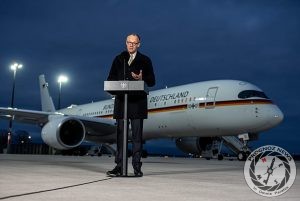
The modern Western politician, observed at close quarters, appears less a statesman than a peripatetic apparition — a figure glimpsed fleetingly at airport gates, in motorcades, on summit stages and in the choreographed spontaneity of handshake diplomacy. One is left to wonder, with only mild irony, whether governance itself has become a secondary activity — something squeezed into the margins between flights.
This is not an entirely new phenomenon. Diplomacy has always required movement. But the scale, frequency and theatricality of contemporary political travel suggest something qualitatively different: a system in which presence has supplanted substance, and where the act of being seen to govern risks displacing the act of governing itself.
Consider the modern calendar of Western leadership. The year is punctuated by an almost liturgical cycle of gatherings — the World Economic Forum in January, the Munich Security Conference in February, successive G7 and G20 meetings, NATO summits, COP climate conferences, bilateral state visits, emergency consultations, and the increasingly frequent ad hoc “coalitions of the willing” that arise in response to crisis. In 2025 alone hundreds of senior policymakers converged physically at such events across continents, reaffirming that in-person diplomacy remains not merely preferred but culturally entrenched.
The justification is always the same: face-to-face interaction is irreplaceable. Indeed surveys of professional meeting planners indicate that roughly 90 per cent still consider physical presence critical to achieving outcomes. Yet one might reasonably ask whether this is a reflection of necessity — or of institutional inertia masquerading as necessity.
The sheer density of political travel raises uncomfortable questions about time allocation. A transatlantic trip — say, from Washington to Brussels — consumes not merely the hours in the air but days of preparation, security coordination, jet lag and recovery. Multiply this by dozens of journeys per year and the arithmetic becomes stark. A senior Western leader may spend a substantial fraction of his or her working life in transit, or preparing to be in transit.
Recent controversies illustrate how elastic the definition of “work travel” has become. In Australia for example, public criticism erupted over ministers claiming taxpayer-funded travel for trips that coincided with personal engagements — weddings, family holidays, and loosely defined “political duties”. The official defence — that such travel is integral to the diffuse and demanding nature of political work — is revealing. It suggests that the boundary between governance and movement has become blurred, if not entirely dissolved.
More subtly, the political incentive structure now rewards mobility over stillness. A leader photographed stepping off an aircraft signals activity, engagement, relevance. A leader sitting quietly in his or her office drafting legislation signals, at best, obscurity. In an era dominated by visual media and instantaneous reporting, motion itself has become a proxy for effectiveness.
This is particularly evident in the context of crisis diplomacy. The war in Ukraine, the instability of the Middle East and the fragmentation of the global economic order have generated an almost continuous cycle of emergency summits and shuttle diplomacy. Europe in 2026, facing what some analysts describe as one of its most dangerous periods in decades, has seen its leaders engaged in near-constant travel to coordinate responses across a fractured geopolitical landscape. Yet the paradox is clear: the more complex the problems, the less time leaders appear to have to engage in the deep, reflective work that such problems demand.
There is also an economic dimension. Travel, even at the level of political elites, is subject to the same pressures affecting the wider world. Rising costs, security concerns and geopolitical tensions are increasingly shaping where and how meetings occur. Yet despite these constraints, the appetite for travel remains undiminished — a testament not only to its perceived value but to the difficulty of imagining an alternative.
One might ask whether technology offers a solution. After all the same Western leaders who insist upon the indispensability of physical presence routinely govern societies in which remote communication has become ubiquitous. The pandemic briefly forced an experiment in virtual diplomacy — summits conducted over video links, negotiations mediated through screens. But the reversion to physical meetings was swift and decisive. The ritual of travel, it seems, carries symbolic weight that no digital substitute can easily replicate.
But symbolism is precisely the problem. When political travel becomes ritualised, it risks degenerating into performance. The summit communiqué, carefully negotiated over sleepless nights, often contains little that could not have been agreed in advance by officials working remotely. The real decisions one suspects are made elsewhere — in smaller rooms, by fewer people, over longer periods, and often without the need for a presidential motorcade.
There is an older model of governance, now largely eclipsed, in which political authority was exercised through deliberation rather than motion. Leaders governed from fixed centres — capitals, councils, courts — and travel was exceptional rather than routine. That model had its own deficiencies, not least insularity and detachment. But it did at least ensure that the bulk of a leader’s time was spent in proximity to the machinery of government.
Today by contrast the machinery risks being left unattended. Civil servants, advisers and institutional processes continue to function, of course — often with admirable efficiency. But the political direction that is supposed to guide them becomes episodic, fragmented and reactive, shaped by the exigencies of travel rather than by coherent strategy.
An edgy conclusion suggests itself. Western politics has become in part a form of theatre in motion — a continuous performance of engagement in which the journey itself is mistaken for progress. The leader as traveller replaces the leader as thinker. The airport lounge supplants the cabinet.
This is not to deny the importance of diplomacy, nor the necessity of personal interaction in a fractured world. But it is to question whether the balance has tipped too far — whether the spectacle of governance has begun to crowd out its substance.
For a continent such as Europe, confronting existential challenges from war, economic stagnation and political fragmentation, this is not a trivial concern. The problems are not merely urgent; they are complex, requiring sustained attention and intellectual labour. They cannot be solved at 30,000 feet.
Perhaps the most radical reform would be the simplest: fewer flights, longer stays, deeper work. But such a reform would require a cultural shift — an admission that governing is not, in fact, best performed in transit.
Until then the Western politician will remain what he has increasingly become: a figure in perpetual motion, governing the world from the aisle seat.
8 Views


Most Readings