History’s Echoes: What the First World War Teaches About Ukraine Today
By Matthew Parish, Associate Editor
Wednesday 22 April 2026
There are moments in history when events appear so unprecedented, so violently dislocating, that contemporaries insist no comparison can suffice. The Russian invasion of Ukraine is often described in such terms. Yet the closer one looks, the more the present conflict begins to resemble an earlier European catastrophe: the First World War. Not because history repeats itself in any mechanical sense, but because patterns of human behaviour, institutional weakness, and strategic miscalculation recur with a stubborn persistence. Ukraine today stands, in several respects, where much of Europe stood in 1914 — on the fault line between empires, ideas, and competing visions of order.
The First World War began not merely as a clash of armies, but as a crisis of political imagination. Europe’s great powers had constructed elaborate systems of alliances, deterrence doctrines and diplomatic rituals, all of which were supposed to prevent precisely the kind of general war that ultimately broke out. When the assassination of Archduke Franz Ferdinand triggered the July Crisis, the machinery of diplomacy proved incapable of restraining escalation. Each state acted according to its own logic of security, honour and perceived necessity. The result was a catastrophe that none of them, individually, had truly intended.
Ukraine’s predicament since 2014, and more dramatically since 2022, echoes this dynamic of systemic failure. The post-Cold War order — grounded in institutions such as NATO and the European Union — was built upon assumptions about deterrence, economic interdependence, and the gradual convergence of political systems. Russia’s leadership however interpreted these structures not as stabilising frameworks but as encroachments upon what it considered its sphere of influence. The annexation of Crimea and the full-scale invasion that followed represent, in effect, a rejection of the post-1991 settlement — much as the outbreak of the First World War represented the collapse of the 19th-century Concert of Europe.
One of the most striking parallels lies in the nature of warfare itself. The First World War is remembered for the brutal stasis of trench warfare — a grinding, attritional struggle in which technological innovation outpaced tactical adaptation. Machine guns, artillery and barbed wire rendered offensive manoeuvre extraordinarily costly, yet generals persisted in strategies that assumed rapid breakthroughs. The result was a war of exhaustion, measured in metres gained and lives lost.
Ukraine’s front lines have at times resembled this earlier conflict with uncanny precision. Extensive trench systems, fortified positions and heavily mined landscapes dominate large stretches of the battlefield. Yet there is also a crucial difference — one that illustrates how technology reshapes, rather than abolishes, historical patterns. Whereas the First World War relied on human observation and rudimentary reconnaissance, Ukraine’s war is saturated with drones, satellite imagery and real-time data analysis. The battlefield is both more transparent and more lethal. The fundamental logic of attrition remains, but it is now mediated by algorithms and sensors rather than binoculars and signal flags.
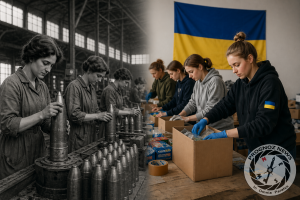
This combination of continuity and change extends to the role of industry and society. The First World War was the first fully industrialised conflict, requiring the mobilisation of entire economies and populations. Factories were repurposed for munitions production; women entered the workforce in unprecedented numbers; governments assumed extraordinary powers over economic life. War became not merely a military endeavour but a societal one.
Ukraine has undergone a similar transformation. Civilian industries have been redirected towards defence production, particularly in the rapidly evolving field of unmanned systems. Volunteer networks, private donors and international partners all contribute to the war effort. The distinction between civilian and military spheres has blurred — as it did in 1914–1918 — creating a totalising environment in which national survival depends upon the integration of every available resource.
Diplomatically too the echoes are unmistakable. The First World War saw the gradual involvement of external powers, turning a regional conflict into a global one. The entry of the United States in 1917 proved transformative, tipping the balance in favour of the Allies. Yet this intervention came only after years of hesitation, internal debate and shifting public opinion.
In Ukraine’s case Western support has been decisive but carefully calibrated. The United States and European allies have provided weapons, intelligence, and financial assistance, while seeking to avoid direct confrontation with Russia. This cautious engagement reflects a modern version of the dilemma faced by policymakers in the early 20th century: how to influence the outcome of a conflict without triggering uncontrollable escalation. The shadow of nuclear weapons — absent in 1914 — adds a further layer of complexity, reinforcing restraint even as it heightens the stakes.
Another lesson from the First World War concerns the unpredictability of duration and outcome. In 1914 many believed the war would be over by Christmas. Instead it dragged on for four years, reshaping the political map of Europe and laying the foundations for future conflicts, including the Second World War. The inability of leaders to anticipate the war’s trajectory was not merely a failure of intelligence, but a failure of imagination.
A similar uncertainty surrounds Ukraine today. Early expectations — both of a swift Russian victory and later of rapid Ukrainian breakthroughs — have repeatedly proven inaccurate. The conflict has settled into a protracted struggle, in which incremental gains are achieved at significant cost. This suggests that, as in the First World War, the decisive factor may not be a single battle or campaign, but the cumulative effect of endurance: economic resilience, political cohesion, and the capacity to sustain military operations over time.
Perhaps the most profound parallel however lies in the question of political order. The First World War marked the end of empires — the Austro-Hungarian, Ottoman, German and Russian — and the emergence of new nation-states. It was a moment of both destruction and creation, in which the principle of national self-determination gained unprecedented prominence, even as it generated new conflicts and instabilities.
Ukraine’s struggle can be understood in similar terms. It is not merely a territorial dispute, but a contest over sovereignty, identity and the right of a nation to determine its own future. In resisting Russian aggression, Ukraine asserts a principle that was central to the post-1918 settlement: that political legitimacy derives from the will of the people, not from imperial inheritance or military force.
Yet history also warns of the fragility of such achievements. The settlement that followed the First World War — embodied in the Treaty of Versailles — was flawed and incomplete. It resolved some conflicts while sowing the seeds of others. If Ukraine’s war eventually leads to a negotiated peace, the challenge will be to construct an order that is both just and durable — one that avoids the mistakes of the past by addressing, rather than merely deferring, underlying tensions.
The echoes of the First World War do not provide a blueprint for Ukraine’s future. They do however offer a set of cautionary insights. They remind us that wars often begin with miscalculation, that they tend to last longer than expected, and that their consequences extend far beyond the battlefield. They illustrate the interplay between technology and strategy, the mobilisation of societies, and the difficulty of managing escalation in a complex international system.
Above all they underscore a simple but unsettling truth: that the structures designed to preserve peace are only as strong as the political will that sustains them. In 1914 that will proved insufficient. The question facing Europe today is whether it has learned enough from its past to avoid a similar failure — or whether, once again, it will find itself overtaken by the very forces it sought to contain.
169 Views



Most Readings