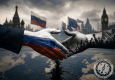
Vladimir Boglaev and the fracture between Russian state narrative and economic reality
By Matthew Parish, Associate Editor
Friday 24 April 2026
In April 2026 at the Moscow Economic Forum, a relatively obscure industrial director from the city of Cherepovets delivered remarks that would, in another political environment, scarcely merit attention. Yet in contemporary Russia they resonated with unusual force.
Vladimir Boglaev, head of a major foundry and mechanical plant, described the situation in the Russian economy in stark terms. “A catastrophe is happening,” he warned. More striking still was his political observation: that the authorities themselves were “actively discrediting the themselves” and had lost contact with reality.
This was not the rhetoric of an opposition politician. It was the language of a man responsible for payrolls, machinery, orders and supply chains—one of those figures upon whom the functioning of the wartime Russian economy ultimately depends.
The industrial critique: a system “overcooled”
Boglaev’s argument was not framed as a moral denunciation of the Kremlin’s war policy. Instead, it was a structural critique of economic management.
He argued that the monetary tightening pursued by the Central Bank—designed to control inflation—had gone too far, effectively “overcooling” the economy. The consequence in his telling was the collapse of demand across multiple sectors, the abandonment of investment, and a shift from expansion to layoffs and reduced working hours.
More significantly, he suggested that the policy had undermined the state’s own declared objective of import substitution—a central pillar of Russia’s wartime economic strategy.
This is the kind of criticism that cannot easily be dismissed as ideological subversion. It arises from the internal contradictions of the system itself.
“The loss of feedback”: a political diagnosis
Where Boglaev’s remarks cross from economics into politics is in his diagnosis of governance.
He spoke of a “complete loss of feedback” between the governing elite and the realities of the economy. This is a striking formulation—one that echoes longstanding critiques of late Soviet governance, in which information flowed upwards only after being filtered, sanitised or distorted.
In this reading the problem is not merely policy error but epistemological failure. The state no longer knows the condition of the country it governs.
Boglaev went further, suggesting that unpopular decisions were being taken in a manner that would actively erode public trust ahead of elections—raising the possibility that elements within the system itself were destabilising it.
Such language, even cautiously expressed, edges into dangerous territory in contemporary Russia.
Reaction and counter-reaction: dissent within the elite
The reaction to Boglaev’s remarks reveals much about the present state of Russian political discourse.
He was praised in some quarters as a rare figure willing to “speak the truth”. But he also was sharply criticised by establishment commentators, who accused him of engaging in political manoeuvring or even of echoing the destabilising impulses associated with the late Soviet period.
This dual reaction is instructive. It shows that dissent in Russia is no longer confined to marginal figures or exiles. It is emerging, however tentatively, within the economic elite itself.
Yet such dissent is immediately politicised and framed as a threat—either to stability, or to the continuity of the state.
War, economy, and the paradox of support
How does this connect to the continued popularity—at least in public terms—of the invasion of Ukraine?
The answer lies in the separation between narrative and experience.
The state’s narrative of the war remains coherent, disciplined and emotionally resonant. It draws upon themes of historical struggle, external threat and national destiny. Within this framework, criticism of the war itself is marginalised or criminalised.
But Boglaev’s critique does not directly challenge that narrative. Instead, it addresses the consequences—the economic strain, the policy distortions, the erosion of industrial capacity.
This allows a peculiar coexistence:
-
public support for the war as an idea
-
private or sectoral dissatisfaction with its economic management
In other words the war remains popular in abstraction, even as its material effects generate unease.
The industrial warning: echoes of the late Soviet period
Boglaev’s comparison of the current situation to the period preceding the collapse of the Soviet Union is perhaps the most revealing element of his intervention.
It is not a prediction of imminent collapse. Rather it is a warning about systemic drift—about a state that continues to function, but increasingly without accurate self-knowledge.
In the late Soviet period such drift manifested in declining productivity, hidden shortages and a widening gap between official statistics and lived reality.
Boglaev’s argument suggests that a similar dynamic may be emerging:
-
policies designed for stability producing stagnation
-
official optimism masking structural weakness
-
decision-making detached from industrial realities
The significance of Boglaev
Vladimir Boglaev is not a dissident in the classical sense. He does not call for regime change. He does not reject the state.
That is precisely what makes his words significant.
He represents a form of internal critique that arises when the mechanisms of governance begin to fail those who depend upon them. His language is not ideological but empirical—rooted in production figures, employment levels and investment decisions.
Boglaev embodies a broader shift within Russia: a movement from silent compliance towards cautious articulation.
The invasion of Ukraine may still command outward loyalty. But beneath that surface, figures like Boglaev point to a growing tension between the demands of war and the capacities of the economy.
Such tensions do not always produce immediate political consequences.
But they accumulate—quietly, persistently—until the system that contains them must either adapt or fracture.
179 Views


Most Readings

Crimea Under Pressure: Ukraine’s Long Campaign Against Russia’s Southern Bastion
99 Views