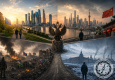
Best solo travel destination in 2026: Ukraine

By Matthew Parish, Associate Editor
Saturday 25 April 2026
Ukraine does not immediately present herself as a conventional destination for the solitary traveller. She does not advertise ease. She does not promise comfort. She does not wrap herself in curated experiences or predictable itineraries. And yet for those who arrive alone, carrying little more than a laptop and a willingness to observe, she reveals herself with an intensity that few countries can match.
One begins perhaps in Lviv — a city that feels at once like a memory of Central Europe and something more fragile, more alert. The cobbled streets are polished not by tourism but by time, and the cafés are filled not with itinerant influencers but with students, lawyers, soldiers on leave. You sit with your coffee and open your computer, and nobody asks you to leave. Nobody hovers. You are left alone — which is precisely what a solo traveller seeks, and what most destinations struggle to provide.
There is a peculiar freedom in this anonymity. Ukraine does not perform for you. She does not rearrange herself to meet your expectations. Instead she invites you to adjust to her rhythms. Power cuts may interrupt your work. Air raid sirens may interrupt your thoughts. And yet somehow, neither quite disrupts the quiet productivity that defines the digital nomad’s life. One learns to pause, to wait, and then to continue — an education in patience that no co-working space in Lisbon or Bali could ever replicate.
In Kyiv the scale shifts. Here is a capital that refuses to behave like one. She is vast, yes, and historically layered — her monasteries and ministries rising above the broad sweep of the Dnipro — yet she moves with a kind of restrained urgency. The metro carries you deep beneath the earth, into stations that double as shelters, and when you emerge you find cafés full, conversations animated, life proceeding with a determination that borders on defiance.
For the remote worker, this creates an environment unlike any other. The internet is fast, the coffee is strong, the cost of living remains — improbably — reasonable. But these are not the real attractions. The true appeal lies in the constant, subtle awareness that what you are doing — answering emails, drafting documents, attending virtual meetings — is taking place against a backdrop of history in motion. It lends even the most trivial task a curious weight.
Further south in Odesa, the atmosphere softens but does not entirely relax. The sea offers its usual illusions — openness, escape, distance — yet even here the realities of the present linger just beneath the surface. You walk along the promenade, laptop closed for the afternoon, and watch the horizon. It is beautiful. It is calm. And it is impossible to forget that this calm is contingent.
For the solo traveller, this creates a paradoxical sense of safety. Ukraine is, in many ways, a country where one is left alone — not ignored, but respected in one’s solitude. People are direct, often generous, occasionally curious, but rarely intrusive. You can spend an entire day moving through a city without being approached, and yet find yourself, in the evening, drawn into conversation with strangers who speak with an openness that feels almost disarming.
And then there is the countryside — the long train journeys that carry you through fields of sunflowers and small stations where time appears to hesitate. The Carpathian Mountains rise in the west, offering a different kind of solitude: one that is not urban and observational, but physical and immediate. Here, the digital nomad becomes briefly analogue. The signal fades. The work pauses. And one is left, simply, with the landscape.
It would be easy at this point to conclude that Ukraine is ideal because she combines affordability, connectivity, culture and solitude. These are, after all, the standard metrics by which such destinations are judged. But to describe her in these terms is to miss the point entirely.
Ukraine is compelling precisely because she does not fit comfortably into the category of a “destination”. She resists consumption. She refuses simplification. For the solo traveller this creates an experience that is not merely enjoyable but transformative — and not always in ways that are immediately pleasant.
There is, inevitably, an undertone — a darkness that cannot be ignored. The signs of conflict are present, sometimes subtly, sometimes not. A boarded window. A uniform glimpsed in a café. A momentary silence as a siren begins. These are not attractions, and it would be grotesque to treat them as such. Yet they shape the experience in ways that are impossible to replicate elsewhere.
The irony, if one is prepared to acknowledge it, is that Ukraine offers a kind of authenticity that the modern travel industry has almost entirely eradicated. She does so not by design, but by circumstance. Where other destinations construct narratives for visitors to consume, Ukraine simply continues to exist — complex, contradictory, unfinished.
For the digital nomad, this presents a challenge as much as an opportunity. One cannot remain entirely detached. The usual posture of ironic distance — of observing a place without being implicated in it — becomes increasingly difficult to sustain. You arrive intending to work remotely, to live lightly, to pass through. And yet over time, the country asserts herself. She demands attention. She invites, perhaps even compels, a degree of engagement.
It is in this tension that Ukraine becomes, for the solo traveller, the most compelling destination in the world. Not because she is easy, or comfortable, or even entirely safe — but because she is real in a way that few places any longer are.
And so you sit, once more, in a café in Lviv or Kyiv, your laptop open, your work continuing as it always does. Outside, life moves forward with a quiet, determined resilience. You are, in every practical sense, alone — and yet, in a way that is difficult to articulate, you are not.
164 Views



Most Readings