Land robots changing the front line landscape in Ukraine
By Matthew Parish
Sunday 26 April 2026
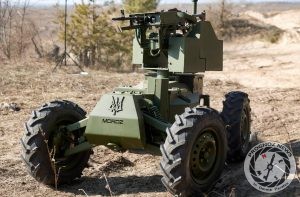
The war in Ukraine has, from its earliest days in 2014 and with terrible intensity since 2022, been a crucible of military innovation. Much attention has been devoted to the aerial domain — to unmanned aerial vehicles, loitering munitions and the adaptation of civilian quadcopters into instruments of reconnaissance and death. Yet a quieter transformation is underway upon the ground. Land robots — ungainly, improvised, sometimes little more than tracked boxes with cameras — are beginning to alter the character of warfare in ways that may prove as consequential as their airborne counterparts.
At first glance the concept is not new. Remote-controlled ground vehicles have long existed in the arsenals of technologically advanced armies, typically used for bomb disposal or engineering tasks. What distinguishes the Ukrainian theatre is not invention but proliferation, adaptation and necessity. Faced with a numerically superior adversary, and one willing to expend human life with startling indifference, Ukrainian forces have sought to conserve their most precious resource: trained soldiers. Land robots have emerged as one answer to this problem.
They are in essence expendable infantry substitutes. Small tracked platforms — often assembled from commercially available components — are sent forward to perform tasks that would otherwise expose human beings to lethal risk. They carry ammunition to forward positions; they evacuate the wounded from zones under constant observation; they deliver explosives to enemy fortifications; they conduct reconnaissance in urban ruins and trench systems where visibility is measured in metres rather than kilometres. In a war defined by artillery saturation and omnipresent drones, any movement detectable by the human eye is swiftly punished. A machine, by contrast, may move without fear.
This has subtle but profound implications for tactics. The static trench warfare that has characterised much of the front line since late 2022 has created an environment of extreme lethality for dismounted infantry. Any attempt at manoeuvre risks immediate detection by aerial reconnaissance and subsequent destruction by artillery or drone strike. Land robots introduce a new variable into this equation. They enable limited forms of manoeuvre beneath the threshold of human exposure — probing enemy positions, testing defences, even initiating assaults in conjunction with aerial drones.
In some sectors, Ukrainian units have begun to experiment with coordinated operations involving both aerial and ground unmanned systems. A drone overhead identifies a target — a dugout, a machine gun nest, a concealed trench entrance. A ground robot, guided by operators at a distance, advances with an explosive payload. The human soldier, once required to approach under fire, is removed from the immediate danger. Warfare becomes, incrementally, a contest of remote perception and mechanical endurance rather than physical courage alone.
Yet it would be mistaken to suppose that this development renders human soldiers obsolete. On the contrary, it alters their role. The soldier becomes an operator, a technician, a decision-maker at one remove from the battlefield. This demands new skills — familiarity with control systems, an understanding of signal interference, the ability to interpret video feeds under stress. It also introduces new vulnerabilities. Communications links may be jammed; signals intercepted; machines captured and repurposed by the enemy. The battlefield becomes as much electromagnetic as physical.
The Russian Federation has not been idle in this regard. Her forces too have begun deploying ground robots, albeit often in more centralised and less flexible ways. There is evidence of robotic platforms used for mine clearance, logistics and even direct assault roles. However the decentralised innovation characteristic of Ukrainian units — driven by necessity, supported by volunteer networks and private companies — has thus far afforded Ukraine a relative advantage in adapting these systems to immediate battlefield needs.
There is also an economic dimension to this transformation. Land robots, particularly improvised ones, are comparatively inexpensive. They can be produced in workshops far from the front, assembled from components that would not attract the attention of export control regimes. In a war of attrition, where the consumption of matériel is relentless, the ability to generate functional systems at low cost is a strategic asset. It allows Ukraine to offset, in part, the industrial capacity advantage of her adversary.
The humanitarian implications are complex. On one level the use of land robots promises a reduction in casualties amongst those who deploy them. A machine destroyed is not a life lost. Medical evacuation by robotic means in particular offers the prospect of saving wounded soldiers who might otherwise be unreachable under fire. Yet there is also a darker aspect. The distancing of human operators from the immediate consequences of their actions may over time lower the psychological barriers to the use of lethal force. Warfare conducted through screens risks becoming abstract, its human cost obscured by pixels and signal delay.
Furthermore the presence of autonomous or semi-autonomous systems raises questions of accountability. If a ground robot delivers an explosive charge that causes unintended civilian harm, where does responsibility lie? With the operator? The commander? The designer of the system? These are not merely theoretical concerns. As the sophistication of such machines increases — and with it the degree of autonomy they may possess — the law of armed conflict will be tested in ways not yet fully understood.
Looking forward, one may discern the outlines of a new form of combined arms warfare. Infantry, armour, artillery, aerial drones and ground robots integrated into a coherent system — each compensating for the vulnerabilities of the others. Tanks, increasingly vulnerable to precision-guided munitions, may be preceded by robotic scouts. Infantry assaults may be led by unmanned platforms carrying suppressive fire or explosive charges. Logistics chains may rely upon autonomous vehicles to traverse exposed terrain.
The war in Ukraine has often been described as a conflict of the twentieth century fought with the technologies of the twenty-first. In the emergence of land robots we see perhaps the first glimpse of a twenty-first century ground war in its own right. It is a war in which presence is decoupled from risk, in which the human body is no longer the sole instrument of military action upon the battlefield.
Yet for all this the essence of war remains unchanged. Territory must still be taken and held. Decisions must still be made under conditions of uncertainty and fear. Machines may extend the reach of human will, but they do not replace it. The mud of the Donbas, the shattered towns of the east, the long lines of trenches stretching across the horizon — these remain stubbornly human environments.
Land robots are revolutionising the war in Ukraine, but their revolution is not one of replacement. It is one of augmentation — of shifting the balance between exposure and protection, between presence and distance. In that shift lies both promise and peril. For Ukraine, fighting for her survival, they are tools of necessity. For the world, observing and learning, they are harbingers of wars yet to come.
176 Views



Most Readings