Israel’s forthcoming general election
By Matthew Parish, Associate Editor
Monday 27 April 2026
The forthcoming Israeli general election, scheduled for October 2026 unless precipitated earlier by coalition collapse, has assumed the character of a national reckoning. It is not merely a contest between parties, nor even between ideologies; it is increasingly a referendum upon the long and controversial premiership of Benjamin Netanyahu, whose authority has been weakened simultaneously by legal jeopardy, health concerns, and the cumulative burdens of war.
Israel approaches this election in a state of sustained mobilisation. Since the attacks of October 2023 and the wars that followed in Gaza, Lebanon, and Iran, she has been governed under conditions that blur the line between emergency and normality. The electorate therefore faces a paradox: it is asked to pass judgement upon leadership at a moment when the state’s strategic environment remains unresolved and volatile.
Netanyahu himself remains at the centre of this paradox. At seventy-six, he has recently disclosed treatment for early-stage prostate cancer, a condition reportedly resolved but nevertheless politically consequential in a system that has long revolved around his personal authority. At the same time his ongoing corruption trial continues to erode his claim to institutional legitimacy, with allegations that he exchanged regulatory favours for favourable media coverage. These legal proceedings, slow but relentless, have become a permanent backdrop to Israeli political life, raising questions not only about his personal future but about the resilience of Israel’s judicial institutions.
Yet Netanyahu is not easily dismissed. He remains the dominant figure in Israeli politics, leading the Likud and polling competitively even amid declining support. Surveys suggest his party still commands a plurality of seats, though not enough to guarantee a governing majority. His political durability lies partly in his ability to embody Israel’s security anxieties, presenting himself as the indispensable steward of a nation under threat. However this claim has been deeply shaken by the failure to prevent the Hamas attack of October 2023 and by the inconclusive outcomes of subsequent conflicts.
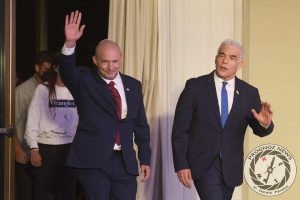
Against him a notable realignment has taken place. Two former prime ministers, Naftali Bennett and Yair Lapid, have agreed to merge their respective political vehicles into a single electoral list, tentatively named “Together”. This alliance is significant not because it resolves ideological differences – it does not – but because it reflects a growing consensus that fragmentation within the opposition has been Netanyahu’s greatest asset.
The Bennett–Lapid partnership is, in essence, a coalition before the election rather than after it. It seeks to present voters with a credible governing alternative, something that Israel’s fractured party system has often failed to provide. Polling suggests that, while Netanyahu’s bloc may fall short of a majority, a unified opposition could assemble one with the support of smaller parties. The strategic question is whether this alliance can maintain coherence long enough to convert electoral arithmetic into stable governance, given that a similar experiment in 2021 collapsed within eighteen months.
Timing remains a critical uncertainty. Israeli law provides for elections in October 2026, but the fragility of Netanyahu’s coalition – already strained by disputes over military service exemptions for ultra-Orthodox communities and by the fiscal pressures of wartime budgeting – leaves open the possibility of an earlier vote. Netanyahu himself has manoeuvred to avoid a premature election he might lose, even as some within his camp have considered exploiting wartime conditions to call one sooner. This tactical ambiguity reflects a broader truth: electoral timing in Israel is often a function of political survival rather than constitutional rhythm.
The wars that frame this election have had a complex and often contradictory effect upon public opinion. Israeli society has rallied around the necessity of military action against Hamas, Hezbollah, and Iranian influence. Yet there is also growing scepticism about the government’s ability to translate battlefield operations into strategic success. The sense of perpetual mobilisation – what some analysts have described as a “super-Sparta” model of society – risks exhausting both the economy and the social contract.
This tension is particularly evident in debates over military service. The long-standing exemption of ultra-Orthodox men from conscription has become increasingly contentious during a protracted war that has demanded repeated reserve call-ups and inflicted significant casualties. The issue cuts across traditional political alignments, fuelling resentment not only towards religious parties but also towards a governing coalition perceived as privileging narrow interests over national cohesion.
Israel’s external conflicts have likewise reshaped her diplomatic environment. Ceasefires imposed or encouraged by external actors, notably the United States, have exposed the limits of Israeli autonomy and have been seized upon by opposition figures as evidence of strategic mismanagement. At the same time continued settlement expansion in the West Bank and legislative initiatives such as the expansion of the death penalty to Palestinian terrorists have intensified international criticism, placing Israel under growing diplomatic pressure.
The electorate thus confronts a landscape marked by frustration as much as fear. There is frustration with a political system that has produced repeated elections and unstable governments; frustration with a war that appears endless; and frustration with leadership that, for many, no longer commands unquestioned trust. Yet there is also a pervasive fear – of external enemies, of internal division, and of the unknown consequences of political change.
The 2026 election may therefore be understood less as a conventional democratic exercise than as a moment of strategic choice. Israelis are not merely selecting a government; they are deciding whether to continue under a leader who has defined the state’s political life for a generation, or to entrust power to an untested coalition united primarily by its opposition to him.
Netanyahu’s future therefore hangs in a delicate balance. His health appears stable, his legal battles ongoing, and his political instincts as sharp as ever. But the forces arrayed against him – institutional, electoral, and psychological – are stronger than at any point in recent years. Whether they will suffice to end his tenure remains uncertain.
What is certain is that Israel enters this election at a crossroads. The outcome will shape not only her domestic political order but also her posture in a region that remains, as ever, unforgiving.
177 Views



Most Readings