The rise and fall of socialist realism
By Matthew Parish
Thursday 30 April 2026
Socialist realism — once proclaimed as the triumphant artistic language of a new civilisation — rose with remarkable speed and declined with equal inevitability. It was not merely an aesthetic doctrine but an instrument of statecraft, a moral code, and a theatre of ideological persuasion. Its history is therefore inseparable from that of the twentieth century’s most ambitious political experiment: the attempt to reshape society through revolutionary socialism under the auspices of the Soviet Union.
The Birth of an Official Aesthetic
In the years following the Russian Revolution, artistic life in Russia was initially chaotic and experimental. Avant-garde movements flourished — Constructivists, Futurists, Suprematists — all competing to define what revolutionary art might mean. Yet by the early 1930s this pluralism came to be regarded as dangerous. The state, consolidating authority under Joseph Stalin, demanded clarity, unity and ideological reliability.
It was in this context that socialist realism was formally codified at the First Congress of Soviet Writers in 1934. It was defined not merely as a style but as a method — one that required artists to depict reality “in its revolutionary development”. This phrase concealed a profound contradiction. Artists were not to portray reality as it was, but as it ought to be according to Marxist-Leninist doctrine. Reality, in effect, was to be corrected.
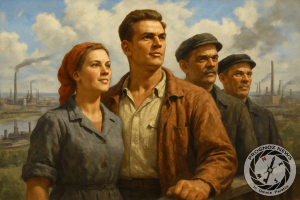
The result was a visual and literary language of extraordinary consistency. Workers appeared heroic, their bodies idealised; peasants smiled beneath abundant harvests; factories gleamed as temples of progress. Figures such as Vladimir Lenin were rendered as near-sacred presences, while Stalin himself often appeared as a paternal figure guiding the masses towards a radiant future.
Art as Political Machinery
Socialist realism functioned less as art in the traditional sense than as a system of communication. It was designed to be immediately intelligible to the masses, rejecting abstraction and ambiguity in favour of narrative clarity. It resembled religious iconography — a comparison not lost on critics — but with Marxism replacing theology.
Its role was particularly evident during the Five-Year Plans and the rapid industrialisation of the 1930s. Paintings, sculptures and novels did not merely reflect economic transformation; they sought to accelerate it. The idealised worker or engineer became a model for emulation, an image through which the state attempted to shape behaviour itself.
Yet this system required strict control. Artists who deviated from the prescribed line risked censorship, professional ruin or worse. The purges of the late 1930s reached into artistic circles, ensuring compliance through fear. Creativity, in its spontaneous and exploratory sense, was subordinated to ideological function.
War, Triumph and Exhaustion
The World War II — or the Great Patriotic War, as it was known in Soviet discourse — provided socialist realism with a renewed sense of purpose. Heroism, sacrifice and collective struggle were themes well suited to its vocabulary. Images of soldiers defending the motherland, of civilians enduring hardship with stoic dignity, reinforced national unity.
In the post-war period socialist realism reached its zenith. It expanded across the Eastern Bloc, imposed upon countries brought within the Soviet sphere of influence. From Warsaw to Sofia artists were instructed to adopt its principles, creating a transnational aesthetic of ideological conformity.
Yet even at its height, signs of fatigue were evident. The repetition of themes and forms led to a certain artistic sterility. The gap between representation and lived reality grew increasingly difficult to ignore. Citizens knew that the smiling abundance depicted on canvas often bore little resemblance to the shortages and constraints of everyday life.
The Thaw and the Slow Unravelling
The death of Stalin in 1953 and the subsequent reforms under Nikita Khrushchev initiated a period of relative liberalisation known as the Thaw. While socialist realism remained the official doctrine, enforcement became less rigid. Artists began to experiment cautiously, introducing elements of personal expression and stylistic variation.
By the 1960s and 1970s a parallel culture of unofficial art had emerged. These artists, often working outside state institutions, rejected the constraints of socialist realism entirely. Their work ranged from abstraction to conceptualism, reflecting a desire to reconnect with broader international currents.
The state responded ambivalently — at times tolerating, at times suppressing these developments. Events such as the “Bulldozer Exhibition” of 1974, in which an unofficial art show was violently dispersed by authorities, revealed the limits of permissible deviation.
Nevertheless the ideological certainty that had sustained socialist realism was eroding. The doctrine no longer commanded genuine belief; it persisted largely through institutional inertia.
Collapse and Afterlife
The dissolution of the Soviet Union in 1991 marked the definitive end of socialist realism as a state-imposed orthodoxy. Without the political structure that had sustained it, it rapidly lost relevance. Artists in post-Soviet societies turned towards pluralism, exploring styles and themes long suppressed.
Yet socialist realism did not vanish entirely. It survives as a historical artefact, a subject of scholarly analysis and occasional aesthetic revival. In some contexts, its imagery has been reappropriated — sometimes ironically, sometimes nostalgically — reflecting complex attitudes towards the Soviet past.
Moreover its legacy extends beyond the borders of the former Soviet Union. The idea that art might serve as a direct instrument of political ideology continues to resonate in various forms around the world. Whenever states seek to control cultural production in pursuit of a unified narrative, echoes of socialist realism can be discerned.
Cultural totalitarianism
The rise and fall of socialist realism illustrates the profound tension between art and power. It achieved a kind of totality rarely seen in cultural history — an entire artistic system subordinated to a single political vision. Yet this very totality contained the seeds of its decline. By denying ambiguity, contradiction and individual perspective, it ultimately undermined the vitality upon which art depends.
Socialist realism stands as both a monument and a warning. It reminds us that art can be marshalled in the service of grand ideals — but also that when creativity is confined within rigid ideological boundaries, it risks losing the very qualities that make it meaningful.
194 Views



Most Readings