The European Political Community’s meeting in Yerevan
By Matthew Parish, Associate Editor
Monday 4 May 2026
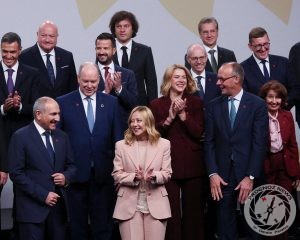
The gathering of the European Political Community in Yerevan, Armenia today is, at first glance, an exercise in diplomatic choreography — a rotating forum of leaders assembled without binding treaties, formal communiqués or the institutional density that characterises the European Union. Yet to dismiss it as merely symbolic would be to misunderstand the quiet evolution of Europe’s geopolitical architecture. The European Political Community, convening in Armenia at a moment of acute regional tension, reflects a continent grappling with its own strategic coherence — and with the shifting boundaries of what Europe means in an era of war and fragmentation.
The European Political Community, conceived in 2022 in the shadow of Russia’s full-scale invasion of Ukraine, is an unusual creation. It is neither an enlargement mechanism nor a substitute for membership in the European Union. Rather it is a political space — deliberately loose, almost improvised — designed to bring together EU member states and non-members alike, including those in the Western Balkans, the South Caucasus and beyond. Its founding impulse was pragmatic: to create a forum where leaders could meet regularly without the procedural rigidity of Brussels, and where questions of security, energy, infrastructure and political alignment could be addressed in a broader European context.
The choice of Yerevan as host city carries a significance that extends far beyond ceremonial rotation. Armenia sits at the fault line of competing geopolitical forces — Russia’s declining but still potent influence, Turkey’s regional ambitions, Iran’s proximity, and the European Union’s tentative outreach into the South Caucasus. To convene the continent’s leaders there is to acknowledge that Europe’s strategic frontier is no longer defined solely by the borders of the Union, but by a wider and more contested neighbourhood.
For Armenia herself the symbolism is acute. Long reliant on Russia as a security guarantor, she has in recent years experienced the limits of that dependence — most starkly in the context of her conflict with Azerbaijan over Nagorno-Karabakh. Moscow’s inability, or unwillingness, to provide decisive support has prompted a recalibration in Yerevan’s foreign policy. She has sought closer ties with Europe, not in the expectation of immediate security guarantees but as part of a broader diversification of her strategic relationships. Hosting the European Political Community is therefore both a diplomatic achievement and a statement of intent — a signal that Armenia wishes to be seen as part of a European political conversation rather than as a peripheral actor in a post-Soviet sphere.
For the European Union and her partners, the meeting underscores a parallel realisation — that stability on the continent cannot be secured within the confines of existing institutions alone. The war in Ukraine has exposed the fragility of Europe’s eastern periphery and the inadequacy of previous assumptions about security order. In response European states have begun to experiment with more flexible forms of coordination, of which the European Political Community is one. It allows for engagement with countries that are unlikely to join the Union in the near term, yet whose alignment is strategically important.
This flexibility is both the Community’s strength and her weakness. Without binding commitments she relies on political will — on the readiness of leaders to translate dialogue into action. Yet precisely because she lacks formal constraints she can adapt quickly to changing circumstances. In Yerevan discussions have ranged across issues that resist neat categorisation: energy corridors linking the Caspian to Europe, transport infrastructure bypassing unstable regions, the management of migration flows, and the persistent challenge of Russian influence in neighbouring states. These are not questions that can be resolved through a single summit, but the very act of convening them in a shared forum contributes to a gradual alignment of perspectives.
There is also a subtler dynamic at play — one concerning the nature of European identity itself. The European Political Community implicitly challenges the binary distinction between members and non-members of the European Union. By bringing together a wider circle of states it suggests that Europe is not merely a legal or institutional category, but a political and civilisational one. This has implications for countries such as Ukraine, Moldova and Georgia, whose aspirations for integration remain uncertain, as well as for states like Armenia that are navigating complex regional environments.
The Community must however contend with the risk of dilution. If it becomes merely a talking shop, its relevance will diminish. The test lies in whether the relationships forged within its framework can produce tangible outcomes — whether in the form of coordinated policies, joint initiatives or simply a clearer understanding of shared interests. In this regard the setting of Yerevan is instructive. It is a place where the abstract language of European cooperation intersects with the hard realities of geopolitics — where questions of security, sovereignty and alignment are not theoretical but immediate.
The presence of so many leaders in Armenia also sends a message to external actors. To Russia it signals that Europe is willing to engage more deeply in regions once considered within Moscow’s sphere of influence. To Turkey it reflects a recognition of her role as both a partner and a competitor in shaping the South Caucasus. To the United States it demonstrates that European states are seeking to develop their own mechanisms of coordination, even as transatlantic ties remain central but frayed. And to countries within the region it offers a glimpse of an alternative framework of engagement — one that is less hierarchical than traditional alliances, yet still anchored in a shared political discourse.
The European Political Community is an experiment — a response to a moment of uncertainty in which established institutions have struggled to keep pace with geopolitical change. Its meeting in Yerevan does not resolve the tensions that define Europe’s eastern neighbourhood, nor does it provide a blueprint for the continent’s future. But it does represent an attempt to think beyond the structures of the past — to create a space in which Europe, in all its diversity, can confront the challenges of a more volatile world.
Whether that experiment will endure depends on the willingness of its participants to invest it with substance. For now, in the Armenian capital, the act of gathering itself carries meaning — a recognition that Europe’s security and political coherence are inseparable from the fate of those who stand at its edges.
166 Views



Most Readings