The new Saudi-Emirati rivalry
By Matthew Parish, Associate Editor
Friday 8 May 2026
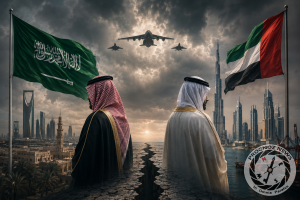
The contemporary geopolitics of the Arabian Peninsula are often misunderstood in Western capitals because the Gulf monarchies are habitually treated as a unified bloc. To diplomats in Washington, London or Brussels, the wealthy Arab monarchies of the Gulf Cooperation Council appear to move in rough synchrony — conservative, pro-Western, heavily armed and fundamentally dependent upon American military protection. Yet beneath the ceremonial summits, coordinated oil production targets and carefully choreographed state visits lies a deep and increasingly consequential rivalry between two states that each seek primacy in the Arab world: Saudi Arabia and United Arab Emirates.
That rivalry has intensified dramatically over the past decade. It has now reached a stage where strategic disagreements between Riyadh and Abu Dhabi increasingly shape the military and diplomatic posture of the wider Middle East. The reported refusal by Saudi Arabia to permit the United States to use her airspace for “Operation Freedom” — an operation subsequently curtailed or abandoned by Washington — has therefore been interpreted by many regional observers not as an isolated tactical disagreement but as part of a much larger geopolitical transformation. Saudi Arabia’s decision reflected an increasingly independent foreign policy, one often at odds not only with the United States but also with the strategic instincts of the Emirates.
For much of the late twentieth century, Saudi Arabia occupied an uncontested position as the dominant Arab power of the Gulf. She possessed the largest population, the holiest cities in Islam, the greatest oil reserves and the broadest influence across Sunni Arab political institutions. The Emirates, by contrast, were viewed as commercially successful but strategically secondary — a federation of wealthy trading ports dependent upon Western protection and careful neutrality.
That relationship has altered radically under the rise of Crown Prince Mohammed bin Salman and Emirati President Mohammed bin Zayed Al Nahyan. At first the two men appeared ideologically aligned. Both favoured authoritarian modernisation, technological development, hostility to political Islam and aggressive regional interventionism. Together they supported Egypt’s military government after the fall of the Muslim Brotherhood, cooperated closely against Qatar during the Gulf blockade crisis and jointly intervened in Yemen.
Yet the apparent harmony concealed divergent visions of regional order.
The Emirati leadership developed a strategy based upon commercial maritime dominance. Abu Dhabi and Dubai sought influence through ports, logistics, banking, intelligence cooperation, technological investment and selective military deployments. The Emirates built relationships stretching from the Horn of Africa to the eastern Mediterranean. She cultivated an image of efficiency, predictability and economic sophistication. Her rulers understood that in a post-oil world, control over trade corridors and financial infrastructure might prove more durable than hydrocarbon wealth alone.
Saudi Arabia’s ambitions became far larger and more existential. Mohammed bin Salman concluded that Saudi Arabia could not indefinitely tolerate a regional system in which smaller Gulf states accumulated disproportionate economic and diplomatic influence. Riyadh therefore embarked upon an enormous programme of national transformation — Vision 2030 — designed not merely to diversify the Saudi economy but to recentralise Arab political and financial gravity around the Kingdom herself.
This inevitably produced competition.
Riyadh increasingly pressured multinational corporations to relocate regional headquarters from Dubai to Saudi Arabia if they wished to secure Saudi government contracts. Saudi Arabia expanded aviation, finance, tourism and logistics infrastructure in direct competition with Emirati business models. The Kingdom invested heavily in Red Sea port projects that might eventually challenge the commercial centrality of Dubai. Even within OPEC+, disputes over oil production quotas exposed growing tension between the two states, particularly because the Emirates sought greater production flexibility while Saudi Arabia prioritised collective price discipline.
The Yemen war revealed even sharper divergences. Publicly, Saudi Arabia and the Emirates remained allies. In practice their objectives became profoundly different. Saudi Arabia primarily sought border security and a stable Yemeni central government that would prevent Houthi missile attacks upon Saudi territory. The Emirates increasingly concentrated upon southern Yemen, maritime access and influence over local proxy militias. Abu Dhabi’s support for southern separatist groups frequently conflicted with Riyadh’s preference for Yemeni territorial unity.
The result was not open hostility but something more subtle and perhaps more dangerous: strategic mistrust between nominal allies.
It is against this background that Saudi Arabia’s reported refusal to permit American military overflight operations acquires wider significance.
For decades the cornerstone of Gulf security rested upon an implicit bargain. The United States guaranteed the external security of the Gulf monarchies; in return, Gulf states broadly aligned themselves with American strategic objectives. That arrangement reached its apex during the 1991 Gulf War, when Saudi territory became the principal staging ground for coalition military operations against Iraq.
Today however the Gulf monarchies increasingly doubt the permanence and reliability of American power. The chaotic withdrawal from Afghanistan, inconsistent American policies towards Syria, fluctuating commitments to Ukraine and domestic polarisation within the United States have all contributed to a perception that Washington is strategically distracted and politically unpredictable.
Saudi Arabia has therefore pursued a more autonomous foreign policy. She has improved relations with China, restored diplomatic relations with Iran through Chinese mediation and adopted a more transactional relationship with Washington. Riyadh no longer appears willing automatically to subordinate Saudi strategic calculations to American operational requirements.
The refusal to permit airspace usage signalled precisely this evolution. Saudi Arabia appears increasingly reluctant to be drawn into confrontations that might expose her territory to retaliation or entangle her in conflicts she does not directly control. The Kingdom has experienced firsthand the vulnerability of critical infrastructure following Houthi and Iranian-linked attacks upon oil installations. Saudi leaders understand that modern missile and drone warfare render even immensely wealthy states acutely vulnerable.
The Emirates calculate differently.
Abu Dhabi has generally maintained a more interventionist and technologically integrated security partnership with the West. Emirati leaders perceive strategic activism as essential to preserving their influence. The Emirates possess a relatively small citizen population and therefore rely disproportionately upon technological superiority, intelligence cooperation and external partnerships. Consequently she often appears more willing than Saudi Arabia to support assertive Western regional operations.
This divergence increasingly places Washington in a difficult position. American strategists historically treated Gulf Arab alliances as structurally coherent. Now they confront a fragmented regional order in which nominal partners pursue increasingly incompatible objectives.
The abandonment or reduction of “Operation Freedom” following Saudi non-cooperation therefore illustrates more than operational inconvenience. It demonstrates the declining ability of the United States to assume automatic strategic compliance amongst her Gulf allies. American military power remains enormous, but regional actors no longer regard themselves merely as subordinate clients within a US-led order.
For the Emirates, this trend presents both opportunity and danger.
Abu Dhabi may believe that Saudi caution creates space for Emirati activism and influence. The Emirates have repeatedly demonstrated agility in exploiting geopolitical vacuums, whether in Libya, Sudan, the Horn of Africa or maritime trade networks. She often acts faster and more coherently than larger regional powers.
However the Emirates cannot realistically replace Saudi Arabia as the foundational Arab power of the Gulf. Saudi Arabia’s demographic scale, religious legitimacy and territorial depth remain overwhelming advantages. Moreover the Emirates remain deeply economically interconnected with Saudi Arabia. Open rupture between the two states would threaten the entire architecture of Gulf prosperity.
Hence the relationship oscillates uneasily between cooperation and rivalry.
There is also a profound ideological component to the tension. Saudi Arabia increasingly seeks strategic sovereignty — the ability to manoeuvre independently amongst competing global powers. The Emirates, while similarly pragmatic, often appear more comfortable operating within Western-led financial and security systems. Abu Dhabi has cultivated a reputation as the Middle East’s most globally integrated commercial hub. Riyadh seeks instead to become a great power centre in her own right.
This distinction matters enormously.
The emerging Middle East is no longer organised around simple pro-Western versus anti-Western alignments. Instead regional powers increasingly pursue multi-vector diplomacy — maintaining relationships simultaneously with Washington, Beijing, Moscow and one another. Gulf monarchies no longer perceive themselves as passive participants in an American security umbrella but as sovereign strategic actors balancing amongst competing centres of power.
In that environment, friction between Saudi Arabia and the Emirates is likely to intensify rather than diminish.
The paradox is that both states remain fundamentally dependent upon each other’s stability. Neither wishes for confrontation. Yet both aspire to regional primacy. Both seek to dominate finance, logistics, artificial intelligence, aviation, energy transition technologies and military influence. Both cultivate relationships with external great powers while attempting to avoid dependency upon them.
The consequence is a cold rivalry conducted through investment policy, diplomacy, intelligence operations, proxy relationships and strategic signalling rather than direct military confrontation.
The abandonment of an American military operation because Saudi Arabia denied access to her airspace may therefore come to be viewed historically as symbolic of a broader transition: the erosion of unquestioned American primacy in the Gulf and the emergence of a fragmented Arab order in which regional powers increasingly pursue autonomous and competing visions of the future.
For Washington, this represents a profound strategic complication. For Riyadh and Abu Dhabi it represents the beginning of a new era in which alliances are no longer permanent, loyalty is transactional and even the closest partners increasingly behave as rivals.
208 Views



Most Readings