The Silent Descent: Ukraine’s First Glided Aerial Bomb
By Matthew Parish, Associate Editor
Wednesday 20 May 2026
For much of the full-scale war in Ukraine, innovation has emerged not from cavernous Soviet-era design bureaux or glittering western defence conglomerates, but from workshops, converted garages, engineering laboratories and improvised industrial spaces scattered across the country. Ukraine’s technological evolution in wartime has often been reactive: a response to Russian advantages in manpower, artillery ammunition or air power. Yet sometimes Ukrainian innovation has achieved something more ambitious — the creation of entirely new systems intended not merely to survive the battlefield, but to reshape it.
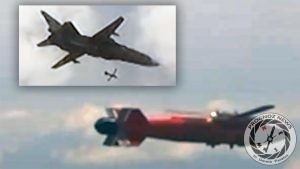
The emergence of Ukraine’s first domestically developed glided aerial bomb represents one such moment.
The development marks a significant shift in Ukrainian military thinking. Since the earliest stages of the full-scale invasion in February 2022, Russia has wielded glide bombs with devastating effect. Russian aircraft, operating from relative sanctuary dozens of kilometres behind the front line, have launched converted Soviet-era FAB-series bombs fitted with inexpensive wing kits and satellite guidance modules. These weapons transformed crude unguided bombs into stand-off precision munitions capable of devastating fortified Ukrainian positions without requiring Russian aircraft to enter the engagement envelope of most Ukrainian air defences.
The consequences have been immense. Entire districts of towns such as Avdiivka, Chasiv Yar and Vovchansk were pulverised by these descending weapons. Russian glide bombs became instruments not merely of tactical destruction, but of psychological warfare. Their enormous blast radius and near-constant presence forced Ukrainian forces into deeper fortifications and complicated troop rotations, logistics and defensive construction.
For years Ukraine lacked a direct equivalent.
Western partners provided precision-guided bombs, including the American Joint Direct Attack Munition-Extended Range (JDAM-ER) kits, which convert conventional aerial bombs into gliding precision weapons. However these systems depended upon western supply chains, compatible aircraft integration and continued foreign political approval. Ukraine’s armed forces therefore faced a persistent strategic vulnerability: dependence upon external stocks for one of modern warfare’s most decisive aerial strike capabilities.
The creation of a Ukrainian glided aerial bomb changes this equation.
While details remain closely guarded for obvious operational reasons, the broad characteristics of the weapon reflect the realities of Ukraine’s wartime industrial environment. Like many contemporary glide bomb systems, the design likely combines several relatively inexpensive but highly effective technologies: deployable wings for aerodynamic lift, satellite-assisted navigation, inertial guidance systems resistant to jamming and a conventional high-explosive warhead derived either from existing Soviet-era bomb stocks or newly produced casings.
The principle behind a glide bomb is deceptively simple. Unlike a missile, a glide bomb possesses no engine. Instead it relies upon altitude and aerodynamic efficiency. Released from an aircraft at speed and height, the weapon extends its wings and travels considerable distances toward its target under computer-guided control. Modern glide bombs may travel dozens of kilometres from release point to impact, allowing aircraft to remain far from enemy air defence systems.
This transforms tactical aviation.
Ukraine’s Soviet-designed aircraft fleet — primarily consisting of ageing Su-24, Su-25, MiG-29 and Su-27 aircraft — has survived the war through dispersion, ingenuity and aggressive adaptation. Yet these aircraft have consistently faced severe operational limitations due to Russian long-range air defence networks. Ukrainian pilots often fly at extremely low altitude to avoid radar detection, a dangerous tactic that reduces payload flexibility and operational reach.
A domestically produced glide bomb offers Ukrainian aviation something critically important: stand-off lethality.
Instead of approaching heavily defended front-line sectors directly, Ukrainian aircraft may launch guided bombs from safer distances. This increases aircraft survivability while simultaneously expanding the destructive reach of Ukraine’s tactical aviation. Even a modest glide range of 40 to 70 kilometres would significantly complicate Russian defensive planning.
Equally important is the economic dimension.
Modern western cruise missiles may cost hundreds of thousands or even millions of dollars per unit. Glide bombs are comparatively inexpensive. The fundamental attraction of the Russian UMPK glide bomb conversion kits has always been their low cost relative to their battlefield effect. A crude Soviet FAB bomb, fitted with folding wings and basic guidance systems, becomes a strategic weapon at a fraction of the price of a sophisticated missile.
Ukraine appears to have absorbed this lesson.
The country’s wartime innovation culture increasingly prioritises scalable, attritional technologies over exquisite but scarce systems. One sees this trend throughout the Ukrainian defence sector: mass-produced first-person-view drones, inexpensive naval drones, electronic warfare improvisations and decentralised drone assembly networks. The glided aerial bomb fits naturally into this philosophy. It is not necessarily intended to be technologically superior to western precision munitions. Rather it is intended to be sufficiently accurate, sufficiently destructive and sufficiently cheap to be used repeatedly at scale.
This distinction matters profoundly in a war increasingly defined by industrial endurance.
The war in Ukraine has become in many respects a contest between production systems. The side capable of manufacturing or procuring sufficient quantities of weapons, drones, ammunition and replacement equipment enjoys escalating advantages over time. Precision matters — but so does volume. A domestically produced glide bomb allows Ukraine to deepen her strike inventory without relying entirely upon western transfer decisions or export constraints.
There are also broader strategic implications.
The appearance of a Ukrainian glide bomb demonstrates the continued maturation of Ukraine’s indigenous defence industry despite relentless Russian missile attacks against industrial infrastructure. Since 2022 Russia has systematically targeted Ukrainian factories, energy systems and logistics nodes in an attempt to cripple military production capacity. Nevertheless Ukrainian engineers and manufacturers have adapted through decentralisation, concealment and rapid innovation cycles.
This mirrors a wider transformation underway in Ukrainian military-industrial culture.
Prior to 2022, much of Ukraine’s defence sector remained burdened by post-Soviet bureaucracy, corruption scandals and fragmented procurement structures. Wartime necessity accelerated reform. Small private companies, volunteer engineering groups and military innovation units gained influence previously monopolised by large state enterprises. Ukraine’s drone industry alone evolved from near insignificance into one of the most dynamic wartime technology sectors in Europe within less than three years.
The glide bomb programme likely emerged from this same ecosystem.
One should also understand the symbolic dimension of the weapon. Russia’s use of glide bombs created a painful asymmetry on the battlefield. Ukrainian troops endured repeated bombardment while lacking a directly comparable capability. The development of a Ukrainian equivalent carries operational significance, but also moral and psychological weight. It signals that Ukraine is no longer solely adapting defensively to Russian battlefield innovations — she is increasingly generating indigenous strike capabilities of her own.
Yet important limitations remain.
Glide bombs are not wonder weapons. Their effectiveness depends heavily upon the survivability of launch aircraft, the resilience of navigation systems against electronic warfare and the availability of reliable targeting intelligence. Russia has developed increasingly sophisticated GPS jamming capabilities across occupied territories, and both sides continuously attempt to disrupt satellite-guided munitions. Ukrainian engineers therefore face an ongoing technological race to improve guidance resilience and terminal accuracy.
Moreover glide bombs remain vulnerable to changing battlefield conditions. Static fortified positions are ideal targets. Highly mobile formations are not. Urban warfare also complicates their use because of the risk of civilian casualties and the sheer destructive force of large conventional warheads.
Nevertheless the broader trend is unmistakable.
Ukraine is moving steadily toward an increasingly self-sufficient strike complex built around drones, long-range missiles and precision-guided munitions manufactured domestically. This matters not only for the present war, but for the future European security architecture. A Ukraine capable of designing and mass-producing modern stand-off weapons becomes not merely a recipient of military aid, but a significant military-industrial power in her own right.
Western governments are already watching this transformation carefully. Ukrainian wartime innovation has become a laboratory for twenty-first century conflict. Lessons derived from Ukrainian drone warfare, electronic warfare improvisation and distributed manufacturing are being studied throughout NATO. The successful development of a domestic glide bomb will attract similar attention.
Indeed one of the paradoxes of the war is that Ukraine — while fighting for national survival — has simultaneously become one of the most innovative military technology environments in the world. The pressures of existential conflict compress development timelines dramatically. Systems that might once have required a decade of procurement bureaucracy are now conceived, tested and deployed within months.
This acceleration carries risks, but also extraordinary adaptive potential.
Ukraine’s first glided aerial bomb therefore represents more than a new munition. It symbolises the emergence of a wartime engineering culture shaped by scarcity, urgency and relentless adaptation. In another era, such weapons might have emerged quietly from classified research programmes over many years. In wartime Ukraine, they emerge under missile attack, energy shortages and constant operational pressure.
That may ultimately prove to be one of Ukraine’s greatest advantages.
Russia retains immense industrial capacity, larger manpower reserves and substantial inherited military infrastructure. Yet Ukraine has repeatedly demonstrated something different: the ability to innovate rapidly under pressure and translate battlefield necessity into technological evolution with remarkable speed.
The glide bomb is another chapter in that story — silent in flight, but strategically loud in implication.
157 Views



Most Readings