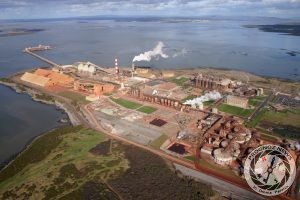
The Aughinish Alumina refinery in Ireland
By Matthew Parish, Associate Editor
Wednesday 17 June 2026
The controversy surrounding the Aughinish Alumina refinery in County Limerick is one of those awkward European stories that the war in Ukraine has made impossible to ignore. On one side stand the principles that have underpinned the European sanctions regime since Russia’s full-scale invasion of Ukraine in February 2022. On the other stand jobs, industrial policy, energy security and the practical difficulties of disentangling global supply chains. The result is a dispute that exposes the tension between Europe’s moral aspirations and its economic realities.
Aughinish Alumina is not a marginal industrial facility. It is Europe’s largest alumina refinery and one of Ireland’s most important heavy industrial assets. Owned by the Russian aluminium giant Rusal, the refinery converts bauxite into alumina, the critical raw material used in aluminium production. For decades it has been an important employer in western Ireland and a significant contributor to regional economic activity.
The difficulty is that alumina occupies a curious position within the sanctions architecture. While the European Union has imposed extensive restrictions on Russian metals and aluminium products, alumina itself has largely escaped sanction. As a consequence, exports from Aughinish to Russia remain legal even while much of the wider economic relationship between Europe and Russia has been dismantled.
What has transformed the issue from a technical trade matter into a political controversy is a series of investigative reports suggesting that alumina exported from Ireland may ultimately enter supply chains connected to Russia’s defence-industrial sector. Investigations by journalists and anti-corruption organisations have alleged that alumina shipped from Ireland reaches Russian smelters whose aluminium products are subsequently sold through intermediary companies that supply Russian military manufacturers. Although investigators have been careful to acknowledge that tracing any specific shipment of alumina to a particular missile, drone or military vehicle is effectively impossible, the broader supply-chain connections have raised profound questions about whether European industry is inadvertently supporting Russia’s war effort.
The political reaction has been fierce. Ukrainian officials, members of the European Parliament and a number of Irish politicians have argued that the current sanctions framework contains a glaring loophole. If aluminium is strategically important to modern warfare—and it unquestionably is—then allowing unrestricted exports of alumina to Russia appears inconsistent with the broader objectives of economic pressure on the Kremlin. European officials, including the EU’s foreign policy leadership, have publicly suggested that alumina may eventually become a target of future sanctions packages.
Yet the opposing argument is not frivolous. The Irish government has been notably cautious. Dublin faces the prospect that sanctions directed at Aughinish could threaten hundreds of highly skilled industrial jobs in a region where such employment opportunities are limited. The refinery is deeply integrated into the local economy and contributes substantially to the Irish industrial base. Irish leaders have also been warned that abrupt sanctions could create wider economic consequences, including effects on energy infrastructure and industrial supply chains.
Moreover, Aughinish and its owners insist that all exports comply fully with European law. The company maintains that it operates under robust compliance procedures and that its activities remain entirely legal under current EU regulations. From a strictly legal perspective, this position is difficult to dispute. Businesses are generally expected to obey the law as it exists rather than as campaigners might wish it to become.
The deeper issue is whether sanctions should be judged by legal form or by strategic effect. Modern sanctions regimes are often drafted in haste and implemented across extraordinarily complex international supply chains. Every sanctions package creates incentives for businesses and governments to search for exceptions, workarounds and loopholes. The Aughinish controversy demonstrates how difficult it is to design measures that are both economically effective and politically sustainable.
There is also an uncomfortable European dimension. Many governments that advocate ever stronger sanctions against Russia remain reluctant when the economic costs fall upon their own workers or industries. The debate in Ireland mirrors similar disputes across Europe concerning energy imports, fertilisers, metals and industrial raw materials. Every sanctions regime eventually encounters the question of who pays the price.
For Ukraine, the answer appears straightforward. Any European material that strengthens Russian industry, directly or indirectly, prolongs the war and increases the capacity of Russia’s military machine. From Kyiv’s perspective, economic inconvenience in Europe cannot be compared with the human cost of continued bombardment, occupation and destruction.
For Ireland, however, the matter is more complicated. The country finds itself hosting a strategically important industrial facility that is simultaneously a major local employer and a source of geopolitical embarrassment. The government must balance solidarity with Ukraine against obligations to Irish workers and communities.
The Aughinish affair therefore illustrates a broader truth about sanctions. They are often presented as a clean moral instrument—a way of opposing aggression without resorting to military force. In practice they are messy, imperfect and full of contradictions. The Russian-owned alumina refinery in Ireland has become a symbol of those contradictions. It reveals how difficult it is to separate European prosperity from global supply chains and how challenging it remains, even after more than four years of full-scale war, to ensure that economic pressure on Russia is comprehensive, coherent and free from unintended loopholes.
Whether alumina ultimately becomes subject to sanctions is a question for European policymakers. But the debate itself has already exposed an uncomfortable reality: in an interconnected world, the boundary between commercial activity and geopolitical responsibility is rarely as clear as governments would like it to be.
6 Views



Most Readings