Stalin’s Theology: The Religion of the Godless
By Matthew Parish, Associate Editor
Friday 3 July 2026
The Soviet Union was founded upon an explicit rejection of religion. Yet one of the great paradoxes of the twentieth century is that under the rule of Joseph Stalin, the officially atheist state developed many of the characteristics of a religious civilisation. Churches were demolished, priests were imprisoned and religious education was prohibited. Nevertheless faith did not disappear. Rather, it was redirected. Stalin’s regime created a political theology in which the Communist Party became the Church, history became providence, Marxism became scripture and Stalin himself assumed the role of an infallible high priest.
This was not theology in the traditional sense. It did not concern itself with God, salvation after death or divine revelation. Instead it sought to answer the same questions religion has always attempted to resolve: why suffering exists, what gives life meaning, how history is ordered and who possesses legitimate authority. In replacing supernatural belief with historical inevitability, Stalinism constructed a secular faith that demanded absolute obedience while permitting no competing source of moral truth.
The philosophical foundations lay in the writings of Karl Marx and Friedrich Engels. Marx famously described religion as the “opium of the people”, not merely as an illusion but as a symptom of economic injustice. Once class exploitation disappeared, religion itself would supposedly become unnecessary. Yet Marx imagined a historical process rather than an authoritarian dictatorship. It was Stalin who transformed Marxist historical theory into a rigid doctrine whose interpretation belonged exclusively to the state.
History under Stalin ceased to be an academic discipline. It became revelation. The Party alone possessed the capacity correctly to interpret the movement of history. Disagreement therefore ceased to be intellectual error and became heresy. Those accused of deviation were not simply mistaken; they were enemies of historical truth itself. Political trials resembled inquisitions in which confession was valued above factual innocence. Like medieval heretics, the accused were expected publicly to acknowledge their sins before punishment.
The Communist Party functioned as a priesthood. Admission required ideological initiation. Advancement depended upon demonstrated orthodoxy. Members were expected to study canonical texts with the seriousness traditionally devoted to sacred scripture. Quotations from Marx, Engels, Vladimir Lenin and increasingly Stalin himself acquired almost scriptural authority. Official publications became commentaries explaining how eternal doctrine should be applied to contemporary circumstances.
Central to Stalin’s political theology was the concept of historical inevitability. If history necessarily progressed towards communism, then every sacrifice made in pursuit of that future acquired moral legitimacy. Famines, forced collectivisation, mass deportations and political executions could all be justified as temporary suffering on the road towards universal redemption. The promise of heaven was replaced by the promise of the classless society. Neither could be immediately observed. Both demanded faith.
This vision transformed ethics. Traditional religious systems usually distinguish between means and ends. Murder, theft and deceit remain morally problematic regardless of political objectives. Stalinism largely dissolved these distinctions. Actions were judged according to whether they advanced the historical mission of socialism. If violence accelerated history, violence became virtue. If deception protected the revolution, deception became honesty in service of a higher truth.
The personality cult surrounding Stalin represented perhaps the clearest theological innovation. Although communist doctrine rejected divine rulers, Stalin gradually became an object of quasi-sacred veneration. Portraits appeared in every workplace and school. Poems celebrated his wisdom. Cities were renamed in his honour. His birthdays became national festivals. Children were taught stories emphasising his compassion, intelligence and superhuman foresight.
The language surrounding Stalin frequently echoed religious devotion. He became the “Father of Nations”, the “Great Leader” and the “Brilliant Genius of Humanity”. These were not merely political titles but expressions of reverence. His authority approached infallibility because questioning him implied questioning history itself.
Ritual occupied an equally important place. Military parades, Party congresses, youth organisations, collective celebrations and mass demonstrations all performed functions once associated with religious festivals. Participation reinforced communal identity while simultaneously displaying loyalty. Public confession sessions resembled religious acts of repentance, except that forgiveness was often absent. Redemption was achieved through complete submission to Party authority rather than divine grace.
The Soviet state also developed its own calendar of saints and martyrs. Revolutionary heroes replaced biblical figures. Lenin’s preserved body in the mausoleum on Red Square functioned almost as a secular relic, attracting pilgrims from across the Soviet Union. Sacred spaces survived even when churches disappeared; only their ideological content changed.
Yet Stalin’s theology differed fundamentally from traditional religion in one crucial respect. Most religious systems recognise a moral authority existing beyond the state. God judges kings as well as ordinary citizens. Under Stalin there existed no higher tribunal. The Party created morality because the Party defined history. There was no independent standard against which governmental action might be measured.
This absence of transcendence proved profoundly dangerous. Religious institutions, despite their historical failures, often preserve moral principles that limit political power. Stalin deliberately eliminated every competing authority: churches, independent intellectuals, civil associations and autonomous legal institutions. Once the state became the sole interpreter of truth, there remained no peaceful mechanism through which its crimes might be condemned.
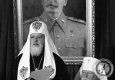
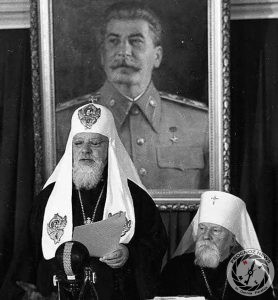
Ironically, Stalin himself partially reversed Soviet anti-religious policy during the Second World War. Recognising the patriotic value of the Russian Orthodox Church during the struggle against Nazi Germany, he permitted limited religious revival. Churches reopened and clergy regained restricted public roles. This was not theological conversion but political pragmatism. Religion remained subordinate to the state and was tolerated only insofar as it strengthened national unity.
The legacy of Stalin’s political theology extends beyond the Soviet period. Many modern authoritarian systems, while differing ideologically, reproduce similar structures. They elevate the leader above ordinary criticism, monopolise historical interpretation, suppress alternative moral authorities and encourage emotional devotion that resembles religious faith more than rational political allegiance.
The lesson is that human beings appear to possess a persistent desire for systems that provide certainty, purpose and collective identity. If traditional religion is removed without leaving space for intellectual pluralism and independent institutions, political ideology may assume religious functions instead. The result can be more dangerous than conventional faith precisely because it combines absolute moral certainty with the coercive machinery of the modern state.
Stalin did not abolish theology. He nationalised it. He transferred sacred authority from heaven to history, from priests to Party officials and from God to the state. The consequences demonstrated that secular societies are not immune from religious impulses. They merely relocate them. When politics becomes theology, disagreement becomes blasphemy, compromise becomes apostasy and power acquires the terrifying certainty of divine command. The twentieth century paid an immense price for that transformation.
91 Views



Most Readings