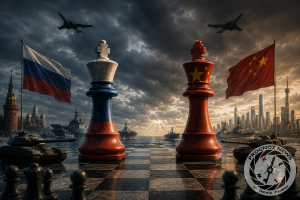
Why Russia and China Do Not Fear the West
By Matthew Parish, Associate Editor
Tuesday 14 July 2026
One of the most striking features of contemporary geopolitics is the confidence with which both Russia and China challenge Western power. This confidence does not necessarily arise because either country believes it is stronger than the collective West in every measurable respect. The combined economies of North America, Europe, Japan, South Korea and Australia remain vastly larger than those of Russia and China together. Western countries continue to dominate advanced finance, much of the world’s scientific research, higher education and a substantial proportion of cutting-edge technology.
Yet power is not merely a question of gross domestic product. It is equally a question of political will. It is here that Moscow and Beijing perceive what they regard as the West’s principal weakness.
For decades, Western governments have become increasingly reluctant to bear prolonged costs in pursuit of strategic objectives. Democracies naturally change governments, and politicians are judged according to electoral cycles rather than historical epochs. Public opinion shifts rapidly, fiscal pressures constrain defence expenditure and political leaders are frequently required to justify every military commitment in immediate economic terms.
Russian and Chinese leaders observe these characteristics with great care. They conclude that Western societies possess extraordinary capabilities but diminishing endurance.
Russia’s experience in Ukraine illustrates this calculation. Moscow undoubtedly underestimated Ukraine’s resistance and the scale of Western military assistance. Nevertheless, after years of war, the Kremlin continues to believe that time favours Russia more than it favours the coalition supporting Kyiv. Russian planners assume that elections in Europe and North America will eventually produce governments less willing to finance an expensive foreign conflict. They believe economic fatigue will accumulate faster in democratic societies than in Russia’s tightly controlled political system.
Whether this judgement proves correct remains uncertain. What matters is that it is sincerely held.
China reaches similar conclusions through a different lens.
Beijing has watched two decades of Western strategic inconsistency. The interventions in Afghanistan and Iraq ended without decisive political success. Libya descended into fragmentation after Western military intervention. Syria demonstrated the limits of American willingness to become deeply engaged in prolonged conflicts. The withdrawal from Afghanistan in 2021 reinforced an impression among many Chinese analysts that the United States increasingly seeks to avoid long military commitments.
To Chinese strategists, these events suggest not military weakness but political hesitation.
The Chinese Communist Party also believes that its own political structure provides strategic advantages. Leadership transitions occur within the Party rather than through competitive elections. National planning extends over decades rather than parliamentary terms. Industrial policy, military procurement and technological investment proceed according to long-term objectives that are comparatively insulated from changes in public opinion.
This produces a confidence that Western democracies often find difficult to match.
Economic interdependence also reduces fear.
Both Russia and China recognise that Western governments are constrained by their own prosperity. Severe sanctions often impose substantial costs upon those imposing them. Supply chains remain deeply interconnected. Europe depends upon international trade. The United States remains heavily integrated into global manufacturing networks. Financial restrictions can be powerful, but they are rarely painless.
The Kremlin learned from sanctions imposed after 2014 and accelerated efforts towards financial resilience, domestic production and alternative trading relationships. China has gone further, seeking technological self-sufficiency, expanding domestic consumption and constructing payment mechanisms less dependent upon Western financial institutions.
Neither country has achieved complete independence. Neither expects to do so. But both believe they have reduced Western economic leverage sufficiently to withstand prolonged confrontation.
Military doctrine contributes another dimension.
Russia possesses the world’s largest nuclear arsenal. China continues rapidly expanding her own strategic nuclear forces. Both governments understand that nuclear deterrence dramatically limits the willingness of Western governments to contemplate direct military confrontation.
The war in Ukraine illustrates this reality. NATO has provided extensive assistance to Ukraine while consistently avoiding direct combat between NATO and Russian forces. Moscow interprets this restraint as confirmation that nuclear deterrence continues to function.
Chinese military planners draw analogous conclusions regarding Taiwan. They assume that any Western intervention would be carefully calibrated to avoid uncontrolled escalation between nuclear powers.
Information warfare also shapes perceptions.
Russian and Chinese officials frequently describe Western societies as internally divided by political polarisation, cultural disputes, declining trust in institutions and fragmented media environments. They see governments struggling to maintain coherent national narratives while social media accelerates political instability.
Whether these assessments are exaggerated is less important than the fact that they influence strategic planning.
Authoritarian governments generally believe that they can suppress internal dissent more effectively than liberal democracies can manage public disagreement. This belief encourages confidence even when their own domestic vulnerabilities remain substantial.
However, confidence should not be mistaken for complacency.
Russia has suffered enormous military and economic losses during the war in Ukraine. China faces slowing economic growth, demographic decline, rising debt and increasing international suspicion. Neither government is free from profound structural challenges.
Indeed much of their apparent confidence may conceal significant insecurity.
Russian political rhetoric often reflects an awareness that the country’s long-term demographic and economic trajectory remains unfavourable. Chinese policymakers openly acknowledge slowing productivity, declining birth rates and the difficulties of sustaining rapid growth as the economy matures.
Their assertiveness may therefore represent an attempt to reshape the international order before these domestic constraints become more acute.
Nor should Western decline be assumed inevitable.
History repeatedly demonstrates that democratic societies possess remarkable capacities for renewal when confronted by existential challenges. The industrial mobilisation of the Second World War, the technological competition of the Cold War and the extraordinary scientific achievements of recent decades all illustrate the adaptability of open societies.
The decisive question is therefore not whether Russia and China fear the West today. It is whether the West can once again demonstrate sufficient unity, strategic patience and political confidence to alter the calculations made in Moscow and Beijing.
Deterrence ultimately depends less upon military inventories than upon credibility. If adversaries conclude that Western commitments will endure despite changing governments, economic pressures and political disagreements, their confidence may diminish considerably.
At present, however, both Russia and China perceive a different picture. They see wealthy societies reluctant to incur sustained sacrifices, electorates increasingly preoccupied with domestic concerns and governments struggling to articulate long-term strategic objectives. They respect Western capabilities while doubting Western resolve.
Whether that perception is accurate is perhaps the defining geopolitical question of the twenty-first century. If it proves mistaken, Russia and China may eventually discover that they have gravely underestimated the resilience of democratic societies. If it proves correct, the international balance of power may continue shifting towards a world in which authoritarian states believe they can challenge the existing order with progressively greater confidence.
99 Views



Most Readings