Nigel Farage and Oswald Mosley: Two Revolts Against the Establishment, Eight Decades Apart
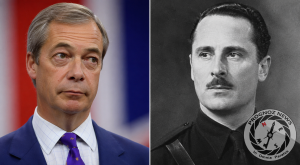
By Matthew Parish, Associate Editor
Wednesday 15 July 2026
British politics has always possessed a remarkable capacity for producing insurgents. From the Chartists of the nineteenth century to the Brexit movement of the twenty-first, figures have emerged who have challenged the political consensus by claiming that the established parties no longer represent the interests of ordinary people. Two of the most striking examples, separated by almost a century, are Sir Oswald Mosley and Nigel Farage. Both built political movements around national sovereignty, criticism of established elites and dissatisfaction with Britain’s relationship with continental Europe. Yet the similarities, although genuine, should not obscure profound differences in ideology, methods and historical circumstances.
To compare the two men requires an appreciation of the Britain in which each emerged. Mosley was a politician shaped by the trauma of the First World War and the Great Depression. Farage belongs to a Britain transformed by deindustrialisation, European integration, globalisation and mass immigration. Their respective political projects reflected these very different worlds.
Mosley began his parliamentary career not as an extremist but as a promising Conservative before moving to Labour. His reputation for brilliance was widely acknowledged even by political opponents. As Chancellor of the Duchy of Lancaster in Ramsay MacDonald’s government, Mosley advanced an ambitious programme to combat unemployment through state-led investment. When these proposals were rejected he resigned, concluding that parliamentary democracy was incapable of responding to the economic catastrophe engulfing Britain.
His subsequent journey into authoritarian politics reflected developments across Europe. Fascist regimes had come to power in Italy and were gathering strength elsewhere. Liberal democracy appeared weak, indecisive and economically ineffective. The Soviet Union represented an alternative revolutionary model that many feared or admired. In this atmosphere Mosley founded the British Union of Fascists, advocating an authoritarian corporate state, protectionist economics and strong executive government. Parliamentary institutions, he argued, should give way to disciplined national leadership.
Nigel Farage emerged from an entirely different political landscape. Britain in the late twentieth century was prosperous by historical standards, but many citizens believed that political decision-making had drifted away from democratic accountability. Membership of the European Union transferred increasing authority to supranational institutions. Large-scale immigration altered the social composition of many communities. Financial globalisation created prosperity for some while leaving others convinced that economic growth benefited metropolitan elites far more than provincial Britain.
Farage’s central political argument was that sovereignty had become diluted. Decisions affecting British citizens were increasingly made by institutions beyond the direct control of the British electorate. Unlike Mosley, who wished to replace parliamentary democracy with executive authoritarianism, Farage consistently argued that democratic institutions should be restored by returning powers from Brussels to Westminster.
This distinction is fundamental. Both men criticised existing political elites, but they proposed opposite constitutional remedies. Mosley sought less parliamentary government. Farage demanded more democratic accountability through Parliament and referendums.
Both politicians also appealed to nationalism, although again with important differences.
Mosley’s nationalism was organic and authoritarian. The nation, in his conception, possessed an almost mystical unity that transcended individual interests. Citizens owed obedience to a powerful state that embodied the national will.
Farage’s nationalism is rooted instead in popular sovereignty. His conception of Britain rests less upon racial or corporatist theories than upon democratic self-government. His argument has consistently been that laws should be made by representatives whom British voters can remove from office.
Immigration provides another area where superficial similarities often obscure substantial distinctions. Mosley incorporated racial thinking into his politics, particularly during the later 1930s when antisemitism became increasingly central to his movement. Jewish communities were openly targeted in BUF propaganda and demonstrations, culminating in violent confrontations such as the Battle of Cable Street in 1936.
Farage has undoubtedly made immigration one of the defining issues of modern British politics. Critics frequently accuse him of employing inflammatory rhetoric, while supporters argue that he has merely articulated concerns long ignored by mainstream politicians. Yet his political arguments have generally focused upon border control, labour market pressures, public services and cultural integration rather than biological theories of racial hierarchy. The distinction is significant. Opposition to levels of immigration is not synonymous with fascism, although rhetoric surrounding immigration can become inflammatory if insufficiently restrained.
Economically the two men were equally different. Mosley rejected both laissez-faire capitalism and Marxist socialism. He favoured a corporate state in which government directed industrial production through cooperation between employers, workers and the state. His economic vision resembled aspects of contemporary Italian Fascism.
Farage has remained fundamentally committed to market economics. Although willing to advocate selective state intervention, particularly after Brexit, his instincts are economically liberal. Lower taxation, deregulation and entrepreneurial activity occupy central positions within his political philosophy. If Mosley distrusted capitalism because he considered it inefficient and unstable, Farage generally distrusts excessive regulation because he believes it suppresses economic dynamism.
The personalities of the two men also reveal interesting contrasts. Mosley possessed aristocratic confidence, intellectual ambition and a taste for grand ideological systems. He saw himself as the architect of an entirely new constitutional order. His speeches often conveyed certainty that history itself was moving towards authoritarian government.
Farage projects a markedly different persona. Rather than presenting himself as an intellectual visionary, he cultivates the image of an ordinary citizen challenging professional politicians. His political style relies heavily upon humour, informality and accessibility. Even his critics generally acknowledge that he has transformed political communication by appearing less like a traditional statesman than a public campaigner.
Their relationships with violence perhaps demonstrate the clearest distinction. Mosley’s British Union of Fascists developed organised uniformed formations, the notorious Blackshirts, whose rallies frequently descended into physical confrontation. Political intimidation became an accepted component of fascist mobilisation across Europe, and Britain was no exception.
Farage’s political career has unfolded entirely within democratic competition. His parties have fought elections, campaigned in referendums and sought legislative influence through constitutional means. While political passions surrounding Brexit became exceptionally intense, Farage neither advocated nor organised paramilitary politics.
Nevertheless there are meaningful similarities worthy of consideration. Both men demonstrated extraordinary political resilience despite repeated setbacks. Both identified issues that mainstream parties initially underestimated. Both proved exceptionally skilled communicators capable of speaking directly to voters who believed themselves neglected by political elites. Both forced Britain’s established parties to respond to questions they would often have preferred to avoid.
There is also a common populist methodology. Each framed politics as a struggle between ordinary citizens and disconnected governing elites. Each accused established institutions of prioritising their own interests above those of the nation. Such populist narratives have appeared repeatedly throughout democratic history and are by no means unique to either individual.
The historical contexts, however, remain decisive. Mosley belonged to an era in which democracy itself appeared vulnerable throughout Europe. Fascist, communist and authoritarian regimes seemed to many contemporaries to offer plausible alternatives to parliamentary government. Britain ultimately rejected Mosley’s vision, but his movement formed part of a continental crisis that culminated in the Second World War.
Farage operates in a mature constitutional democracy whose institutions, despite frequent criticism, remain deeply entrenched. His greatest political success, the referendum leading to Britain’s withdrawal from the European Union, occurred through the ballot box rather than through constitutional rupture. Whether one regards Brexit as a triumph or a mistake, it was achieved by democratic procedure.
It is therefore misleading either to equate the two men or to deny every point of comparison. They share characteristics common to insurgent populists: hostility towards established elites, confidence in national identity, scepticism towards supranational structures and an ability to mobilise voters who feel politically marginalised. Yet they diverge fundamentally in their attitudes towards democracy, constitutional government, political violence, race and the organisation of the economy.
History often tempts commentators towards simplistic analogies. Every nationalist becomes another fascist, every populist another demagogue, every challenge to established authority another threat to democracy. Such comparisons may generate headlines, but they rarely illuminate reality. The careers of Oswald Mosley and Nigel Farage demonstrate that political movements can share certain techniques and themes while remaining fundamentally different in constitutional purpose and ideological substance.
Britain has repeatedly produced political outsiders who have reshaped public debate. Some sought to destroy liberal democracy. Others sought to redirect it. Understanding which is which requires careful historical analysis rather than rhetorical convenience. That distinction remains as important today as it was in the turbulent decades between the two world wars.
8 Views



Most Readings