The Trump Whisperer: Alexander Stubb and the Curious Art of Friendship with an American President
By Matthew Parish
Thursday 3 September 2026
There are few more improbable political friendships in the contemporary Western world than that between Alexander Stubb, President of Finland, and Donald Trump, President of the United States. One is an urbane, multilingual European liberal, an academic as much as a politician, steeped in the institutions of the European Union and instinctively committed to multilateralism. The other has built his political career upon contempt for precisely those sorts of institutions, distrust of the European political establishment and an intensely personal, transactional conception of international affairs. Yet by the summer of 2026 Stubb has emerged as one of the European leaders with the most unusual degree of access to Trump — and therefore as a surprisingly important figure in the diplomacy surrounding Ukraine, NATO and the future of the transatlantic alliance.
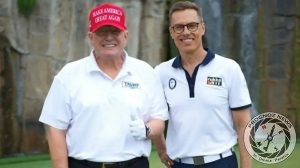
The relationship began, appropriately enough for Donald Trump, on a golf course. In March 2025 Stubb travelled unofficially to Florida, where he and Trump breakfasted, played golf and lunched together at Mar-a-Lago. Ukraine was among the subjects they discussed. What might otherwise have been dismissed as a curious piece of sporting diplomacy proved consequential. Trump likes golf, admires good golfers and places unusual importance upon personal chemistry. Stubb happens to be an accomplished golfer as well as a formidable endurance athlete. The Finnish President discovered an avenue into Trump’s confidence that many larger European countries had conspicuously failed to find.
There is a temptation to regard this as trivial. It is anything but. Diplomacy has always depended partly upon personalities, although the bureaucratisation of Western foreign policy during the late twentieth century encouraged diplomats to pretend otherwise. With Trump the personal element is amplified. He judges political leaders as people before he judges the elaborate briefing papers their officials have prepared. He distinguishes between those he regards as strong and weak, interesting and tedious, winners and losers. A European statesman who wishes to influence Trump therefore commits an elementary mistake if he begins by lecturing him about the sanctity of institutions Trump has spent much of his political career criticising.
Stubb appears to understand this better than most.
He does not imitate Trump. That would be absurd. Nor does he flatter him indiscriminately. Instead he has developed the rather more sophisticated technique of taking Trump seriously on Trump’s own terms while using the resulting personal relationship to introduce arguments that the American President might be less inclined to hear from somebody else. Stubb’s peculiar diplomatic usefulness lies precisely in the fact that nobody could plausibly mistake him for a Trumpian politician. He is a committed European, an Atlanticist and a determined supporter of Ukraine. Yet Trump appears willing to listen to him.
That has made Finland disproportionately important. With a population of some 5.6 million, Finland would not ordinarily be expected to occupy the front rank of diplomacy between Washington and Europe. Yet geography and history have bestowed upon the country an expertise that is suddenly valuable. Finland shares more than 1,300 kilometres of frontier with Russia. She fought the Soviet Union in the Winter War, survived the peculiar compromises imposed upon her by the Cold War, retained a powerful culture of national defence and abandoned military non-alignment to join NATO in 2023 after Russia’s full-scale invasion of Ukraine.
When a Finnish President tells an American President something about Russia, therefore, the advice carries a certain historical weight. Stubb’s central message has been remarkably consistent: Vladimir Putin must be dealt with from a position of strength. Negotiation is necessary because wars ultimately end through political settlements, but negotiation without military and economic pressure merely invites Moscow to pocket concessions and return for more. Stubb has consequently attempted to reconcile two propositions that are often presented as incompatible in Western debate — that Trump is right to seek an end to the war and that any durable end requires preventing Russia from interpreting diplomacy as Western exhaustion.
This has placed Stubb in an exceptionally delicate position. Trump’s instincts towards Russia have fluctuated. He has periodically expressed impatience with Putin while simultaneously demonstrating impatience with the costs of American support for Ukraine. Stubb, by contrast, inhabits a country where Russian power is not an abstraction debated in Washington think tanks. Finland’s security policy rests upon the proposition that Russia must be deterred because the consequences of failed deterrence are potentially existential.
The Finnish President’s achievement has been to communicate this difference without allowing it to become a rupture. The relationship has also produced tangible commercial and strategic consequences. What began partly as conversations about Finnish expertise in icebreakers developed into a major Finnish-American programme under which the United States would acquire up to eleven Arctic Security Cutters, with vessels initially constructed in Finland and further ships built in the United States using Finnish expertise. The arrangement was strategically attractive to Washington because the United States has long lagged behind Russia in Arctic icebreaking capacity. For Finland it demonstrated something equally important: personal diplomacy with Trump could be converted into industrial cooperation rather than merely photographs and compliments.
There is a lesson here for the rest of Europe. European governments spent much of Trump’s first presidency expressing horror at him. Some of that horror was understandable. Yet indignation is not a foreign policy. Trump returned to the White House because American voters elected him, and European security cannot sensibly be constructed upon the hope that Americans will eventually choose presidents whom Europeans find more congenial.
Stubb’s method begins with accepting political reality.
That does not mean accepting every Trump proposition. Indeed Stubb’s importance lies partly in his willingness to disagree. What matters is the manner of disagreement. He treats Trump neither as a monster who must be publicly denounced nor as an emperor who must be appeased. He treats him as the President of the United States — a difficult, powerful and indispensable interlocutor with whom European leaders must find ways of doing business.
By 2026 this role has become more important as tensions within NATO have intensified. In April Stubb spoke with Trump as the American President was again contemplating the future of US participation in the alliance. Stubb’s response was characteristically pragmatic: Europe was already creating what he described as a “more European NATO”, with European countries assuming greater responsibility for their own defence. This was not an abandonment of Atlanticism. It was an attempt to save Atlanticism by adapting it to the political realities of contemporary America.
That distinction matters. Europeans sometimes speak as though strategic autonomy and the transatlantic alliance were alternatives. Stubb understands that they are increasingly complementary. The more capable Europe becomes of defending herself, the easier it becomes for an American President such as Trump to regard NATO as an advantageous bargain rather than a charitable subsidy. The argument for European rearmament can therefore be expressed simultaneously in Macronian language — Europe must be capable of acting for herself — and in Trumpian language: Europeans must pay more of the bill.
Finland already possesses credibility in making that argument. Her defence culture was never dismantled to the extent that occurred elsewhere in Europe after the Cold War. Conscription, reserves, civil preparedness, artillery and an ingrained consciousness of the Russian threat survived the years in which much of Western Europe imagined that major interstate warfare had become obsolete. Finland therefore approaches the contemporary European security crisis not as a country suddenly discovering military necessity but as one whose historical pessimism has been vindicated.
This gives Stubb another advantage with Trump. He can credibly say that Finland is not asking America to defend a country unwilling to defend itself. Ukraine remains the ultimate test of the relationship. Stubb has become an increasingly significant interlocutor in the diplomacy surrounding the war precisely because he occupies an unusual position between camps. He enjoys close relations with President Volodymyr Zelenskyy, is emphatically committed to Ukrainian sovereignty and understands the Russian security problem from Finland’s own history. At the same time he possesses a channel to Trump that Kyiv and some European capitals have not always found easy to maintain. As recently as July 2026, Zelenskyy met both Trump and Stubb during a Washington visit centred upon air defence, Patriot production and attempts to revive stalled negotiations with Russia.
Stubb therefore performs something approaching the role of translator. He explains Trump to Europeans and European strategic realities to Trump. This is a more important function than it sounds. Much of the transatlantic crisis is not caused by absolute incompatibility of interests but by radically different political vocabularies. Europeans speak of values, institutions and international law. Trump speaks of leverage, expenditure, strength and deals. The objectives are sometimes less different than the language in which they are expressed.
A skilled intermediary learns both languages. Yet there are limits to what Stubb can achieve. Personal access is not control. Trump remains Trump, and no foreign leader — however agreeable the round of golf — can reliably determine the decisions of an American President who prides himself upon unpredictability. Stubb himself has never suggested otherwise. The danger of the “Trump whisperer” mythology is that it exaggerates the ability of one European statesman to moderate forces within American politics that are vastly larger than any personal relationship.
Nor should Europe construct its security around the assumption that somebody will always be able to telephone the White House and persuade its occupant to reconsider. The deeper lesson of Stubb’s diplomacy is almost the opposite. Europe must become stronger precisely because American policy has become less predictable.
There is nevertheless something refreshingly adult about Stubb’s approach. International politics is not a seminar in which states select their interlocutors according to ideological compatibility. The task of statesmanship is to deal with the world as it exists. Finland knows this perhaps better than most countries. For much of her modern history she survived beside a vastly larger and frequently hostile neighbour through a combination of military preparedness, political intelligence, caution and stubbornness — the celebrated Finnish sisu.
Stubb has adapted that tradition to a very different challenge. America is not Finland’s adversary but her indispensable ally. The problem is therefore not how to resist Washington but how to keep Washington engaged while Europeans acquire the strength necessary to carry more of the burden themselves.
Golf has helped. Icebreakers have helped. Personal chemistry has helped. But beneath these colourful details lies a serious strategic philosophy.
Alexander Stubb has understood that the Trump presidency cannot simply be wished away, moralised away or endured until some imagined restoration of the old Atlantic order. That order has already changed. The United States remains overwhelmingly powerful but increasingly demands tangible returns from alliances. Europe remains wealthy but has been forced to rediscover military power. Russia remains dangerous. Ukraine remains the battlefield upon which the credibility of the post-Cold War European settlement is being tested.
Between these realities stands the Finnish President — smiling, energetic, apparently indefatigable and carrying a set of golf clubs. It is an improbable form of diplomacy. Yet improbable diplomacy is sometimes precisely what difficult times require. If Stubb can continue persuading Trump that a strong Europe, a secure Finland, a sovereign Ukraine and a viable NATO are not burdens upon American power but multipliers of it, then his curious friendship with the American President may prove substantially more consequential than anyone imagined when the two men first walked onto a Florida fairway.
And there is a broader lesson. The future of the Atlantic alliance will not be preserved by nostalgia for the world before Trump. It will survive only if Europeans learn simultaneously to defend themselves and to deal intelligently with the America that actually exists. Alexander Stubb, perhaps more successfully than any other European statesman of his generation, appears to have understood both halves of that proposition.
6 Views


Most Readings



Crimea Under Pressure: Ukraine’s Long Campaign Against Russia’s Southern Bastion
96 Views