Anglo-French resolve to interdict Russia’s shadow fleet
By Matthew Parish, Associate Editor
Saturday 21 March 2026
The war at sea between Russia and her Western adversaries has entered a new and delicate phase. No longer confined to submarines lurking beneath Arctic ice or missile cruisers exchanging threats across distant horizons, maritime confrontation has shifted into the ambiguous legal and operational space occupied by the so-called “shadow fleet” — a vast, improvised armada of ageing tankers and cargo vessels through which Russia sustains her sanctioned economy. It is here, amongst false flags, opaque ownership structures and uncertain jurisdiction, that Britain and France have begun to act with increasing resolve.
These Anglo-French efforts, still embryonic but rapidly evolving, represent one of the most consequential developments in the enforcement of sanctions against Russia since the beginning of her full-scale invasion of Ukraine. They sit at the intersection of maritime law, naval power and economic warfare — and they carry risks that extend far beyond the cargoes they seek to interdict.
The nature of the shadow fleet
The “shadow fleet” is not a fleet in the traditional naval sense. It has no unified command, no standardised registry, and no coherent legal identity. Rather it is a diffuse network of approximately 1,000 to 1,500 vessels — frequently old, poorly maintained and underinsured — that transport Russian oil and other sanctioned commodities through a labyrinth of shell companies and flags of convenience.
These ships routinely engage in practices designed to obscure their provenance: disabling transponders, falsifying documentation, conducting ship-to-ship transfers in international waters, and reflagging under jurisdictions with minimal regulatory oversight. The result is a quasi-stateless maritime system — one that exists deliberately at the margins of international law.
The scale of this enterprise is considerable. Russia is estimated to move well over a million barrels of oil per day through such channels, generating substantial revenue despite Western price caps and embargoes. In effect the shadow fleet is not merely a logistical workaround; it is an essential pillar of Russia’s wartime economy.
From monitoring to interdiction
For much of the period since 2022 Western responses to this phenomenon were cautious. Surveillance, sanctioning of individual vessels, and diplomatic pressure constituted the primary tools of enforcement. However in early 2026 a discernible shift occurred — from passive observation to active interdiction.
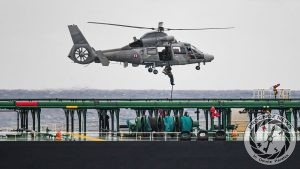
France has been at the forefront of this transition. Her navy has conducted a series of high-profile boardings and seizures in the Mediterranean, often in coordination with British intelligence and naval assets. The interception of the tanker Deyna in March 2026 exemplifies this new posture: a vessel departing from Murmansk under a false flag was boarded, inspected and diverted under suspicion of sanctions evasion.
This was not an isolated incident. Earlier operations against vessels such as the Grinch and other suspect tankers reveal a pattern of increasingly assertive enforcement, conducted in accordance with the United Nations Convention on the Law of the Sea but pushing its interpretative boundaries.
Britain’s role, while less publicly visible, has been no less significant. Royal Navy assets and British surveillance systems have tracked shadow fleet movements through chokepoints such as the English Channel and the Strait of Gibraltar, providing intelligence and operational support to allied interdictions. The United Kingdom has also expanded her sanctions list dramatically, targeting hundreds of vessels linked to the shadow trade.
Together these actions mark a transition from economic sanctions as a legal instrument to sanctions enforcement as a naval mission.
Legal ambiguity and strategic calculation
Yet these operations exist within a highly contested legal framework. The law of the sea traditionally affords vessels significant protections, particularly in international waters. Boarding a foreign-flagged ship requires either flag-state consent, clear evidence of statelessness, or suspicion of specific offences such as piracy or slave trading.
The Anglo-French strategy therefore hinges on a critical legal argument: that many shadow fleet vessels, by virtue of false flags, fraudulent documentation or lack of valid registration, may be treated as stateless. Stateless vessels are subject to boarding and inspection by any state — a principle that opens the door to precisely the kind of interventions now being undertaken.
This interpretation, while legally defensible, is not uncontested. Russia has characterised such actions as piracy and has hinted at retaliatory measures, including the deployment of naval escorts to protect her commercial shipping. The risk of escalation — whether through miscalculation or deliberate signalling — is therefore ever-present.
Moreover, the selective enforcement of maritime law raises broader questions about precedent. If Western powers assert expansive rights to interdict vessels suspected of sanctions evasion, other states may seek to apply similar doctrines in less benign contexts.
Operational challenges at sea
Interdicting the shadow fleet is not merely a legal exercise; it is a complex operational undertaking. These vessels operate across vast maritime spaces, often in congested or politically sensitive waters. Identifying them requires sophisticated intelligence, including satellite tracking, financial analysis and signals interception.
Even when identified, boarding operations carry inherent risks. Crews may be uncooperative or uncertain of their legal status; documentation may be deliberately misleading; and the vessels themselves may be structurally unsound, posing environmental hazards in the event of damage or seizure.
Indeed one of the paradoxes of the shadow fleet is that its very decrepitude constitutes both a vulnerability and a threat. Poor maintenance and lack of insurance increase the likelihood of accidents — oil spills, collisions or mechanical failures — that could have catastrophic ecological consequences for European coastlines.
The Anglo-French interdiction effort must therefore balance enforcement with prudence, ensuring that the act of stopping a vessel does not itself precipitate the disaster it seeks to prevent.
Economic warfare and strategic impact
At its core the campaign against the shadow fleet is an exercise in economic warfare. By disrupting the logistical channels through which Russia exports her energy resources, Britain and France aim to erode the financial foundation of the Kremlin’s war effort.
The effectiveness of this strategy remains uncertain. While individual seizures may impose costs — delays, fines, reputational damage — the sheer scale and adaptability of the shadow fleet make comprehensive interdiction difficult. Vessels can be reflagged, rerouted or replaced; new intermediaries can be established; and alternative markets, particularly in Asia, remain receptive to discounted Russian oil.
Nevertheless the cumulative effect of sustained pressure may be significant. Increased risk raises insurance costs, deters legitimate service providers and complicates financing arrangements. Over time these factors may constrain the profitability and operational viability of the shadow trade.
Equally important is the signalling effect. Anglo-French actions demonstrate a willingness to enforce sanctions not merely on paper but in practice — a message directed as much at third countries and commercial actors as at Russia herself.
A maritime frontier of the Ukraine war
The interdiction of the shadow fleet represents a new maritime frontier in the war connected with Ukraine. It extends the conflict beyond land and air into the global commons of the sea, where legal norms, commercial interests and military capabilities intersect in complex and unpredictable ways.
For Britain and France the challenge is to sustain this effort without provoking uncontrolled escalation. For Russia the imperative is to preserve the flows of revenue upon which her war depends. Between them lies a contested maritime space in which the rules are still being written.
In this environment each boarding, each seizure and each legal argument contributes to the gradual redefinition of how sanctions are enforced in the twenty-first century. The outcome will not only shape the trajectory of the war in Ukraine; it will also determine the future of maritime order in an era of geopolitical fragmentation.
What began as a shadow economy at sea is becoming, increasingly, a theatre of open confrontation.
237 Views



Most Readings