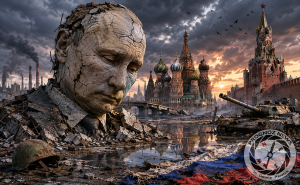
The Ruins Vladimir Putin Will Leave Behind
By Matthew Parish, Associate Editor
Wednesday 3 June 2026
When historians eventually come to write the final chapter of Vladimir Putin’s rule over Russia, they may conclude that his greatest achievement was not the restoration of Russian power, but the destruction of much of what made Russia a great power in the first place.
Putin came to office in 1999 amidst the chaos that followed the collapse of the Soviet Union. Russia was poor, politically unstable and internationally diminished. The country’s armed forces were weak, her institutions dysfunctional and her economy vulnerable to oligarchic capture. Many Russians regarded the 1990s as a decade of humiliation.
For a time, Putin appeared to offer an alternative. Rising energy prices filled the state’s coffers. Moscow regained control over the regions. Living standards improved. Russia returned to the world stage with growing confidence. To many observers, both inside and outside the country, Putin seemed to have achieved what his predecessors could not: stability.
Yet the tragedy of modern Russia is that the stability he created ultimately became the foundation of a far deeper instability. The longer he remained in power, the more the Russian state ceased to serve the interests of Russia and instead became an instrument for preserving his own authority.
The result is that whenever Putin eventually leaves the scene, whether through retirement, death or political displacement, he is likely to leave behind a country whose apparent strength conceals profound structural decay.
The first ruin will be demographic.
Russia entered the twenty-first century already burdened by a declining population, low birth rates and serious public health problems. These challenges have only intensified. Hundreds of thousands of young Russians have left the country since the full-scale invasion of Ukraine in 2022. Many of them were among the best educated, most entrepreneurial and internationally connected members of society.
The war has also imposed a terrible demographic cost. Tens of thousands of Russian soldiers have been killed, with many more suffering life-changing injuries. While precise figures remain disputed, the scale of Russian casualties is beyond anything the country has experienced since Afghanistan and perhaps since the Second World War.
The demographic consequences of these losses will continue long after the fighting ends. A nation already struggling with population decline has sacrificed large numbers of young men in their most productive years. Such losses cannot easily be replaced.
The second ruin will be economic.
Contrary to many Western predictions, Russia’s economy has not collapsed under sanctions. It has adapted. It has redirected trade towards Asia, expanded military production and exploited loopholes in the international financial system.
Yet adaptation is not the same as prosperity.
An increasingly large proportion of Russia’s economic activity now depends upon wartime expenditure. Defence production creates employment and stimulates industrial output, but weapons do not create long-term wealth. Tanks, missiles and artillery shells are consumed rather than invested. They generate destruction rather than productive capacity.
The Soviet Union demonstrated this principle repeatedly. An economy can devote extraordinary resources to military power while simultaneously becoming poorer, less innovative and less competitive.
Russia’s dependence upon hydrocarbons remains substantial. Her technological dependence upon foreign components remains considerable. Her private sector increasingly operates under political constraints. Foreign investment has largely evaporated.
The economy Putin leaves behind may appear robust on paper. Beneath the surface, however, it risks resembling a building whose façade remains intact while its foundations quietly crumble.
The third ruin will be institutional.
Perhaps no damage inflicted by Putin has been more severe than the destruction of independent institutions.
Modern states require courts capable of acting independently of political leaders. They require professional civil services. They require reliable regulatory systems. They require media organisations capable of exposing mistakes and corruption. They require political mechanisms that allow governments to correct errors before those errors become disasters.
Under Putin, virtually all of these safeguards have been weakened or eliminated.
Political loyalty has become more important than competence. Courts have increasingly served political objectives. Elections have become ritualised exercises rather than genuine contests. Independent journalism has largely disappeared.
The consequence is that Russia increasingly resembles a personalist system rather than an institutional state.
Personalist systems often appear strong while the leader remains in power. Their weaknesses become visible only after the leader departs.
The Soviet Union survived Stalin. Yet the institutional distortions created by Stalin haunted Soviet governance for decades. The same may prove true of Putin’s Russia.
The fourth ruin will be geopolitical.
Putin’s supporters often argue that he restored Russia’s status as a great power. Yet a great power’s influence depends not merely upon fear, but upon attraction.
Throughout much of modern history, Russia exercised influence because others wished to cooperate with her. Russian culture, science, literature and education generated admiration across the world.
Today, Russia’s international image has been profoundly damaged.
Relations with Europe have deteriorated to their lowest point since the Cold War. Military cooperation between European states has accelerated specifically in response to Russian actions. Countries that once sought accommodation with Moscow increasingly perceive Russia as a long-term security threat.
Even where Russia has maintained partnerships, the relationship is often less advantageous than before. Dependence upon China has increased dramatically. Moscow increasingly occupies the role of junior partner within a relationship that Soviet and Russian leaders historically sought to avoid.
Future Russian governments may discover that rebuilding trust takes far longer than destroying it.
The fifth ruin will be psychological.
Putin’s Russia has become increasingly dependent upon narratives of external threat, historical grievance and national victimhood.
Every society requires some sense of national purpose. Yet nations that define themselves primarily through hostility towards perceived enemies often struggle to imagine constructive futures.
For years, Russian citizens have been told that their country is surrounded by adversaries. They have been told that dissent serves foreign interests. They have been told that criticism weakens the state.
Such narratives may strengthen political control in the short term. In the long term, they corrode social trust.
When Putin eventually departs, Russians will face difficult questions. Why did so many talented citizens leave? Why did so many young men die? Why did economic opportunities diminish? Why did relations with neighbouring countries collapse?
Answering those questions honestly may prove painful.
Yet perhaps the greatest irony of Putin’s legacy is that he may ultimately be remembered not as the leader who restored Russia’s greatness, but as the leader who accelerated the decline he claimed to oppose.
Russia is an ancient civilisation with extraordinary cultural achievements. She has survived tsars, revolutions, famines, invasions and ideological catastrophes. She will survive Putin as well.
But survival is not the same as flourishing.
The Russia that emerges after Putin will inherit damaged institutions, weakened demographics, economic distortions, geopolitical isolation and profound social scars. Repairing those problems may require a generation or more.
The ruins he leaves behind will not be physical alone. They will be found in absent young people, hollowed institutions, broken trust and lost opportunities.
Empires are often destroyed by external enemies. Nations are frequently weakened by economic crises. But some leaders leave a more subtle form of devastation. They leave behind a country that appears formidable from afar, yet whose internal strength has been quietly consumed by decades of personalised rule.
That may ultimately be Vladimir Putin’s most enduring legacy.
179 Views


Most Readings